Identified shares
Identified shares refers to the specific share identification method of tax-lot accounting where an investor designates the precise purchase date and cost basis of shares being sold to minimize capital gains taxes.
Identified shares refers to the specific share identification method (often termed “Spec ID” or specific lot accounting), an advanced tax-lot accounting technique utilized by equity investors, fund managers, and wealth advisors. Governed in the United States by Internal Revenue Code Treasury Regulation § 1.1012-1(c), the method allows an investor selling a portion of their holdings in a corporation, exchange-traded fund (ETF), or mutual fund to explicitly designate the exact purchase lot, acquisition date, and original cost basis of the shares being liquidated. Compared to default accounting conventions like First-In, First-Out (FIFO) or average cost, identifying specific shares provides absolute control over realized capital gains, capital losses, and holding-period tax rates.
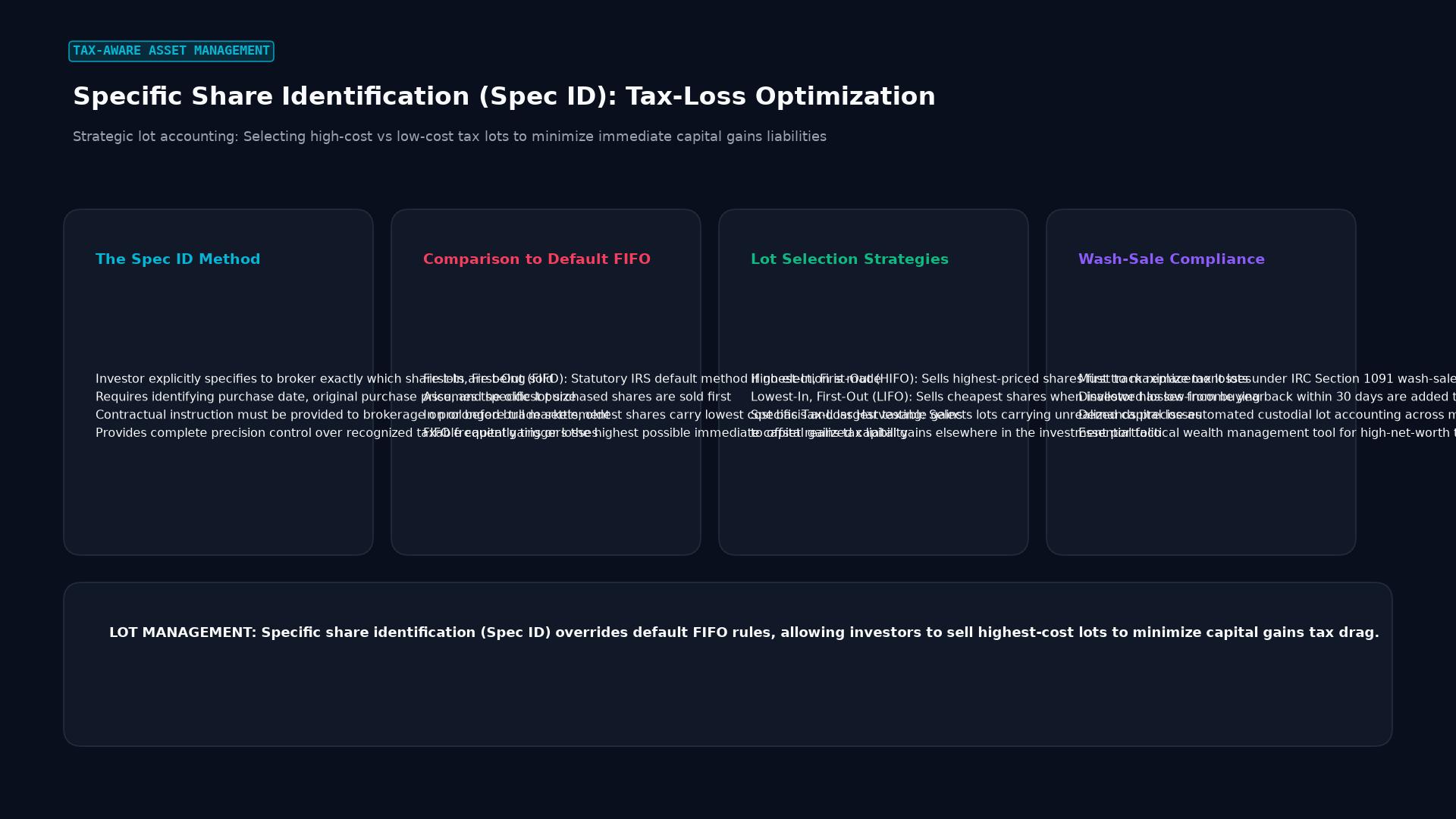 Figure: Strategic lot accounting: Selecting high-cost vs low-cost tax lots to minimize immediate capital gains liabilities
The Statutory Mechanics of Treasury Regulation § 1.1012-1(c)
Under United States federal tax law, when an investor sells securities acquired in separate transactions at varying prices, the Internal Revenue Service enforces First-In, First-Out (FIFO) as the statutory default accounting method. Under FIFO, the oldest shares in the account are deemed sold first. In an appreciating stock, FIFO automatically realizes the lowest cost basis, generating the largest possible taxable capital gain.
To supersede the FIFO default, Treasury Regulation § 1.1012-1(c)(2) establishes strict, mandatory procedural requirements that the taxpayer must fulfill to legally establish “identified shares”:
- Contemporaneous Specification: The investor must explicitly specify to the custodial broker or transfer agent the particular shares to be sold, identifying both the distinct acquisition date and the specific purchase price, at the time of the order execution.
- Written Broker Confirmation: Within a reasonable period following the transaction, the broker must confirm the specification in writing (typically documented on the official electronic trade confirmation or brokerage statement).
If an investor fails to provide specific instructions prior to settlement, or attempts to designate lots retroactively after the trade has settled, the IRS legally invalidates the selection and recalculates the tax liability using the FIFO method.
Strategic Tax Lot Selection Methods
Modern institutional brokerage platforms permit investors to automate specific share identification by setting algorithmic default execution rules across their taxable investment accounts:
1. Highest-In, First-Out (HIFO)
Under the HIFO selection rule, the broker automatically sells the shares carrying the highest purchase price first:
- Tax Deferral Objective: By maximizing the cost basis subtracted from sales proceeds, HIFO minimizes immediate realized capital gains.
- Capital Preservation: By deferring tax payments to future years, the investor keeps capital invested in the compounding market portfolio longer.
2. Tax-Loss Harvesting (Loss Maximization)
During market pullbacks, an investor can specifically identify lots that are trading at an unrealized loss, selling only those underwater shares while keeping profitable lots untouched:
- Capital losses realized from identified shares offset dollar-for-dollar any capital gains realized across the portfolio.
- Excess net capital losses can offset up to $3,000 of ordinary wage income annually on US federal income tax returns, with remaining losses carried forward indefinitely.
3. Holding Period Optimization: Long-Term vs Short-Term
In the United States, tax rates on capital gains diverge substantially based on the asset’s holding period:
- Short-Term Capital Gains ($\le 365$ Days): Taxed at ordinary income rates, reaching up to 37 percent at the federal level.
- Long-Term Capital Gains ($> 365$ Days): Taxed at preferential rates of 0 percent, 15 percent, or 20 percent (plus the 3.8 percent Net Investment Income Tax for high earners).
By identifying specific shares, an investor can intentionally avoid selling shares that are within weeks of crossing the 365-day threshold, preventing an unnecessary punitive short-term tax penalty.
$$\text{Realized Gain/Loss} = \text{Gross Proceeds} - \text{Identified Lot Cost Basis}$$
$$\text{Tax Liability} = \text{Realized Gain} \times \tau_{\text{Holding Period Rate}}$$
| Tax Lot Accounting Method | Selection Mechanism | Realized Gain in Bull Market | Operational Flexibility |
|---|---|---|---|
| First-In, First-Out (FIFO) | Sells oldest chronological lot | Highest (Max Tax Liability) | Zero; rigid statutory default |
| Last-In, First-Out (LIFO) | Sells newest chronological lot | Moderate | Low; chronological only |
| Average Cost Method | Divides total cost by share count | Moderate | Restricted primarily to mutual funds |
| Identified Shares (Spec ID) | Explicit user selection of lot | Lowest (Optimized for Taxes) | Complete control over tax consequences |
The 2008 Mandate: Covered vs Noncovered Shares
The compliance landscape for identified shares was transformed by the Emergency Economic Stabilization Act of 2008:
- Covered Shares: For corporate equities acquired on or after January 1, 2011 (and mutual funds/ETFs acquired on or after January 1, 2012), federal law requires custodial brokerages to track and report the precise adjusted cost basis, acquisition date, and lot classification directly to the IRS on Form 1099-B.
- Noncovered Shares: Equities purchased prior to the statutory implementation dates are classified as noncovered shares. For noncovered lots, the broker is not required to report cost basis to the IRS, requiring the taxpayer to maintain independent historical ledger records.
When executing trades today, brokerage trading interfaces display detailed tax-lot selectors, allowing traders to click on individual lots and view real-time tax consequences before hitting the submit button.
Managing the Wash-Sale Rule with Identified Shares
Specific share identification interacts directly with Internal Revenue Code Section 1091 (the Wash-Sale Rule):
- The wash-sale rule disallows a tax deduction for a loss realized on the sale of stock if the taxpayer acquires “substantially identical” stock within a 61-day window (30 days before the sale, the day of the sale, and 30 days after the sale).
- When utilizing identified shares to harvest a tax loss on a specific high-cost lot, the investor must ensure they do not purchase additional shares of that same company within 30 days. If a wash sale occurs, the disallowed loss is added to the cost basis of the newly acquired shares, deferring the tax deduction until the replacement shares are sold.
Frequently Asked Questions
Can an investor switch from the Average Cost method to Identified Shares for mutual funds?
An investor can revoke an average cost election for future mutual fund purchases, but the IRS imposes strict transitional rules. Once a lot’s basis has been calculated and used under the average cost method to report a prior sale, that specific lot cannot be retroactively separated into individual identified shares. However, new prospective purchases can be segregated into specific lots if the investor notifies the broker in writing prior to subsequent sales.
What is the difference between Spec ID and HIFO?
Specific identification (Spec ID) is the overarching legal accounting framework that gives the taxpayer the right to designate distinct lots. Highest-In, First-Out (HIFO) is a specific automated execution strategy within that framework where the brokerage algorithm automatically selects the highest-cost shares to minimize taxable gains.
How does identified shares work with dividend reinvestment plans (DRIPs)?
When an investor participates in a dividend reinvestment plan (DRIP), quarterly dividends purchase fractional shares at different market prices throughout the year, creating dozens of micro-lots. Using identified shares allows the investor to select specific dividend-reinvestment lots when trimming a position, avoiding the automatic liquidation of low-basis dividend shares received years earlier.
Ready to trade forex?
Open a free demo account with a regulated broker. Practice with virtual funds before risking real money.