Mail-order catalogue
A mail-order catalogue is a direct-response commercial publication containing product descriptions, specifications, and pricing that enables consumers to purchase goods remotely for delivery by postal or parcel logistics.
A mail-order catalogue is a printed or electronic publication distributed by merchants to market commercial merchandise directly to consumers without requiring a physical retail storefront. Customers review product specifications, SKUs, and published prices, submitting orders remotely by postal mail, telegraph, telephone, or electronic data interchange (EDI) for parcel delivery to their residences or commercial premises.
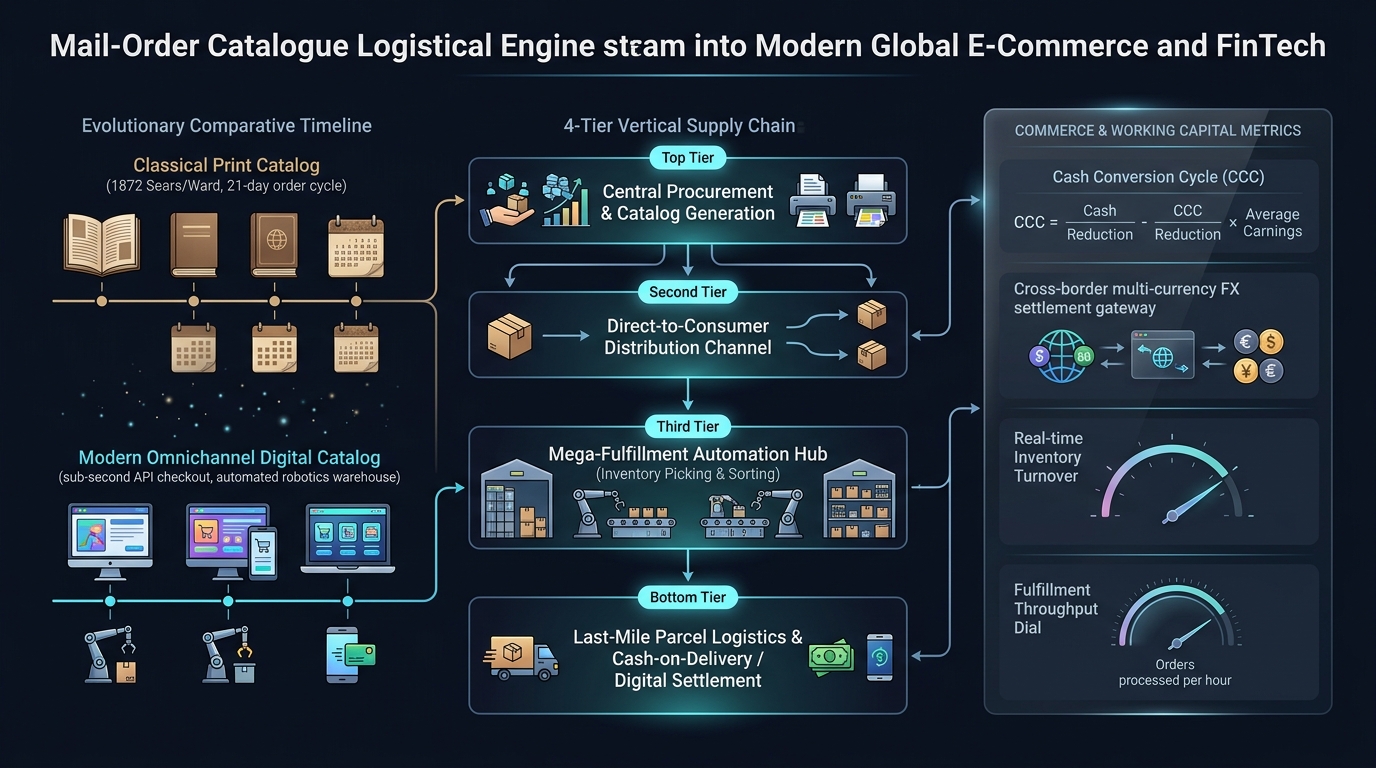
In economic history and modern commerce, the mail-order catalogue served as the foundational precursor to electronic commerce (e-commerce). It introduced fundamental business innovations: centralized warehouse logistics, standardized nation-wide pricing, the elimination of local retail middlemen, cash-on-delivery (COD) mechanisms, consumer revolving credit, and liberal return policies (“satisfaction guaranteed or your money back”).
Historical Emergence and Economic Transformation
The mail-order catalogue business model emerged in the late nineteenth century, driven by rapid industrialization, national rail connectivity, and postal infrastructure expansions:
1. Aaron Montgomery Ward and the Grange Movement (1872)
In 1872, Aaron Montgomery Ward produced the world’s first modern mail-order catalogue: a single $8 \times 12$ inch price sheet listing 163 items for sale. Ward targeted rural farmers affiliated with the National Grange of the Order of Patrons of Husbandry.
At the time, rural consumers were subjected to extortionate markups and substandard goods from isolated local general stores that operated as regional monopolies. By purchasing directly from manufacturers in cash and bypassing regional wholesalers, Ward passed substantial volume discounts to rural households, establishing the operational principle of disintermediation.
2. Sears, Roebuck & Company: “The Consumer’s Bible” (1888–1893)
Richard Sears, an enterprising railway station agent, and watchmaker Alvah Roebuck expanded the model exponentially. The Sears, Roebuck catalogue grew from a modest jewelry publication into a 500-page compendium colloquially revered across rural America as “The Wish Book” or “The Farmer’s Bible”. By 1897, the Sears catalogue offered thousands of items: clothing, agricultural machinery, firearms, medical tonics, musical instruments, and entire pre-cut “kit homes” shipped via rail freight.
+--------------------------------------------------------------------+
|               KEY INFRASTRUCTURE DRIVERS (1880-1915)               |
+--------------------------------------------------------------------+
| 1. Transcontinental Railroad Expansion: Standardized national freight|
|    rates and accelerated bulk merchandise movement across states.  |
| 2. Rural Free Delivery (RFD, 1896): US Postal Service mandated     |
|    home mail delivery to rural farms without surcharge.            |
| 3. Parcel Post Act (1913): Slashed package shipping costs, creating|
|    an affordable national distribution pipeline for packages up to  |
|    50 pounds.                                                      |
+--------------------------------------------------------------------+
These public infrastructure investments enabled Sears and Montgomery Ward to construct multi-million-square-foot fulfillment complexes in Chicago, utilizing pneumatic tubes, conveyor belts, and specialized sorting tracks that presaged the internal architectures of contemporary automated distribution centers.
Working Capital Dynamics and Unit Economics
The financial economics of the mail-order catalogue model are governed by working capital efficiency, circulation economics, and consumer acquisition metrics.
1. The Cash Conversion Cycle (CCC)
Mail-order businesses operate on unique working capital dynamics. In its classic cash-with-order or credit-card formulation, the mail-order merchant collects payment before fulfilling or manufacturing the inventory, yielding an advantageous Cash Conversion Cycle:
$$\text{CCC} = \text{DIO} + \text{DSO} - \text{DPO}$$
Where:
- $\text{DIO}$ is Days Inventory Outstanding (the average duration goods spend in the warehouse).
- $\text{DSO}$ is Days Sales Outstanding (near zero for cash, money order, or credit card transactions).
- $\text{DPO}$ is Days Payable Outstanding (credit terms negotiated with suppliers, typically 30 to 60 days).
When $\text{DPO} > \text{DIO} + \text{DSO}$, the company operates with a negative working capital cycle, generating cash inflows from customer orders before paying suppliers for physical inventory.
2. Circulation Economics and Revenue Per Catalogue Mailed (RPCM)
Because printing, paper stock, and bulk postal distribution represent heavy fixed capital commitments, catalogue executives evaluate campaigns using circulation yield metrics:
$$\text{RPCM} = \frac{\text{Total Gross Sales Generated}}{\text{Total Catalogues Circulated}}$$
$$\text{Net Contribution Per Catalogue} = \text{RPCM} - (\text{Cost of Goods Sold} + \text{Fulfillment Cost} + \text{Cost per Catalogue})$$
The Cost per Catalogue ($CPC$) includes paper procurement, color lithography printing, data list hygiene, and USPS presorted bulk mail postage:
$$\text{CPC} = \frac{\text{Printing & Production} + \text{List Rental / Data Screening} + \text{Postage}}{\text{Total Print Run}}$$
To maximize yield, merchants employ RFM segmentation:
- Recency: When did the consumer last place an order?
- Frequency: How often does the consumer purchase within a 12-month cycle?
- Monetary Value: What is the average order value ($AOV$)?
Consumers scoring in top RFM deciles receive high-frequency, specialized seasonal catalogues, while low-scoring contacts are purged from mailing lists to conserve capital.
       CIRCULATION PROFITABILITY THRESHOLD

$ / Catalogue
   ^
   |                     * RPCM (Revenue Per Catalogue)
   |                    /
   |                   /  PROFIT MARGIN
   |                  /
   |  ---------------+------------------------ Break-Even Cost Line
   |  /////////////// \                      (Printing + Postal Fees)
   |  // NET LOSS //   \
   +--------------------+-------------------->
   0                   Decile Cutoff (RFM Score)
Consumer Protection and the FTC 30-Day Rule
The remote nature of mail-order transactions historical created opportunities for fraudulent or negligent merchant behavior, such as collecting consumer cash and failing to dispatch goods promptly.
To eliminate these commercial abuses, the US Federal Trade Commission (FTC) promulgated the Mail or Telephone Order Merchandise Trade Regulation Rule (16 CFR Part 435) in 1975, subsequently amended to cover internet transactions (the “Mail, Internet, or Telephone Order Merchandise Rule”):
- The 30-Day Shipping Requirement: If a merchant does not state an explicit shipping timeframe in its catalogue or promotional materials, it must ship the ordered merchandise within 30 days of receiving a properly completed order accompanied by payment.
- Mandatory Delay Notification: If a merchant cannot fulfill the order within 30 days (or the advertised timeframe), it must proactively provide the customer with an explicit option:
- Consent to the shipping delay to a revised, specified delivery date.
- Cancel the order and receive a prompt, full refund.
- Refund Timeline Mandates: If the consumer elects cancellation, or if the merchant fails to obtain consent for delays exceeding 30 days:
- First-party cash, check, or money-order payments must be refunded within 7 business days.
- Credit card accounts must be credited within 1 billing cycle.
Violations of 16 CFR Part 435 carry severe civil monetary penalties (exceeding $50,000 per statutory violation) enforced by the FTC and federal courts.
Real-World Case Study: The Rise and Fall of Sears, Roebuck & Co.
The commercial trajectory of Sears, Roebuck & Co. illustrates the structural lifecycle of direct-to-consumer merchandising.
+--------------------------------------------------------------------+
|            THE STRATEGIC EVOLUTION OF SEARS, ROEBUCK               |
+--------------------------------------------------------------------+
| 1. Agrarian Mail-Order Hegemony (1893-1925): Captured rural US     |
|    purchasing through massive catalogue distribution and rail hubs.|
| 2. Urban Retail Pivot (1925-1970): General Robert E. Wood observed |
|    the rise of the automobile and paved suburban roads. Sears built|
|    physical department stores with parking lots; became world's    |
|    largest retailer.                                               |
| 3. Conglomerate Diversification (1980s): Expanded into financial   |
|    services (Allstate Insurance, Dean Witter, Discover Card).      |
| 4. Discontinuation of General Catalogue (1993): Shuttered the big  |
|    book catalogue citing high printing costs ($100M+ annual drag). |
| 5. Strategic Blind Spot: Shuttering the catalogue left Sears with  |
|    idle logistics infrastructure right as the commercial internet  |
|    emerged (Amazon founded in 1994).                               |
| 6. Final Bankruptcy (2018): Liquidation following decades of       |
|    market share loss to Walmart, Home Depot, and digital commerce. |
+--------------------------------------------------------------------+
In the 1920s, Sears visionary executive General Robert E. Wood recognized that the automobile and paved national highways were changing American demographics. Farm families were driving into towns to shop. Sears adapted by opening brick-and-mortar retail stores alongside its catalogue business, growing into the world’s most profitable merchandising conglomerate.
However, by 1993, Sears management viewed the 1,000-page general catalogue as an expensive relic of paper and ink, terminating the publication to cut corporate overhead. In doing so, Sears dismantled its national home delivery distribution and fulfillment competencies just months before Jeff Bezos incorporated Amazon.com in 1994. Amazon effectively repurposed the classical mail-order catalogue architecture: replacing paper printing with web servers, telephone orders with digital shopping carts, and postal money orders with encrypted online credit card processing.
Modern Successors: Direct-to-Consumer (DTC) and Omnichannel Retailing
The operational principles developed by mail-order catalogue houses remain central to modern retail and logistics:
- Specialty Catalogues: While general department store “big books” have disappeared, high-margin vertical brands (e.g., Williams-Sonoma, Patagonia, Restoration Hardware, Lands’ End) continue circulating physical catalogues as tactile, high-impact branding instruments that drive online web purchases.
- Micro-Targeted Direct Mail: Modern direct marketers integrate customer relationship management (CRM) software, AI-driven predictive purchase modeling, and programmatic digital print presses to generate customized print catalogues tailored to individual household purchasing profiles.
- Fulfillment Logistics: The picking, packing, multi-tier SKU management, and returns handling pioneered by Sears Chicago fulfillment hubs serve as the architectural blueprint for contemporary logistics networks managed by Amazon Fulfillment Services and third-party logistics (3PL) providers.
Frequently Asked Questions
Why did late nineteenth-century consumers prefer mail-order catalogues over local stores?
Rural consumers in the late 1800s faced local general stores that carried limited inventory, charged high markups due to lack of competition, and frequently practiced price discrimination based on personal familiarity. Mail-order catalogues provided a wide assortment of factory-fresh goods, transparent fixed prices, detailed specifications, and an unconditional money-back guarantee, allowing rural households to buy goods at the same prices paid in major cities.
How did the mail-order catalogue influence modern consumer credit?
Catalogue merchants pioneered accessible consumer credit. Beginning in the early 1900s, Sears and Montgomery Ward introduced installment payment plans (“Easy Payment Terms”), allowing middle-class families to acquire expensive capital goods such as sewing machines, wood stoves, and farm equipment with a modest down payment followed by fixed monthly installments. This system evolved into modern revolving credit lines and retail credit cards.
Is the FTC 30-Day Rule applicable to modern e-commerce websites?
Yes. The Federal Trade Commission’s Mail, Internet, or Telephone Order Merchandise Rule (16 CFR Part 435) applies equally to modern e-commerce storefronts, mobile app purchases, and traditional paper mail-order catalogues. Online retailers must have a reasonable basis for stated shipping claims, dispatch orders within 30 days if no timeframe is stated, notify buyers of shipping delays, and issue prompt refunds upon cancellation.
Ready to trade forex?
Open a free demo account with a regulated broker. Practice with virtual funds before risking real money.