OEM
OEM (Original Equipment Manufacturer) refers to a company whose products, components, or subassemblies are integrated into the finished products of another firm, or a firm that manufactures finished equipment sold under another brand's trademark.
In industrial economics, supply chain management, and technology manufacturing, the acronym OEM (Original Equipment Manufacturer) describes a commercial enterprise whose manufactured parts, subsystems, or completed products are integrated into the product line of another company, which subsequently markets and distributes the finished good to retail or enterprise end-users.
Depending on the specific industrial domain, the term carries two complementary perspectives:
- Automotive and Heavy Industrial Engineering: The OEM is traditionally defined as the final brand manufacturer and system integrator (such as Toyota, General Motors, or Boeing) that designs the vehicle or aircraft, sources specialized parts from a global network of Tier-1 and Tier-2 suppliers (such as Bosch, Denso, or Safran), and sells the completed machinery under its own brand. Concurrently, parts produced by those suppliers according to factory technical specifications are labeled OEM parts.
- Electronics, Computing, and Consumer Hardware: The OEM is often the contract manufacturer or component fabricator that builds physical hardware or subcomponents based on the buyer’s engineering specifications. The purchasing entity, known as a Value-Added Reseller (VAR), system integrator, or brand marketer (such as Apple or Dell), packages, brands, and sells the hardware alongside proprietary operating software, warranty services, and customer support.
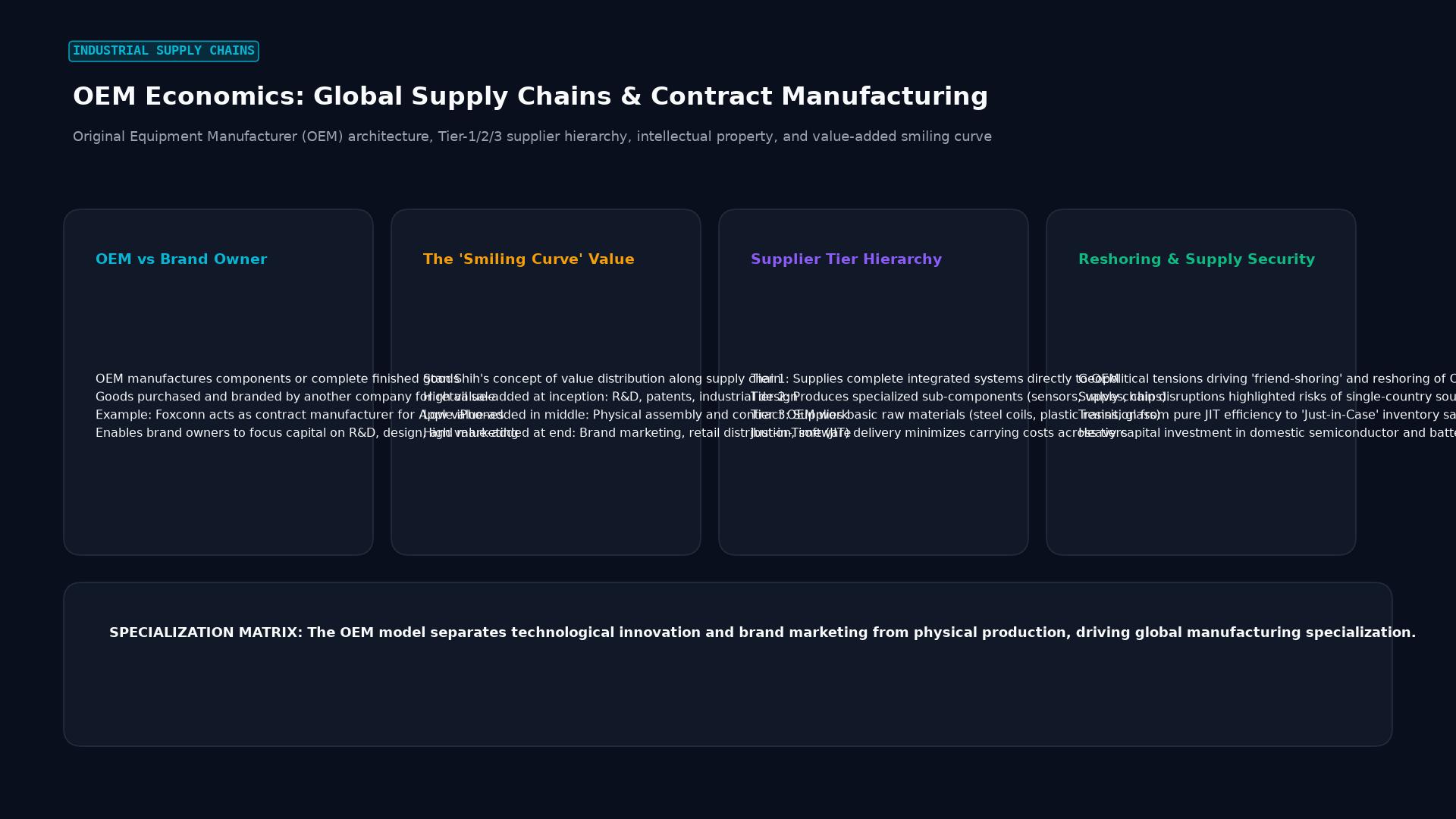 Figure: Original Equipment Manufacturer (OEM) architecture, Tier-1/2/3 supplier hierarchy, intellectual property, and value-added smiling curve
The Supply Chain Hierarchy: Tiers and Integration
Modern industrial production is organized in an interconnected pyramid where component parts undergo sequential value enhancement before reaching final assembly:
                     THE INDUSTRIAL SUPPLY CHAIN PYRAMID

                           +-----------------------+
                           |     END CONSUMER      |
                           +-----------------------+
                                       ^
                                       | Retail / Dealership Network
                           +-----------------------+
                           |      OEM BRAND        |
                           |  (System Integrator)  |
                           +-----------------------+
                                       ^
                                       | Subsystem Assemblies
                           +-----------------------+
                           |    TIER-1 SUPPLIERS   |
                           | (Bosch, Denso, Magna) |
                           +-----------------------+
                                       ^
                                       | Fabricated Components
                           +-----------------------+
                           |    TIER-2 SUPPLIERS   |
                           | (Machining, Circuits) |
                           +-----------------------+
                                       ^
                                       | Raw Industrial Materials
                           +-----------------------+
                           |    TIER-3 SUPPLIERS   |
                           | (Steel, Aluminum, Oil)|
                           +-----------------------+
1. Tier-3 Suppliers (Raw Materials and Extraction)
The base of the industrial pyramid. These enterprises process raw natural resources into standardized industrial commodities (such as smelting bauxite into aluminum ingots, refining petrochemicals into polymer plastics, or converting iron ore into hot-rolled coil steel).
2. Tier-2 Suppliers (Component Specialists)
Tier-2 manufacturers purchase raw industrial materials from Tier-3 producers to fabricate precision components: specialized microchips, hydraulic seals, molded wiring harnesses, and stamped metal fasteners. Tier-2 firms rarely sell directly to final brand owners; their output feeds into Tier-1 assembly plants.
3. Tier-1 Suppliers (Subsystem Integrators)
Tier-1 suppliers operate multi-billion-dollar global footprints, building integrated vehicle or electronic subsystems:
- In the automotive industry, Tier-1 giants (such as Continental, ZF Friedrichshafen, and Magna International) design and manufacture complete antilock braking systems (ABS), automatic transmissions, advanced driver assistance radar modules, and fully assembled seating systems.
- Tier-1 firms work in direct collaboration with OEM engineering teams during the multi-year vehicle development cycle, maintaining dedicated just-in-time (JIT) sequencing facilities adjacent to OEM assembly lines.
4. The OEM (Final Assembler)
The OEM coordinates the final assembly, quality assurance, regulatory crash testing, and brand distribution. The OEM commands ultimate legal liability for product safety under consumer protection statutes and maintains the authorized dealership and maintenance network.
Structural Taxonomies: OEM vs. ODM vs. EMS vs. VAR
In global consumer electronics and hardware technology, manufacturing relationships are categorized by which entity owns the intellectual property (IP) and design blueprints:
+------------------------+-------------------+------------------+-------------------+
| Model Type             | Product Design    | Manufacturing    | Branding & Sales  |
+------------------------+-------------------+------------------+-------------------+
| OEM (Original          | Brand Client      | Contract Builder | Brand Client      |
| Equipment Manufacturer)| designs specs     | fabricates parts | markets product   |
+------------------------+-------------------+------------------+-------------------+
| ODM (Original          | Manufacturer      | Manufacturer     | White-label client|
| Design Manufacturer)   | designs from R&D  | builds in bulk   | slaps on logo     |
+------------------------+-------------------+------------------+-------------------+
| EMS (Electronic        | Brand Client      | Highly automated | Brand Client      |
| Manufacturing Services)| provides exact BOM| contract assembly| handles channel   |
+------------------------+-------------------+------------------+-------------------+
| VAR (Value-Added       | Third-party OEM   | Third-party OEM  | VAR bundles with  |
| Reseller)              | hardware platform | creates system   | custom software   |
+------------------------+-------------------+------------------+-------------------+- OEM (Original Equipment Manufacturer): The customer enterprise designs the product from scratch, retaining all patents, industrial blueprints, and proprietary software. The OEM fabricates the physical hardware strictly according to the customer’s engineering guidelines.
- ODM (Original Design Manufacturer): The contract manufacturer designs and engineers the product internally, maintaining its own catalog of ready-made designs (such as power adapters, laptop chassis, or network routers). Corporate clients select an existing model from the ODM catalog, apply custom branding and aesthetic tweaks, and sell the finished item as their own.
- EMS (Electronic Manufacturing Services): Specialized assembly contractors (such as Foxconn, Jabil, and Sanmina) that provide printed circuit board assembly (PCBA), component sourcing, surface-mount technology (SMT), testing, and logistics services. EMS firms compete on operational speed, global procurement scale, and manufacturing yields.
- VAR (Value-Added Reseller): An intermediary enterprise that purchases OEM hardware and packages it with customized proprietary software, specialized peripheral sensors, and systems integration services to deliver a turnkey vertical solution (such as installing clinical diagnostic software onto an OEM industrial workstation for hospital deployments).
Economic Dynamics: Stan Shih’s “Smiling Curve”
The distribution of economic profitability across the OEM value chain is explained by The Smiling Curve, an economic concept formulated in 1992 by Stan Shih, the founder of Acer:
                        THE VALUE-ADD "SMILING CURVE"

  Value-Add / Profit Margin
   ^
   |  [HIGH MARGIN]                                           [HIGH MARGIN]
   |  R&D, Patents,                                           Branding, Marketing,
   |  System Architecture                                     Direct Retail, Cloud
   |         \                                                     /
   |          \                                                   /
   |           \                                                 /
   |            \                                               /
   |             \                                             /
   |              \                                           /
   |               +-----------------------------------------+
   |                            [LOW MARGIN]
   |                      Pure Contract Assembly
   |                        & Component Stamping
   +------------------------------------------------------------------------>
      Pre-Production               Manufacturing                 Post-Production
      (Upstream)                    (Midstream)                    (Downstream)
In the modern globalized economy, the physical act of component manufacturing and pure assembly occupies the lowest point of the curve, generating thin operating margins (frequently 2% to 5%) due to intense capital expenditure overhead, labor costs, and commodity competition.
The highest economic value-add and operating margins (often 20% to 50%+) are captured at the two opposite ends of the spectrum:
- Upstream (Pre-Production): Proprietary research and development, patented semiconductor design (e.g., Nvidia, Qualcomm), and advanced materials science.
- Downstream (Post-Production): Global brand equity, customer relationship management, proprietary ecosystem platforms, direct-to-consumer sales, and recurring software subscriptions (e.g., Apple, Tesla).
Automotive Microstructure: OEM vs. OES vs. Aftermarket
In the automotive replacement parts industry, vehicle components are strictly stratified into three quality and pricing tiers:
+------------------------+--------------------------------------------------+
| Component Category     | Market Definition and Characteristics            |
+------------------------+--------------------------------------------------+
| Genuine OEM Parts      | Built by the vehicle maker or its certified      |
| (Original Equipment)   | Tier-1 supplier, packaged in genuine branded     |
|                        | boxes (e.g., BMW Genuine Parts) with dealership  |
|                        | warranty backing; commands highest retail price. |
+------------------------+--------------------------------------------------+
| OES Parts (Original    | Fabricated on the exact same factory assembly    |
| Equipment Supplier)    | line by the Tier-1 supplier (e.g., Bosch, Brembo)|
|                        | but packaged in supplier branding; identical     |
|                        | engineering quality at a 20% to 40% discount.   |
+------------------------+--------------------------------------------------+
| Aftermarket Parts      | Produced by third-party reverse-engineering      |
| (Non-OEM Copies)       | manufacturers without automaker blueprints;      |
|                        | varied quality, lowest price point.              |
+------------------------+--------------------------------------------------+
OEM Warranty Protection and the Magnuson-Moss Act
In the United States, auto manufacturers historically attempted to void consumer vehicle warranties if the owner serviced the car using non-OEM parts.
To protect consumer choice and independent mechanics, Congress enacted the Magnuson-Moss Warranty Act of 1975 (enforced by the Federal Trade Commission):
- Legally prohibits vehicle manufacturers from conditioning warranties on the exclusive use of brand-name OEM parts (the “tie-in sales” rule) unless the manufacturer provides the part for free.
- An automaker cannot deny a warranty claim simply because an aftermarket or OES part was installed, unless the manufacturer proves that the specific third-party component directly caused the mechanical failure.
Software Licensing: OEM Windows and Embedded Systems
In the technology software sector, the OEM model operates through specialized commercial licensing agreements:
- OEM Software Licenses (e.g., Microsoft Windows OEM): Microsoft sells discounted, volume-licensed copies of the Windows operating system directly to PC manufacturers (such as Lenovo, HP, and Acer) for pre-installation onto new hardware.
- System Locking: An OEM software license is legally and digitally bound to the specific motherboard of the original physical computer. Unlike full retail packaged software licenses, an OEM license cannot be transferred to a new computer if the hardware is upgraded.
- Support Obligations: Under the OEM contract, the hardware manufacturer assumes complete legal responsibility for providing technical customer support for the operating system, relieving the software developer of direct customer service overhead.
Working Capital Dynamics: Supply Chain Financing in the OEM Chain
Managing working capital across an extended OEM supply chain is a critical corporate finance discipline:
                   THE OEM CASH CONVERSION CYCLE (CCC)

  Tier-1 Supplier                                           OEM Brand Integrator
  +-------------------------------------+                   +----------------------------------+
  | - Buys raw materials (DPO = 60 days)|                   | - Demands JIT Delivery           |
  | - Holds WIP inventory (DIO = 45 days)                   | - Sells to dealers (DSO = 15 days|
  | - Awaits OEM payment (DSO = 90 days)| <== Long Credit = | - Pays supplier (DPO = 90+ days) |
  +-------------------------------------+     Terms Drag    +----------------------------------+
                     \                                      /
                      +--- Financed via Reverse Factoring -+
Large OEM assemblers often possess massive market leverage relative to their smaller component suppliers. To optimize their own balance sheets, OEMs frequently enforce extended payment terms of 90, 120, or 180 days:
- Working Capital Strain: Small Tier-2 and Tier-3 suppliers face substantial cash flow crunches while carrying inventory and payroll costs long before receiving payment.
- Reverse Factoring (Supply Chain Financing): To prevent supply chain bankruptcy, OEMs partner with commercial banks to establish supply chain financing programs. The bank pays the supplier immediately at a minor discount based on the OEM’s superior credit rating, and the OEM settles the full invoice with the bank at maturity.
Best Practices for Evaluating OEM Relationships
- Audit Supplier Customer Concentration: Equity analysts evaluating Tier-1 and Tier-2 component makers must track customer concentration metrics in SEC Form 10-K filings. A supplier deriving over 30% of its revenues from a single OEM customer faces severe downside risk if that customer redesigns its platform or demands sudden price concessions.
- Track the Inventory-to-Sales Velocity: In contract electronics manufacturing, rapid component obsolescence can trigger sudden inventory write-downs. An acceleration in Days Inventory Outstanding (DIO) across an OEM supply chain often signals weakening end-consumer demand.
- Assess Geopolitical Supply Chain Relocation: Multinationals are increasingly pivoting from single-source manufacturing in China toward “China Plus One” strategies, establishing OEM component manufacturing hubs in Vietnam, India, and Mexico to mitigate tariff exposure.
Frequently Asked Questions (FAQ)
What is the primary difference between an OEM and an ODM?
An OEM (Original Equipment Manufacturer) builds products or components based strictly on the proprietary designs, engineering specifications, and blueprints provided by the purchasing client company. In contrast, an ODM (Original Design Manufacturer) designs, engineers, and fabricates the product internally, allowing client companies to purchase the pre-existing design and sell it under their own brand with minimal modifications.
Are OEM replacement parts identical to factory parts?
Yes. Genuine OEM replacement parts are manufactured either directly by the original brand or by the certified Tier-1 supplier that manufactured the parts installed in the vehicle on the factory assembly line. They match the exact engineering blueprints, metallurgical tolerances, and safety standards of the original equipment, which is why they command higher prices than generic aftermarket parts.
What is an OEM license in computing software?
An OEM software license is a specialized, discounted license sold directly to computer hardware manufacturers for pre-installation onto new computers. Unlike a retail software license, an OEM license is permanently tied to the unique motherboard of that specific machine and cannot be legally transferred to another PC. In parallel, the hardware manufacturer, rather than the software developer, is responsible for providing technical support.
Ready to trade forex?
Open a free demo account with a regulated broker. Practice with virtual funds before risking real money.