PAC bond
A PAC (Planned Amortization Class) bond is a structured tranche within a Collateralized Mortgage Obligation (CMO) that adheres to a predetermined principal repayment schedule, protected against both contraction risk and extension risk by companion or support tranches within a specified prepayment collar.
A PAC bond (Planned Amortization Class bond) is a premier structured debt instrument engineered within a Collateralized Mortgage Obligation (CMO). First developed by Wall Street fixed income syndicates in the mid-1980s, the PAC bond was designed to overcome the single greatest structural defect of traditional mortgage pass-through securities: prepayment risk.
In a standard residential mortgage pass-through security, homeowners possess an unconstrained embedded option to refinance or prepay their mortgages early, exposing bond investors to severe cash flow volatility. When interest rates fall, homeowners prepay rapidly, returning principal prematurely to investors (contraction risk). When interest rates rise, refinancing freezes, extending the bond’s duration precisely when bond prices are declining (extension risk).
The PAC bond solves this problem by establishing a strictly protected, predetermined principal amortization schedule. As long as the actual prepayment rate of the underlying collateral mortgage pool remains within an established range of prepayment speeds, known as the PAC collar or PAC bands, the PAC bond investor receives contractual principal repayments with the predictability of a corporate sinking fund debenture.
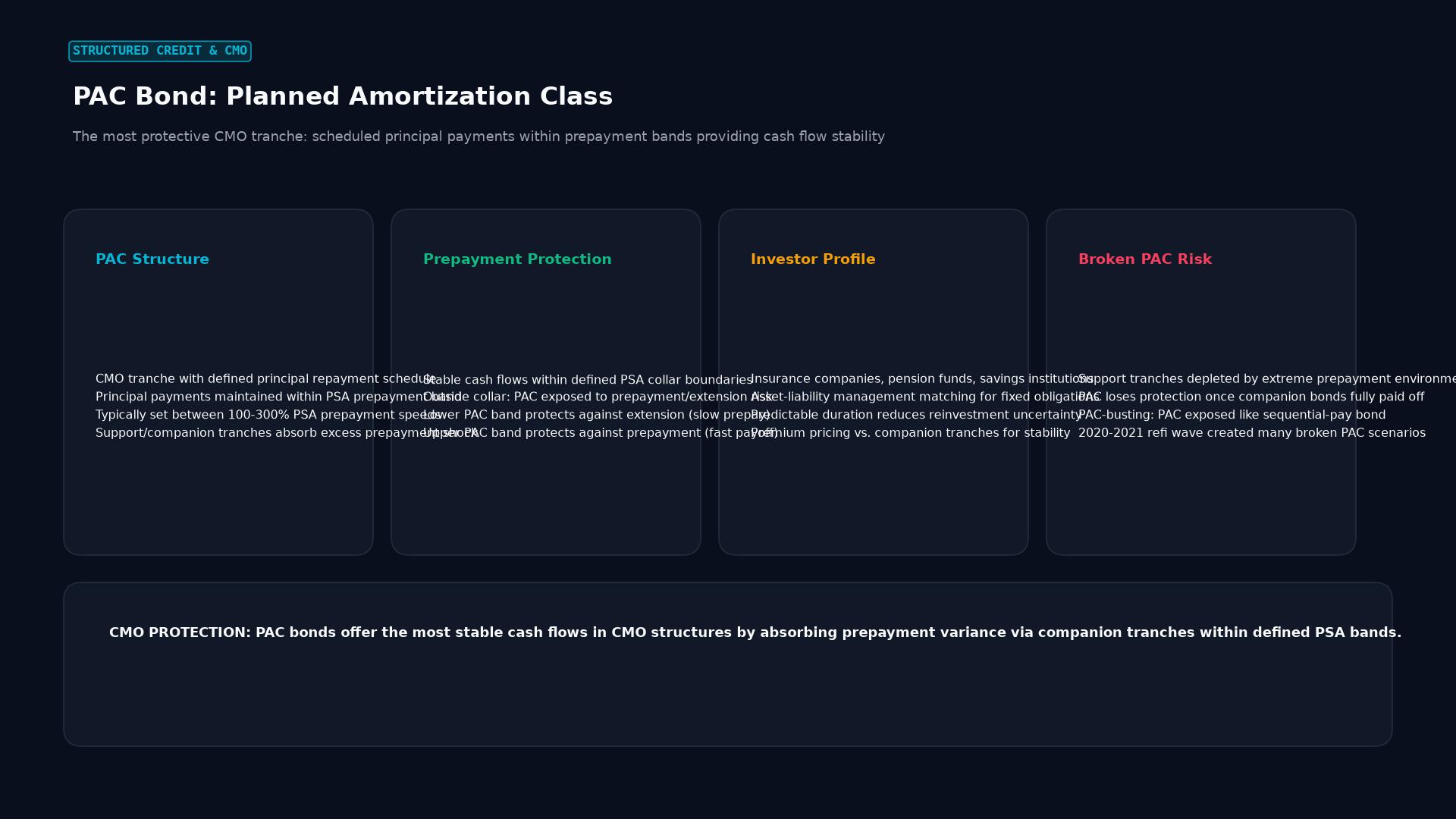 Figure: The most protective CMO tranche: scheduled principal payments within prepayment bands providing cash flow stability
The Structural Mechanics: The Sinking Fund Principle
The core mechanism enabling a PAC bond to deliver predictable amortization is the derivation of its sinking fund schedule, calculated using the standard Public Securities Association (PSA) Prepayment Benchmark.
1. Constructing the PAC Principal Schedule
When structuring a CMO, the financial engineering team establishes a conservative lower prepayment speed and an upper prepayment speed (e.g., 100% PSA to 300% PSA):
- At the Lower Bound (100% PSA): The model simulates the minimum principal cash flow generated by the mortgage pool assuming high interest rates and minimal refinancing.
- At the Upper Bound (300% PSA): The model simulates principal cash flows assuming low interest rates and rapid refinancing.
The PAC bond’s legal amortization schedule is constructed by taking the minimum principal cash flow available in each period between the two boundary schedules: $$\text{PAC Scheduled Principal}_t = \min \left[ P_t^{\text{Lower PSA}}, P_t^{\text{Upper PSA}} \right]$$
Because the scheduled payment represents the conservative intersection of both scenarios, the underlying mortgage pool is mathematically guaranteed to generate sufficient principal cash flows to satisfy the PAC schedule on every single payment date, provided actual prepayments remain between the lower and upper collars.
                      DERIVATION OF PAC PRINCIPAL SCHEDULE

  Principal Cash Flow ($)
   ^
   |        / \  (Prepayments at 300% PSA - High Cash Flow Early)
   |       /   \
   |      /     \--------------------------------
   |     /       \                              |
   |    /         \    PAC SINKING FUND         |
   |   /           \   SCHEDULE (Minimum of     |
   |  /             \  both collar speeds)      |
   | /               \                          |
   |/                 \                         |
   |-------------------+------------------------+ (Prepayments at 100% PSA)
   +------------------------------------------------------------------------> Time
The Symbiotic Relationship: PAC vs. Companion Tranches
A PAC bond cannot exist in isolation. In mortgage structured finance, total cash flow risk is conserved: risk cannot be destroyed, only reallocated across tranches.
To provide cash flow certainty to the PAC bond, the CMO structure creates Companion Tranches (also termed Support Tranches), which act as financial shock absorbers:
                    THE CMO CASH FLOW REDISTRIBUTION WATERFALL

                       Underlying Residential Mortgage Pool
                      (Monthly Homeowner Principal & Prepayments)
                                          |
                                          v
                    +-------------------------------------------+
                    |       CASH FLOW ALLOCATION WATERFALL      |
                    +-------------------------------------------+
                                          |
                   +----------------------+----------------------+
                   |                                             |
                   v                                             v
     PLANNED AMORTIZATION CLASS (PAC)                 COMPANION / SUPPORT TRANCHES
     - Guaranteed priority claim                     - Subordinated prepayment claim
     - Receives exact scheduled principal            - Absorbs ALL excess prepayments
     - Low volatility, stable duration               - Absorbs ALL payment shortfalls
     - Low yield spread (AAA safety)                 - High volatility, high yield spread
1. Falling Interest Rates (Prepayment Surges)
When mortgage interest rates drop, homeowners refinance, flooding the CMO trust with massive unplanned principal prepayments:
- The PAC bond receives strictly its predetermined scheduled principal payment for that month.
- All surplus principal prepayments are routed directly to the Companion Tranche, paying down companion bondholders early.
- Result: The PAC bond avoids contraction risk. The companion tranche suffers severe contraction risk.
2. Rising Interest Rates (Prepayment Freezes)
When interest rates rise, mortgage refinancing halts, causing pool principal cash flows to shrink:
- Principal cash flows are allocated first to the PAC bond to satisfy its contractual sinking fund schedule.
- The companion tranche receives zero principal repayments until the PAC schedule is 100% satisfied.
- Result: The PAC bond avoids extension risk. The companion tranche suffers severe extension risk, transforming into a long-duration zero-principal asset.
“Busting the PAC”: Extreme Prepayment Scenarios
While a PAC bond provides extraordinary cash flow stability within its defined collar, its protection is conditional, not absolute. If macroeconomic interest rate shifts push actual prepayments outside the designated PAC bands for a sustained period, the PAC bond is compromised:
+------------------------+--------------------------------------------------+
| Collar Break Condition | Structural Consequence to the PAC Bond          |
+------------------------+--------------------------------------------------+
| Prepayments Exceed the | All companion tranches are completely retired    |
| Upper Collar (>300% PSA| early (the support is exhausted). Excess cash    |
| for extended duration) | flows spill directly into the PAC bond, causing  |
|                        | unwanted contraction and early redemption.       |
+------------------------+--------------------------------------------------+
| Prepayments Fall Below | Total mortgage pool principal is insufficient to |
| the Lower Collar (<100%| satisfy the PAC schedule, even after giving zero |
| PSA for extended time) | to companions. The PAC suffers payment delays    |
|                        | and unwanted maturity extension.                 |
+------------------------+--------------------------------------------------+
When a PAC bond’s companion tranches are fully paid off, the bond is described on institutional trading desks as a “Busted PAC.” Once busted, the PAC loses its prepayment shield and behaves like an ordinary sequential pass-through security, directly exposed to prevailing market volatility.
The PAC Taxonomy: PAC I, PAC II, and TAC Bonds
To satisfy varying institutional risk appetites, financial engineers structure tiered PAC hierarchies:
+------------------+-----------------------------+-----------------------------+
| Bond Type        | Collar Width / Structure    | Priority & Risk Profile     |
+------------------+-----------------------------+-----------------------------+
| PAC I (Standard) | Broad collar band           | Senior priority claim on    |
|                  | (e.g., 90% to 300% PSA)     | collateral; maximum safety. |
+------------------+-----------------------------+-----------------------------+
| PAC II (Support) | Narrow collar band          | Supported by companion      |
|                  | (e.g., 125% to 225% PSA)    | tranches, but acts as a     |
|                  |                             | support for PAC I tranches. |
+------------------+-----------------------------+-----------------------------+
| TAC Bond (Target | Single-point protection     | Protects against contraction|
| Amortization)    | (e.g., exactly 175% PSA);   | risk, but offers zero       |
|                  | no lower collar band        | protection against extension|
+------------------+-----------------------------+-----------------------------+- PAC I: The primary senior tranche, possessing the widest prepayment collar and the absolute first claim on cash flows generated by the structure.
- PAC II (PAC Support Tranche): A secondary planned class carved out of the companion tranche. It receives an amortization schedule supported by lower-tier companions, but its schedule is subordinated to the primary PAC I. If the collateral pool experiences stress, PAC II cash flows are cannibalized to keep the PAC I on schedule.
- TAC (Targeted Amortization Class) Bonds: A related derivative instrument that establishes a principal repayment schedule based on a single targeted prepayment speed (e.g., 175% PSA) rather than a collar. TACs provide dependable protection against rising prepayments (contraction risk), but offer zero protection against falling prepayments (extension risk).
Institutional Investors and Asset-Liability Matching (ALM)
PAC bonds are among the most sought-after fixed income instruments by conservative institutional asset managers:
+------------------------+--------------------------------------------------+
| Institutional Buyer    | Investment Objective & Balance Sheet Application |
+------------------------+--------------------------------------------------+
| Life Insurance Cos.    | Immunizing long-term guaranteed liabilities      |
|                        | (such as fixed annuities and whole life policies)|
|                        | requiring precise cash flow matching.            |
+------------------------+--------------------------------------------------+
| Defined-Benefit Pension| Eliminating duration mismatch between fixed debt |
| Funds                  | assets and multi-decade pensioner benefit claims.|
+------------------------+--------------------------------------------------+
| Commercial Bank ALCO   | Investing surplus regulatory reserves into AAA-  |
| Desks                  | rated Agency debt without taking on interest     |
|                        | rate risk or mortgage duration extensions.       |
+------------------------+--------------------------------------------------+
Because of their superior cash flow predictability, PAC bonds trade at tighter yield spreads over US Treasuries than sequential-pay mortgage tranches or companion bonds, reflecting their low option risk premium.
Valuation and Quantitative Spread Analytics: Option-Adjusted Spread (OAS)
When analyzing PAC bonds, institutional fixed income analysts utilize advanced Monte Carlo simulation models:
1. The Option-Adjusted Spread (OAS)
Because mortgage collateral contains embedded prepayment options, standard nominal yield-to-maturity (YTM) metrics are fundamentally misleading. Analysts evaluate PAC bonds using the Option-Adjusted Spread (OAS): $$\text{Nominal Spread} = \text{OAS} + \text{Option Cost}$$
- Option Cost: The compensation required for bearing prepayment uncertainty.
- In a well-structured PAC I bond with broad collar protection, the Option Cost is near zero, meaning its OAS closely tracks its nominal spread.
- In a companion tranche, the Option Cost is exceedingly high, reflecting the massive prepayment volatility absorbed by the tranche.
2. Effective Duration and Effective Convexity
- Effective Duration: Measures price sensitivity to benchmark yield curve shifts: $$\text{Effective Duration} = \frac{P_- - P_+}{2 \times P_0 \times \Delta y}$$ A PAC bond displays a remarkably stable effective duration across large yield shocks ($\pm 100$ bps), whereas traditional mortgage pass-throughs suffer duration shortening when yields fall and duration lengthening when yields rise.
- Positive vs. Negative Convexity: Standard mortgage securities exhibit negative convexity (the price rises slower when rates fall and drops faster when rates rise). PAC bonds restore positive convexity across their collar band, making them behave like traditional corporate or government bonds.
Best Practices for Trading and Investing in PAC Bonds
- Monitor Effective Collar Drift Over Time: As a CMO mortgage pool seasons and companion tranches pay down, the remaining prepayment collar drifts. Fixed income analysts must run monthly cash flow updates to track whether the effective collar has narrowed. A PAC that opened with a 100%–300% PSA band may narrow to 150%–220% PSA after four years, increasing the probability of a collar bust.
- Examine the Volume of Remaining Companion Support: The durability of a PAC bond’s protection is directly proportional to the remaining dollar balance of its supporting companion tranches. If companion tranches have amortized down to less than 15% of the total CMO deal structure, the PAC bond is on the verge of losing its protective shield.
- Audit Collateral Underlying Characteristics: PAC performance is governed by collateral composition. Pools composed of high-balance loans or California real estate prepay with significantly higher sensitivity to refinancing incentives than rural low-balance loans, testing upper collar thresholds faster.
Frequently Asked Questions (FAQ)
What is the primary purpose of a PAC bond in a Collateralized Mortgage Obligation?
The primary purpose of a PAC (Planned Amortization Class) bond is to provide fixed income investors with a predictable, guaranteed principal repayment schedule that protects them from both contraction risk (early repayment when interest rates decline) and extension risk (delayed repayment when interest rates rise). This is achieved through the support of companion tranches that absorb all excess prepayment volatility within a specified collar band.
How does a PAC bond differ from a companion tranche?
A PAC bond and a companion tranche are complementary components of the same CMO structure. The PAC bond receives absolute priority in cash flow distribution according to a fixed sinking fund schedule, giving it stable duration and minimal prepayment risk. In contrast, the companion tranche acts as a shock absorber: it absorbs all excess prepayments when interest rates fall and receives zero principal when prepayments slow down. Consequently, companion tranches carry high cash flow volatility and offer significantly higher yields.
What does it mean when a PAC bond is “busted”?
A PAC bond is “busted” when underlying mortgage prepayments fall outside the established collar band for a prolonged period, completely exhausting the companion tranches. Once all companion tranches are fully paid off or unable to absorb additional volatility, the PAC bond loses its structural protection. From that point forward, the busted PAC behaves like a standard sequential mortgage pass-through security, directly exposed to contraction and extension risks.
Ready to trade forex?
Open a free demo account with a regulated broker. Practice with virtual funds before risking real money.