Pac-man
The Pac-Man defense is an aggressive corporate anti-takeover strategy wherein a target company facing a hostile takeover bid attempts to reverse the acquisition by launching a counter-tender offer to purchase the hostile bidder.
The Pac-Man defense is one of the most aggressive and dramatic anti-takeover strategies in modern corporate finance, mergers and acquisitions (M&A), and corporate governance. When a target corporation becomes the subject of an unsolicited, hostile takeover bid, rather than relying solely on passive defensive barriers (such as poison pills, staggered boards, or litigation), the target board of directors goes on the offensive.
The target firm secures massive emergency credit facilities, issues a public counter-tender offer to acquire the common stock of the hostile suitor, and attempts to purchase controlling ownership of the very entity attempting to acquire it.
The strategy takes its colorful name from the iconic 1980 Namco arcade video game Pac-Man:
- Throughout the game, the player moves through a maze while being relentlessly hunted by enemy ghosts.
- However, when Pac-Man consumes an energized “power pellet,” the dynamic instantaneously reverses: the ghosts flash blue, become vulnerable, and Pac-Man turns around to chase and consume his pursuers.
- In corporate finance, the hostile acquirer is the ghost, and the target’s counter-tender offer is the power pellet that transforms the hunted company into the predator.
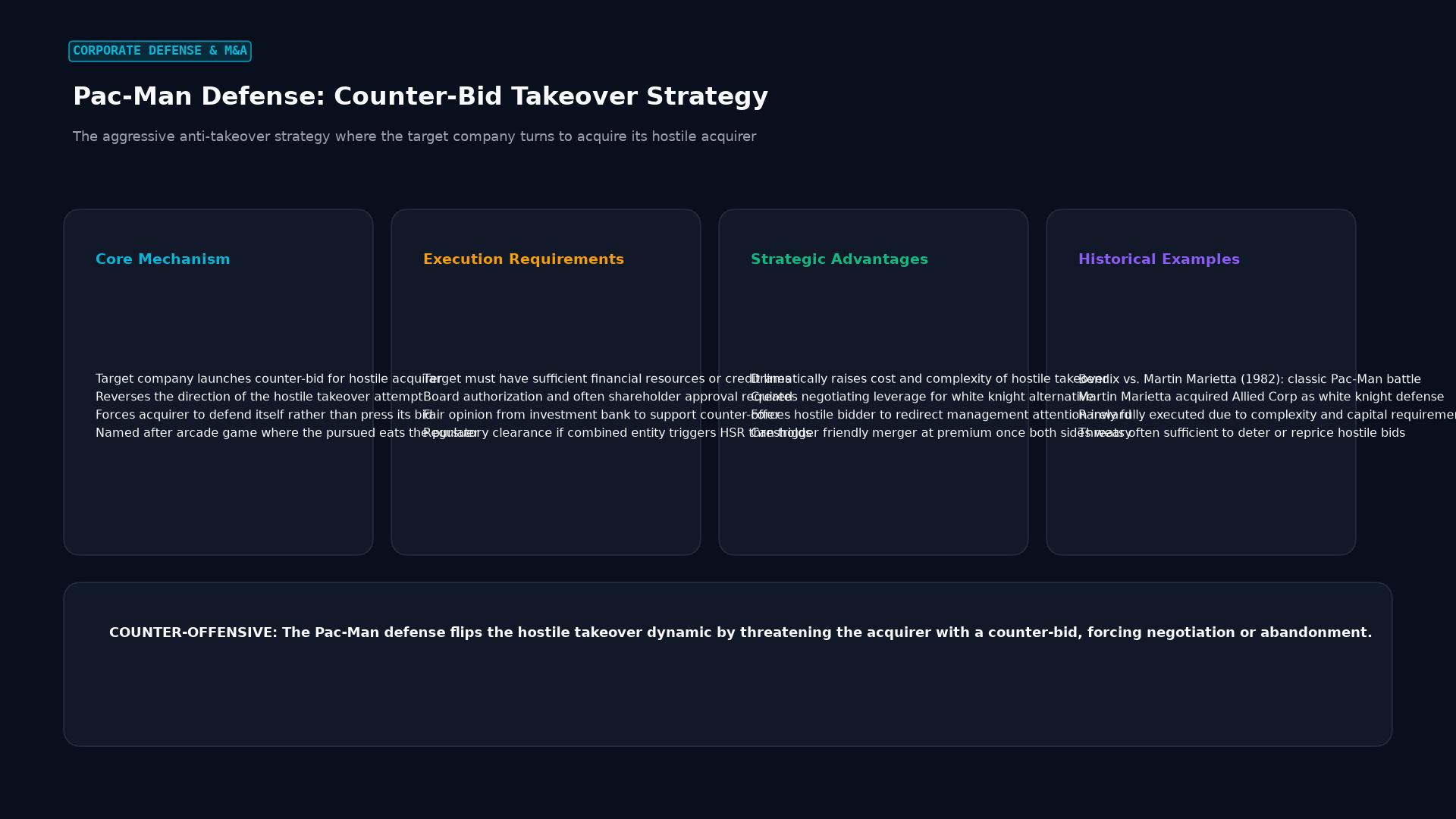 Figure: The aggressive anti-takeover strategy where the target company turns to acquire its hostile acquirer
The Historic Precedent: Bendix vs. Martin Marietta (1982)
The Pac-Man defense was first conceptualized and deployed during the legendary four-way corporate takeover war of 1982 involving the Bendix Corporation and aerospace defense contractor Martin Marietta:
+------------------------+--------------------------------------------------+
| Date / Event           | Tactical Maneuver and Market Shock               |
+------------------------+--------------------------------------------------+
| August 25, 1982        | Bendix Corp (led by CEO William Agee) launched a |
|                        | hostile $43/share tender offer for Martin        |
|                        | Marietta, valuing the defense firm at $1.5B.     |
+------------------------+--------------------------------------------------+
| August 30, 1982        | Martin Marietta (led by CEO Thomas Pownall)      |
|                        | rejected the bid and activated the inaugural     |
|                        | "Pac-Man defense," launching a counter-bid to    |
|                        | purchase Bendix for $75 per share ($1.5B).       |
+------------------------+--------------------------------------------------+
| September 7, 1982      | Martin Marietta secured a $1 billion credit line |
|                        | from a syndicate of commercial banks to fund the |
|                        | outright acquisition of its pursuer.             |
+------------------------+--------------------------------------------------+
| September 22, 1982     | The Dual-Tender Gridlock: Bendix purchased 70% of|
|                        | Martin Marietta, while Martin Marietta           |
|                        | simultaneously bought 50% of Bendix!             |
+------------------------+--------------------------------------------------+
| Resolution             | Industrial conglomerate Allied Corp entered as a |
|                        | White Knight, acquiring Bendix. Martin Marietta  |
|                        | survived as an independent aerospace contractor. |
+------------------------+--------------------------------------------------+
The Legal and Financial Gridlock
The Bendix-Martin Marietta battle resulted in an unprecedented corporate paradox known as the circular ownership dilemma: each company owned a controlling voting majority in the other.
Under the corporate law of Delaware (where Bendix was incorporated) and Maryland (where Martin Marietta was incorporated), severe statutory conflicts emerged regarding which company had the legal right to vote its shares first to fire the rival board of directors. The extreme debt burden assumed by both corporations to finance their competing share purchases threatened both firms with bankruptcy until Allied Corporation acquired Bendix, leaving Martin Marietta severely indebted but sovereign.
Notable Modern Case Studies
While rare due to extreme capital costs, the Pac-Man defense has been executed across diverse global corporate battles:
+------------------------+--------------------------------------------------+
| Corporate Contest      | Strategic Outcome and Mechanics                  |
+------------------------+--------------------------------------------------+
| American Brands vs.    | In 1988, corporate raider Meshulam Riklis's      |
| E-II Holdings (1988)   | E-II Holdings launched a hostile tender offer for|
|                        | American Brands. American Brands immediately     |
|                        | turned around and launched a counter-tender offer|
|                        | that successfully purchased E-II Holdings for    |
|                        | $1.2 billion, eliminating the hostile threat.    |
+------------------------+--------------------------------------------------+
| TotalFina vs.          | In 1999, TotalFina launched a hostile €42B bid   |
| Elf Aquitaine (1999)   | for French oil rival Elf Aquitaine. Elf responded|
|                        | with a Pac-Man counter-bid for TotalFina valued  |
|                        | at €50B. The battle concluded in a friendly,     |
|                        | negotiated merger forming Total (now TotalEnergies)|
+------------------------+--------------------------------------------------+
| Porsche vs.            | Between 2005 and 2008, Porsche attempted a slow  |
| Volkswagen (2008)      | hostile takeover of the much larger Volkswagen AG|
|                        | via derivative options. When the 2008 financial  |
|                        | panic froze Porsche's debt refinancing, VW turned|
|                        | around and acquired Porsche AG in a reverse      |
|                        | corporate integration.                           |
+------------------------+--------------------------------------------------+
Legal and Governance Framework: The Delaware Standards
In the United States, defensive tactics adopted by boards of directors during hostile takeovers are governed primarily by Delaware General Corporation Law (DGCL), interpreted by the Delaware Court of Chancery and Supreme Court:
                     THE UNOCAL TEST FOR DEFENSIVE ACTIONS

             Hostile Tender Offer Threat Emerges
                              |
                              v
    Step 1: Reasonable Grounds for Perceived Threat?
    (Did the board demonstrate good faith and reasonable
     investigation that the bid harmed corporate policy?)
                              |
                     YES ====>|
                              v
    Step 2: Proportionality of the Defensive Response?
    (Was the Pac-Man counter-offer reasonable in relation
     to the threat, without being preclusive or coercive?)
                              |
                     YES ====>|
                              v
     Board Action Protected under the Business Judgment Rule
1. The Unocal Proportionality Standard
In the landmark 1985 ruling Unocal Corp. v. Mesa Petroleum Co., the Delaware Supreme Court established the legal framework for defensive measures:
- Directors must demonstrate that they had reasonable grounds for believing that a danger to corporate policy and effectiveness existed.
- The defensive response must be proportional to the threat posed.
- While launching a Pac-Man counter-offer is legally permissible, courts examine whether the defense was designed to protect legitimate enterprise value or merely to entrench incumbent management at the expense of shareholder welfare.
2. DGCL Section 160(c): The Circular Voting Prohibition
Under Delaware General Corporation Law Section 160(c), the law explicitly prevents circular voting abuse: $$\text{Shares of Parent Owned by Controlled Subsidiary } \Longrightarrow \text{CANNOT BE VOTED}$$ If Company A owns a majority of the voting stock of Company B, any shares of Company A that Company B purchases are legally disenfranchised. Company B cannot vote those shares to overthrow Company A’s board. This statutory provision represents a critical legal hurdle for any target firm considering a Pac-Man defense against a Delaware-incorporated acquirer.
Financial Architecture and Risks of the Pac-Man Strategy
Deploying a Pac-Man counter-offer requires immense financial firepower, exposing the target company to severe balance sheet vulnerabilities:
+------------------------+--------------------------------------------------+
| Risk Factor            | Corporate Finance Consequence                    |
+------------------------+--------------------------------------------------+
| Explosive Leverage     | Target must raise billions in bridge loans and   |
| (Debt Overhang)        | high-yield bonds, causing credit rating cuts.    |
+------------------------+--------------------------------------------------+
| Poison Pill Reciprocity| Target risks triggering the hostile bidder's     |
|                        | existing Shareholder Rights Plan, diluting value.|
+------------------------+--------------------------------------------------+
| Mutual Capital Destruct| Heavy investment banking fees, legal retainers,  |
|                        | and breakup penalties deplete operating capital. |
+------------------------+--------------------------------------------------+
| Winner's Curse         | The target may succeed in purchasing the bidder, |
|                        | only to discover it overpaid for an incompatible |
|                        | asset saddled with unserviceable debt.           |
+------------------------+--------------------------------------------------+
1. The Financing Mechanism
A target company cannot execute a credible Pac-Man defense without confirmed, committed financing. The target’s investment bank (such as Goldman Sachs, Morgan Stanley, or JPMorgan) must assemble a syndicated group of commercial banks to issue a binding “Highly Confident Letter” or committed credit agreement: $$\text{Financing Package} = \text{Senior Bank Debt} + \text{Mezzanine Debt} + \text{Existing Cash Reserves}$$
If the hostile bidder has a market capitalization three times larger than the target, raising sufficient debt to acquire the larger predator can stretch the target’s debt-to-EBITDA leverage ratios to dangerous levels (e.g., $6.0\times$ to $9.0\times$), resulting in immediate downgrades to junk status by rating agencies.
2. The “Suicide Pact” Dynamic
Because both companies are simultaneously attempting to purchase each other using borrowed money, the Pac-Man defense creates a game-theoretic standoff akin to a financial “suicide pact.”
If both management teams refuse to back down, both firms will deplete their cash reserves, issue dilutive equity, and encumber their operating divisions with multi-billion-dollar debt burdens. This dynamic often forces both sides to the negotiating table, or prompts a neutral third-party White Knight to acquire one or both entities.
Comparative Matrix: Pac-Man Defense vs. Alternative Anti-Takeover Tools
+------------------------+-----------------------------+-----------------------------+-----------------------------+
| Dimension              | Pac-Man Defense             | Poison Pill (Flip-In)       | White Knight Defense        |
+------------------------+-----------------------------+-----------------------------+-----------------------------+
| Operational Nature     | Aggressive counter-attack   | Passive legal poison        | Friendly third-party rescue |
|                        | (Target bids for bidder)    | (Dilutes hostile stake)     | (Acquisition by ally)       |
+------------------------+-----------------------------+-----------------------------+-----------------------------+
| Capital Requirements   | Massive (Requires billions  | Minimal (Requires board     | Zero for target (Buyer funds|
|                        | in committed debt lines)    | approval and rights plan)   | the entire buyout)          |
+------------------------+-----------------------------+-----------------------------+-----------------------------+
| Corporate Independence | Retained (Target aims to    | Retained (Stops hostile     | Lost (Target is acquired by |
|                        | remain sovereign owner)     | bidder from closing bid)    | the friendly rescuer)       |
+------------------------+-----------------------------+-----------------------------+-----------------------------+
| Balance Sheet Impact   | Extreme leverage increase;  | Zero balance sheet damage;  | Minimal damage to target;   |
|                        | high financial risk         | strictly share dilution     | friendly integration        |
+------------------------+-----------------------------+-----------------------------+-----------------------------+
Best Practices for Evaluating Takeover Defenses
- Conduct Rigorous Proportionality Reviews: Corporate boards must ensure that counter-tender offers satisfy the Unocal test. Directors who approve a reckless Pac-Man defense purely to preserve their executive seats risk personal liability for breaching their fiduciary duty of loyalty to shareholders.
- Examine State Corporate Anti-Takeover Statutes: Legal counsel must analyze the corporate charters and state statutory restrictions (such as DGCL § 160(c) or Maryland Control Share Acquisition Acts) of both the target and the bidder to identify statutory circular voting prohibitions before launching a counter-bid.
- Analyze Post-Acquisition Debt Service: M&A financial analysts must model combined cash flows under conservative stress tests. If the combined company cannot service debt under a 200-basis-point interest rate increase, a Pac-Man victory will result in financial distress.
Frequently Asked Questions (FAQ)
What is the origin of the term “Pac-Man defense”?
The term was coined during the 1982 corporate takeover battle between Bendix and Martin Marietta. Financial commentators named the defense after the popular 1980 arcade video game Pac-Man, in which the main character is chased by ghosts until he eats an energized power pellet, turning around to chase and eat the ghosts. In corporate finance, a target company facing a hostile takeover turns around and launches a counter-bid to acquire its hostile pursuer.
Can a smaller company use the Pac-Man defense against a larger company?
Yes, but doing so requires immense amounts of debt financing. For a smaller company to acquire a larger hostile bidder, it must partner with investment banks to secure large syndicated loan facilities, bridge loans, and junk bond commitments. While this can succeed, the resulting financial leverage places the smaller firm under extreme debt stress if the acquisition is finalized.
Why is the Pac-Man defense rarely used in modern mergers and acquisitions?
The Pac-Man defense is rarely used today because modern corporate boards have access to more cost-effective, less destructive defensive mechanisms. Strategies such as modern Poison Pills (Shareholder Rights Plans), staggered boards, and dual-class voting structures can halt a hostile takeover without requiring the target to borrow billions of dollars and endanger its solvency.
Ready to trade forex?
Open a free demo account with a regulated broker. Practice with virtual funds before risking real money.