Package policy
A package policy is an insurance contract that bundles two or more distinct coverage parts or lines of insurance, typically combining property and liability protections, into a single integrated policy with consolidated billing and administration.
A package policy is an insurance contract that combines two or more distinct lines of coverage, most fundamentally combining first-party property insurance and third-party liability insurance, into a single unified policy framework. Developed to replace the fragmented, administrative inefficiency of purchasing separate standalone monoline policies, a package policy provides policyholders with comprehensive risk protection, lower premium costs through multiline bundling discounts, consolidated claims administration, and the elimination of dangerous coverage gaps.
In commercial enterprise risk management, the industry standard framework is the Commercial Package Policy (CPP), standardized by the Insurance Services Office (ISO) in 1986. In personal lines insurance, the ubiquitous Homeowners Policy (HO series) represents a classic package policy, integrating physical dwelling and personal property coverage with personal liability and medical payments coverage in a single contract.
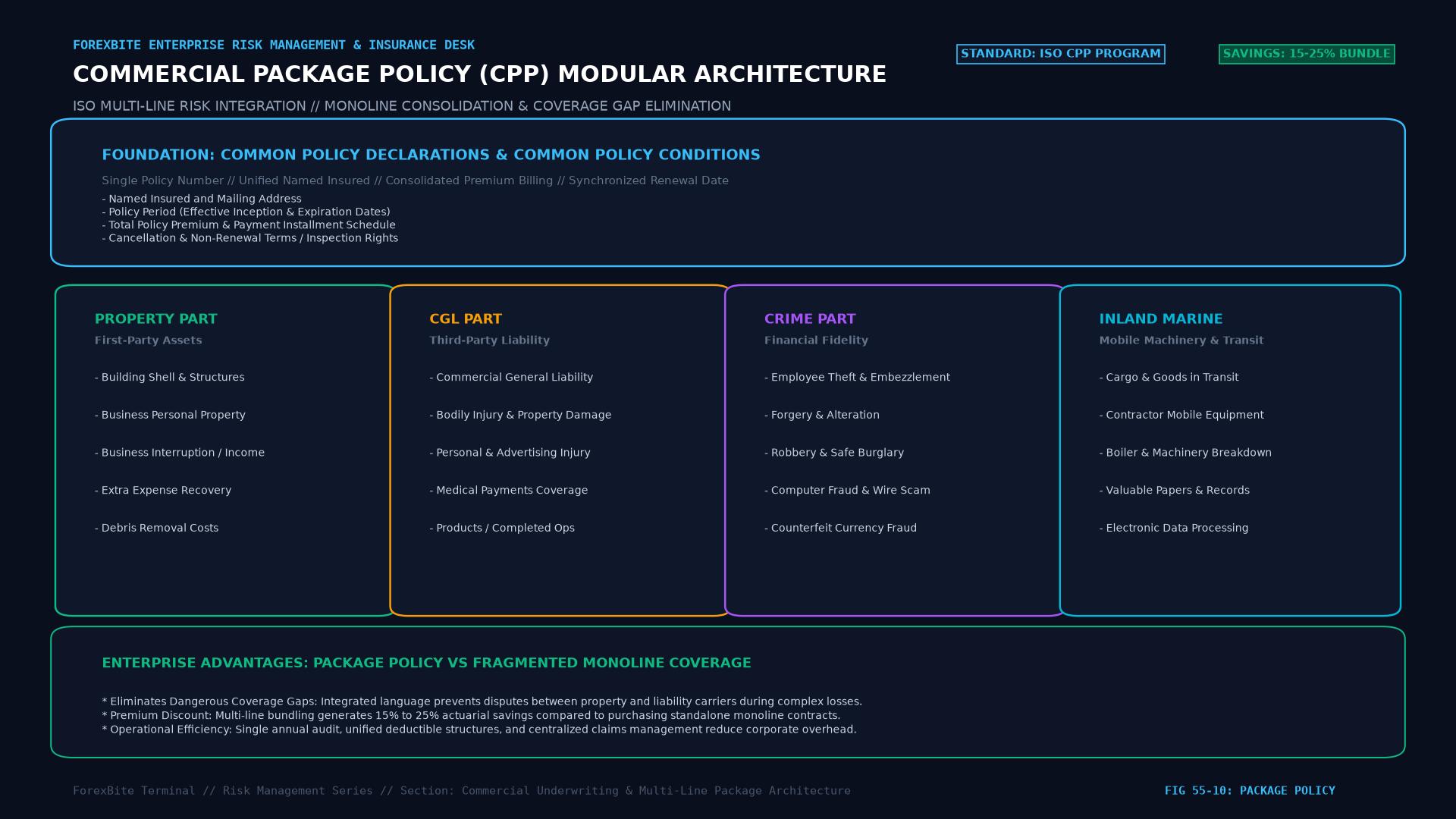 Figure: The ISO Commercial Package Policy (CPP) architecture integrating property, liability, crime, and inland marine coverage parts under unified policy conditions.
Historical Origins: The Monoline Era to the ISO Revolution
The Fragmented Monoline Era
Prior to the mid-twentieth century, state insurance statutory frameworks strictly enforced the monoline system:
- A single insurance company was legally prohibited by its corporate charter from writing both property insurance (fire and marine) and casualty insurance (workers’ compensation and liability).
- To obtain comprehensive coverage, an industrial enterprise or retail store had to negotiate separate insurance policies with multiple independent insurance carriers.
- This fragmentation generated extreme administrative friction: disparate policy renewal dates, separate premium invoices, overlapping deductibles, and bitter inter-carrier disputes when a loss occurred that touched both property and liability lines.
The 1986 ISO Modernization
With the relaxation of state charter restrictions and the introduction of multiple-line underwriting legislation, the Insurance Services Office (ISO) revolutionized commercial risk management in 1986 by introducing the standardized Commercial Package Policy (CPP) program:
- Established a modular, “building block” contract structure.
- Permitted an insured business to assemble customized coverage parts tailored to its specific operational risks while operating under a single set of Common Policy Declarations and Common Policy Conditions.
Core Modular Components of a Commercial Package Policy (CPP)
A modern Commercial Package Policy is structured around a central chassis comprising two mandatory administrative forms and two or more modular coverage parts:
+------------------------+--------------------------------------------------+
| Contract Component     | Structural Role and Risk Covered                 |
+------------------------+--------------------------------------------------+
| Common Policy          | Identifies the First Named Insured, physical     |
| Declarations           | locations, policy inception and expiration dates,|
|                        | and the itemized premium breakdown by line.      |
+------------------------+--------------------------------------------------+
| Common Policy          | Establishes baseline statutory rules governing   |
| Conditions             | cancellation, policy changes, audit rights, and  |
|                        | premium payment obligations.                     |
+------------------------+--------------------------------------------------+
| Commercial Property    | Covers direct physical loss or damage to buildings|
| Coverage Part          | business personal property, and stock inventory. |
+------------------------+--------------------------------------------------+
| Commercial General     | Protects against third-party lawsuits alleging   |
| Liability (CGL) Part   | bodily injury, property damage, or advertising.  |
+------------------------+--------------------------------------------------+
| Commercial Crime Part  | Insures against employee dishonesty, forgery,    |
|                        | counterfeit currency, and unauthorized wire theft|
+------------------------+--------------------------------------------------+
| Inland Marine Part     | Covers property in transit, specialized mobile   |
|                        | equipment, fine arts, and telecommunications.    |
+------------------------+--------------------------------------------------+
| Equipment Breakdown    | Insures against mechanical failure, steam boiler |
| (Boiler & Machinery)   | explosions, electrical arcing, and power surges. |
+------------------------+--------------------------------------------------+
1. The Commercial Property Coverage Part
Protects tangible corporate assets against specified perils (Basic, Broad, or Special Causes of Loss forms):
- Building Coverage: Real property structures, outdoor fixtures, and permanently installed machinery.
- Business Personal Property (BPP): Furniture, fixtures, machinery, and raw material inventory situated within 100 feet of the described premises.
- Business Income and Extra Expense (BII): Covers lost operating profits and continuing fixed operating expenses (such as key payroll and debt service) incurred while operations are suspended following a covered direct physical property loss.
2. The Commercial General Liability (CGL) Part
Provides defense and indemnity protection against civil lawsuits filed by third parties:
- Coverage A (Bodily Injury and Property Damage): Premises liability (e.g., a customer slip-and-fall in a retail store) and products/completed operations liability (e.g., a defectively manufactured power tool causing consumer injury).
- Coverage B (Personal and Advertising Injury): False arrest, malicious prosecution, wrongful eviction, libel, slander, and copyright infringement in promotional marketing.
- Coverage C (Medical Payments): Immediate reimbursement of minor customer medical expenses incurred on premises, payable regardless of legal fault.
Commercial Package Policy (CPP) vs. Business Owner’s Policy (BOP)
In commercial underwriting, package insurance is segmented into two distinct products based on enterprise scale and complexity:
+------------------------+-----------------------------+-----------------------------+
| Feature                | Business Owner's Policy (BOP| Commercial Package Policy(CPP)|
+------------------------+-----------------------------+-----------------------------+
| Target Demographic     | Small, low-risk enterprises | Mid-market to large corporate|
|                        | (bakeries, small offices,   | enterprises with complex,    |
|                        | dry cleaners, barbershops)  | high-risk operations        |
+------------------------+-----------------------------+-----------------------------+
| Customization Level    | Rigid, pre-packaged bundle; | Highly modular; every term, |
|                        | limited elective options    | sub-limit, and endorsement  |
|                        |                             | is individually negotiated  |
+------------------------+-----------------------------+-----------------------------+
| Underwriting Speed     | Automated, rapid issuance;  | Meticulous underwriter audit|
|                        | simplified application      | inspection reports, loss runs|
+------------------------+-----------------------------+-----------------------------+
| Pricing & Premium      | Highly discounted, flat rate| Scaled pricing based on     |
|                        | packaging for small limits  | customized composite rating |
+------------------------+-----------------------------+-----------------------------+
1. The Business Owner’s Policy (BOP)
A BOP is an off-the-shelf, standardized package policy designed specifically for small businesses with straightforward risk profiles. Eligibility is strictly constrained (e.g., annual revenues under $5 million, maximum square footage limits, and absence of hazardous manufacturing operations). While convenient and affordable, a BOP lacks the flexibility required by industrial manufacturers or global shipping enterprises.
2. The Commercial Package Policy (CPP)
A CPP is fully customizable. A large manufacturing conglomerate can design a CPP that includes commercial property, general liability, and commercial inland marine, while excluding auto or crime coverage if those lines are placed through specialized global specialty syndicates.
Strategic Advantages of a Package Policy
                    THE MULTILINE PACKAGING ADVANTAGE

  FRAGMENTED MONOLINE APPROACH                 INTEGRATED PACKAGE POLICY
  +-------------------------------------+      +-----------------------------------+
  | - Carrier A: Property Policy        |      |                                   |
  | - Carrier B: General Liability      | ===> |   Commercial Package Policy (CPP) |
  | - Carrier C: Inland Marine          |      |   (Single Underwriter, Unified)   |
  | - 3 separate renewal dates          |      | - 10% to 15% Package Discount     |
  | - 3 distinct minimum premiums       |      | - Single annual renewal date      |
  | - Coverage gap litigation finger-   |      | - Seamless inter-line claims      |
  |   pointing between carriers         |      | - Zero inter-carrier finger-point |
  +-------------------------------------+      +-----------------------------------+
1. Multiline Premium Discounts
Insurance carriers incur substantial operational expenses acquiring, underwriting, and administering individual accounts. When an insured places multiple lines of business within a single package policy, the underwriter passes administrative savings back to the client in the form of a package discount (typically reducing total gross premiums by 10% to 15% compared to purchasing standalone monoline contracts).
2. Elimination of Coverage Gaps and Cross-Line Disputes
When property and liability coverages are placed with separate, competing insurance carriers, complex property damage claims frequently result in protracted finger-pointing:
- Scenario: A commercial roofing contractor causes a fire while repairing a building. The building owner’s property insurer and the contractor’s liability insurer engage in months of subrogation disputes before reimbursing the business.
- The Package Solution: Under a unified package policy, the primary carrier investigates and adjusts the entire loss under coordinated claims management, paying property claims immediately without leaving the policyholder caught in inter-carrier litigation.
3. Streamlined Risk Governance
A package policy aligns all corporate insurance lines to a single annual effective date and common policy term. Corporate risk managers manage a single annual renewal audit rather than tracking staggered expirations throughout the calendar year.
Lines Typically Excluded from a Standard Package Policy
While a Commercial Package Policy is flexible, statutory and operational constraints prevent certain major commercial lines from being included inside standard package forms:
+------------------------+--------------------------------------------------+
| Excluded Line          | Statutory or Operational Rationale               |
+------------------------+--------------------------------------------------+
| Workers' Compensation  | Governed by strict, mandatory state statutory    |
| & Employers Liability  | compensation acts and state rating bureau audits |
|                        | (NCCI); must be written as a standalone policy.  |
+------------------------+--------------------------------------------------+
| Directors & Officers   | Specialized executive management liability;      |
| (D&O) Liability        | written on claims-made forms with unique consent-|
|                        | to-settle clauses and separate policy limits.    |
+------------------------+--------------------------------------------------+
| Cyber Risk & Data      | Rapidly evolving underwriting loss environment;  |
| Breach Liability       | require dedicated forensics, ransomware coverage,|
|                        | and specialized extortion crisis response teams. |
+------------------------+--------------------------------------------------+
| Commercial Umbrella /  | Sits directly above underlying primary lines;    |
| Excess Liability       | must be structured as an independent follow-form|
|                        | contract over scheduled primary policy layers.   |
+------------------------+--------------------------------------------------+
Best Practices for Structuring Package Policies
- Conduct an Annual Exposure Basis Audit: General liability premiums are calculated using variable exposure bases (such as gross annual revenue or gross payroll), while property premiums are calculated using total insured values (TIV). Ensure that projected exposure bases reflect actual economic activity to avoid large unexpected additional premium bills during end-of-year payroll audits.
- Review Cause of Loss Forms: Always verify whether property coverage under the package policy is written on a Special Causes of Loss form (open perils, covering all direct physical loss except what is expressly excluded) rather than a Basic or Broad form (named perils only).
- Verify Adequate Sub-Limits for Time Element Coverages: Check that the Business Income and Extra Expense coverage within the package policy includes sufficient indemnity periods (typically at least 12 to 18 months) and adequate sub-limits for utility services failure and civil authority ingress/egress shutdowns.
Frequently Asked Questions (FAQ)
What is the difference between a monoline policy and a package policy?
A monoline policy is an insurance contract that covers only a single, specific line of risk (such as a standalone commercial property policy or a standalone general liability policy). In contrast, a package policy bundles two or more distinct lines of insurance (such as property, liability, crime, and inland marine) into a single unified contract with combined administration and discounted pricing.
What is the difference between a CPP and a BOP?
A Business Owner’s Policy (BOP) is a pre-packaged, standardized package policy designed specifically for small businesses with straightforward, low-risk operations. A Commercial Package Policy (CPP) is a modular, highly customizable policy framework designed for medium-to-large corporate enterprises that allows the business to individually negotiate coverage parts, terms, and limits tailored to complex industrial exposures.
Can Workers’ Compensation be included in a Commercial Package Policy?
No. Workers’ Compensation cannot be combined into a standard Commercial Package Policy. Because Workers’ Compensation is governed by strict, mandatory state statutes, compulsory benefit levels, and state insurance rating bureaus (such as the NCCI), it must be issued as a completely separate, standalone policy.
Ready to trade forex?
Open a free demo account with a regulated broker. Practice with virtual funds before risking real money.