PIR
PIR stands for Prescribed Investor Rate in New Zealand wealth management, or Property Inspection Report in commercial real estate and mortgage underwriting.
What Does PIR Stand For?
In financial management, wealth planning, and institutional asset underwriting, the acronym PIR primarily refers to two distinct industry concepts:
- Prescribed Investor Rate (PIR): The statutory tax rate applied to an individual’s or entity’s investment income derived from a Portfolio Investment Entity (PIE) under New Zealand tax law. Administered by Inland Revenue (Te Tari Tāke / IRD), the PIR regime caps investment tax rates at 28%, offering tax advantages over standard personal income tax rates.
- Property Inspection Report (PIR): A formal engineering and physical condition assessment conducted during commercial real estate due diligence and mortgage underwriting. The report evaluates structural soundness, mechanical, electrical, and plumbing (MEP) systems, and estimates deferred maintenance reserves.
- Post-Implementation Review (PIR): An institutional project governance audit conducted following the deployment of financial trading infrastructure, core banking software, or merger integrations to assess realized returns versus projected capital expenditures.
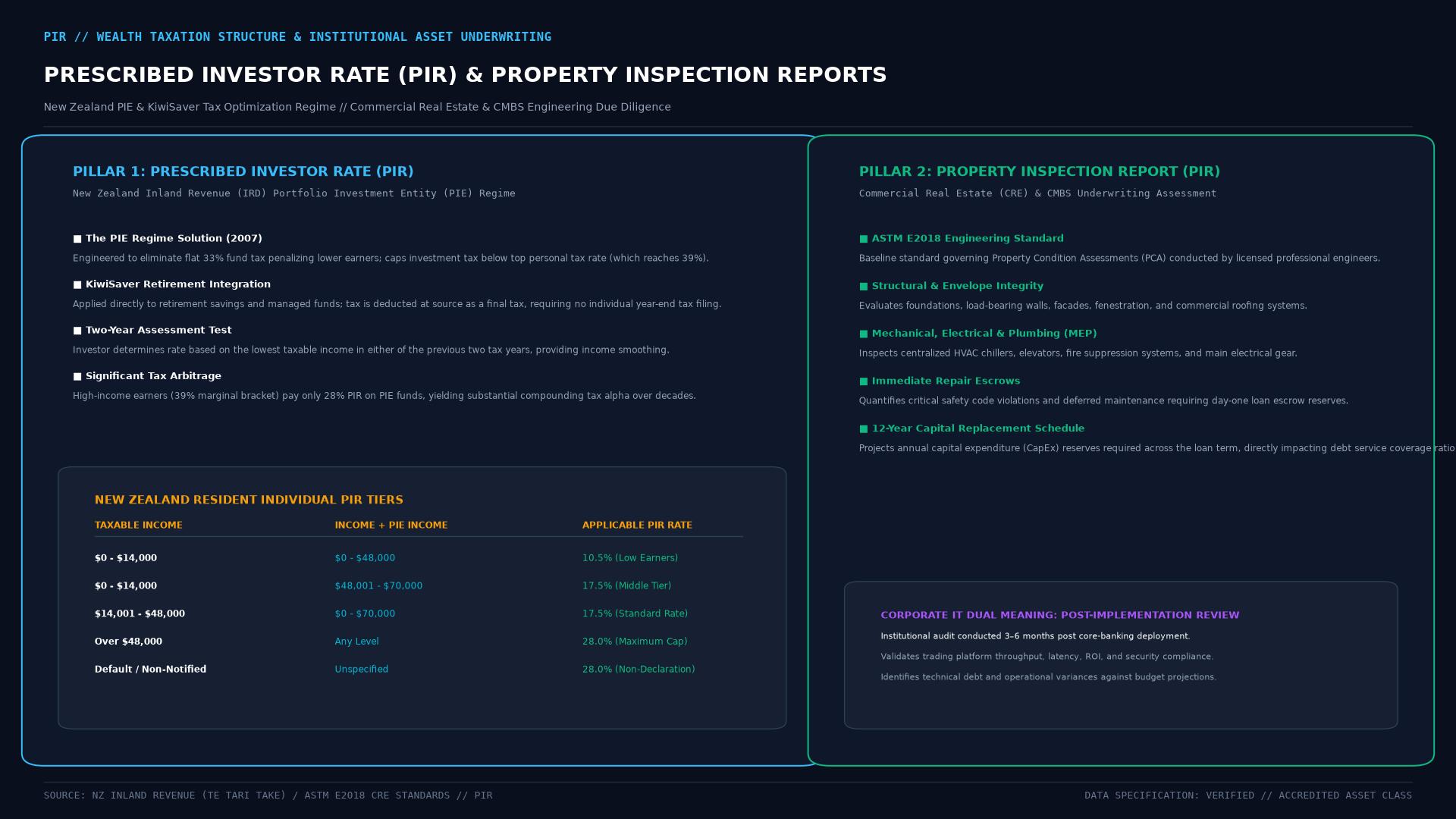 Figure: Dual institutional framework of PIR: The New Zealand Prescribed Investor Rate (PIR) regime across KiwiSaver and PIE funds with capped tax tiers (10.5%, 17.5%, 28%) alongside Property Inspection Reports in commercial real estate and CMBS underwriting.
1. Prescribed Investor Rate (PIR) in Wealth Management
The Prescribed Investor Rate (PIR) is a cornerstone of the New Zealand investment ecosystem. Established under the Portfolio Investment Entity (PIE) tax legislation in 2007, it dictates the tax rate at which investment income, such as interest, foreign dividends, and certain deemed returns, is taxed within collective investment vehicles, including KiwiSaver retirement schemes and retail managed funds.
The Problem PIR Solved
Prior to the introduction of the PIE regime, investment funds were typically taxed at a flat rate of 33%. This structure penalized low-income and middle-income savers whose personal marginal income tax rates were lower than 33%, while offering no relief to high earners.
The PIR framework established targeted tax tiers based on an investor’s prior taxable income, ensuring that investors pay a tax rate that reflects their personal financial position.
       Investor Enrolls in Managed Fund or KiwiSaver (PIE)
                                │
                                ▼
       Investor Evaluates Taxable Income Over Prior 2 Tax Years
       (Includes Salary, Business Earnings, and PIE Allocations)
                                │
                                ▼
       PIR Tier Selected: 10.5%, 17.5%, or 28.0%
                                │
                                ▼
       Fund Manager Deducts Tax Directly at Chosen PIR
       Income Does Not Enter Personal Year-End Tax Return
                                │
                                ▼
       Automated IRD Reconciliation at Fiscal Year-End
PIR Tax Brackets and Eligibility Rules
For individual New Zealand tax residents, the PIR is determined using a two-year lookback rule. An investor evaluates their income in the preceding two tax years (a New Zealand tax year runs from April 1 to March 31). If the investor qualifies for a lower rate in either of the two preceding years, they are entitled to use that lower PIR.
+------------------------------------------------------------------------------------+
|                NEW ZEALAND PRESCRIBED INVESTOR RATE (PIR) TIERS                    |
+---------+----------------------------+---------------------------------------------+
| PIR     | TAXABLE INCOME CRITERIA    | TOTAL INCOME CRITERIA (Taxable + PIE)       |
+---------+----------------------------+---------------------------------------------+
| 10.5%   | $14,000 or less            | AND total income is $48,000 or less         |
+---------+----------------------------+---------------------------------------------+
| 17.5%   | $48,000 or less            | AND total income is $70,000 or less         |
|         | (and does not qualify for  | (and does not qualify for 10.5%)            |
|         | 10.5% PIR)                 |                                             |
+---------+----------------------------+---------------------------------------------+
| 28.0%   | Exceeds $48,000            | OR total income exceeds $70,000             |
|         | (or does not meet lower    | (Maximum capped rate for all individuals)   |
|         | threshold combinations)    |                                             |
+---------+----------------------------+---------------------------------------------+
The 28% Maximum Cap: Tax Arbitrage for High Earners
A major feature of the New Zealand PIE regime is that the maximum individual PIR is capped at 28%.
In contrast, New Zealand’s standard marginal personal income tax brackets extend significantly higher:
- $33%$ on income between $$78,100$ and $$180,000$.
- $39%$ on all personal taxable income exceeding $$180,000$.
+------------------------------------------------------------------------------------+
|                         TAX RATE COMPARISON: PERSONAL VS. PIE                      |
+---------------------+-------------------+---------------------+--------------------+
| INCOME LEVEL        | PERSONAL MARGINAL | PIE PRESCRIBED RATE | ANNUAL TAX SAVING  |
|                     | TAX BRACKET       | (PIR CAP)           | ON $50,000 RETURN  |
+---------------------+-------------------+---------------------+--------------------+
| Up to $14,000       | 10.5%             | 10.5%               | $0                 |
| $14,001 - $48,000   | 17.5%             | 17.5%               | $0                 |
| $48,001 - $70,000   | 30.0%             | 28.0%               | $1,000 (2% delta)  |
| $78,101 - $180,000  | 33.0%             | 28.0%               | $2,500 (5% delta)  |
| Exceeding $180,000  | 39.0%             | 28.0%               | $5,500 (11% delta) |
+---------------------+-------------------+---------------------+--------------------+
For high-net-worth investors and executives earning over $$180,000$, holding assets directly (such as standard fixed-term bank deposits) subjects interest returns to a $39%$ tax rate. By routing those cash allocations through a PIE cash management fund, the effective tax rate drops to $28%$, generating an immediate $1,100$ basis point ($11%$) tax saving on annual gains.
IRD End-of-Year Automated Reconciliation
Fund managers automatically deduct tax at the investor’s nominated PIR and remit the funds directly to Inland Revenue.
Historically, if an investor declared an incorrect PIR:
- Under-declaring a PIR (e.g., claiming 17.5% when earning enough to require 28%) resulted in back taxes and potential statutory penalties.
- Over-declaring a PIR resulted in overpaid tax that was legally non-refundable.
Under current statutory reforms, Inland Revenue automatically reconciles an individual’s PIR against their actual employer income records and PIE fund data at the end of each tax year. If an investor overpaid or underpaid tax due to an incorrect PIR selection, the IRD automatically credits a tax refund or issues an assessment notice for the difference.
2. Property Inspection Report (PIR) in Real Estate Underwriting
In commercial mortgage origination, structured real estate finance, and Commercial Mortgage-Backed Securities (CMBS) syndication, a Property Inspection Report (PIR), also referred to as a Property Condition Assessment (PCA), is an indispensable due diligence requirement.
       Commercial Loan Application Submitted
                         │
                         ▼
       Lender Commissions Independent Engineering PIR
       (Compliant with ASTM E2018 Standards)
                         │
                         ▼
       On-Site Physical Inspection & Documentation Review
       - Roof Membrane, Foundation, Structural Envelope
       - HVAC, Chillers, Elevators, Fire Protection
       - ADA Accessibility & Environmental Risks
                         │
                         ▼
       PIR Delivers Two Critical Underwriting Outputs:
       1. Immediate Repair Cost Schedule (Deducted from loan)
       2. Replacement Reserve Budget (Escrowed monthly)
                         │
                         ▼
       Credit Committee Approves Debt Sizing & Debt Yield
Components of an Institutional Real Estate PIR
Prepared by licensed civil engineers or building survey firms, a comprehensive PIR adheres to ASTM standards (such as ASTM E2018, the Standard Guide for Property Condition Assessments):
- Building Envelope and Structural Systems: Inspects foundations, load-bearing concrete, steel framing, exterior facade, and roofing systems for water penetration or settlement cracks.
- Mechanical, Electrical, and Plumbing (MEP): Evaluates central boilers, cooling towers, commercial elevators, and electrical distribution panels to determine remaining useful life (RUL).
- Life Safety and Regulatory Compliance: Verifies automatic fire sprinkler systems, emergency egress corridors, and compliance with the Americans with Disabilities Act (ADA).
Impact on Loan Sizing and Debt Yield
Underwriters utilize the PIR’s findings to adjust commercial loan metrics:
- Immediate Repairs Escrow: If the PIR identifies safety hazards or urgent repairs, lenders require the borrower to deposit $100%$ to $125%$ of the estimated repair cost into an upfront repair escrow account at loan closing.
- Replacement Reserves: The PIR calculates the required annual replacement reserves (e.g., $$0.25$ per square foot per year) over the loan term. This expense is deducted directly from gross operating income to arrive at Net Operating Income (NOI), directly affecting the property’s calculated Debt Service Coverage Ratio (DSCR) and maximum loan amount.
3. Post-Implementation Review (PIR) in Corporate Governance
In investment banking operations, treasury technology, and fintech infrastructure, a Post-Implementation Review (PIR) is an audit process executed between 3 and 12 months following the completion of a major strategic initiative.
+------------------------------------------------------------------------------------+
|                         POST-IMPLEMENTATION REVIEW (PIR) AUDIT                     |
+-------------------+----------------------------------------------------------------+
| AUDIT DOMAIN      | CORE ASSESSMENT QUESTIONS                                      |
+-------------------+----------------------------------------------------------------+
| Financial ROI     | Did the project achieve its forecasted Internal Rate of Return |
|                   | (IRR) and net present value (NPV)? Were cost overruns present? |
+-------------------+----------------------------------------------------------------+
| Operational Scope | Are latency, throughput, and error rates matching the agreed   |
|                   | Service Level Agreements (SLAs) in live production?            |
+-------------------+----------------------------------------------------------------+
| Risk & Compliance | Did the implementation expose the institution to unexpected    |
|                   | cybersecurity vulnerabilities or regulatory audit findings?    |
+-------------------+----------------------------------------------------------------+
A PIR prevents corporate memory loss by cataloging operational mistakes and technical debt. It provides the board of directors and chief risk officers with verified data on whether capital investments delivered their intended competitive advantages.
Key Takeaways
- Multi-Disciplinary Acronym: In financial circles, PIR represents Prescribed Investor Rate in tax management, Property Inspection Report in real estate underwriting, or Post-Implementation Review in project governance.
- New Zealand PIE Framework: In wealth management, the Prescribed Investor Rate determines the tax deducted from managed funds and KiwiSaver investments across three distinct tiers: 10.5%, 17.5%, and 28%.
- High-Earner Tax Shelter: The PIR regime caps the maximum tax rate at 28%, creating substantial tax savings for top-bracket taxpayers who would otherwise face a 39% personal marginal tax rate.
- Two-Year Lookback Rule: New Zealand individual investors determine their PIR eligibility based on the lower income calculation of the previous two tax years.
- Underwriting Pillar in Real Estate: In commercial property finance, a PIR provides lenders with independent verification of physical asset conditions, dictating immediate repair escrows and ongoing replacement reserve deductions.
Frequently Asked Questions (FAQ)
What happens if an investor chooses the wrong Prescribed Investor Rate (PIR)?
If an investor in New Zealand selects an incorrect Prescribed Investor Rate with their fund manager, Inland Revenue’s automated systems detect the discrepancy during the year-end tax reconciliation. If the investor declared a PIR that was too low (e.g., claiming 17.5% instead of 28%), the IRD issues an assessment notice requiring the investor to pay the unpaid tax balance. If the investor selected a PIR that was too high, resulting in over-taxation, Inland Revenue automatically calculates a tax refund and credits it to the taxpayer.
Can non-residents invest in New Zealand PIE funds, and what PIR applies to them?
Yes. Non-resident international investors can invest in New Zealand Portfolio Investment Entities. For foreign investors, the applicable PIR depends on whether the fund is structured as a Foreign Investment Zero-Rate PIE or a Foreign Investment Variable-Rate PIE. In zero-rate funds investing entirely in offshore assets, non-residents enjoy a 0% PIR on foreign income. In variable-rate funds holding domestic assets, non-resident rates range between 0% and 28% depending on the asset class and applicable double taxation treaties.
Why is an ASTM E2018 Property Inspection Report mandatory for CMBS commercial loans?
Commercial Mortgage-Backed Securities (CMBS) loans are packaged and sold to bond investors who will never visit the underlying commercial collateral. Credit rating agencies (such as Moody’s, S&P, and Fitch) and bondholders require independent, standardized documentation confirming that the real estate is structurally sound and free from hidden liabilities. An ASTM E2018-compliant Property Inspection Report provides objective engineering verification of the property’s physical condition, establishing replacement reserve figures that protect bond cash flows over the loan life.
Ready to trade forex?
Open a free demo account with a regulated broker. Practice with virtual funds before risking real money.