Tier One
The core measure of a commercial bank's financial solvency and loss-absorbing equity under Basel III regulatory standards, or denoting an elite Tier-1 money-center bank that provides top-tier interbank market liquidity.
What Does “Tier One” Mean?
In international banking and finance, the designation “Tier One” carries two distinct, authoritative meanings depending on whether it describes regulatory capital or interbank liquidity architecture:
- Tier 1 Regulatory Capital: Under the Basel Accords (Basel I, II, and III) established by the Bank for International Settlements (BIS) in Basel, Switzerland, Tier 1 capital represents the primary, highest-quality, and most reliable form of loss-absorbing capital held by a commercial bank. It consists of funds that can absorb unexpected operational and credit losses on an ongoing basis while the bank remains a solvent “going concern.”
- Tier-1 Liquidity Providers (Tier-1 Banks): In the global foreign exchange and derivatives markets, “Tier-1” describes the elite oligopoly of global money-center investment banks (such as JPMorgan Chase, Citi, Deutsche Bank, HSBC, UBS, and Barclays). These institutions maintain direct credit lines with one another and trade directly on Tier-1 electronic matching engines (such as EBS and Refinitiv Dealing), providing the foundational liquidity that powers the entire global financial ecosystem.
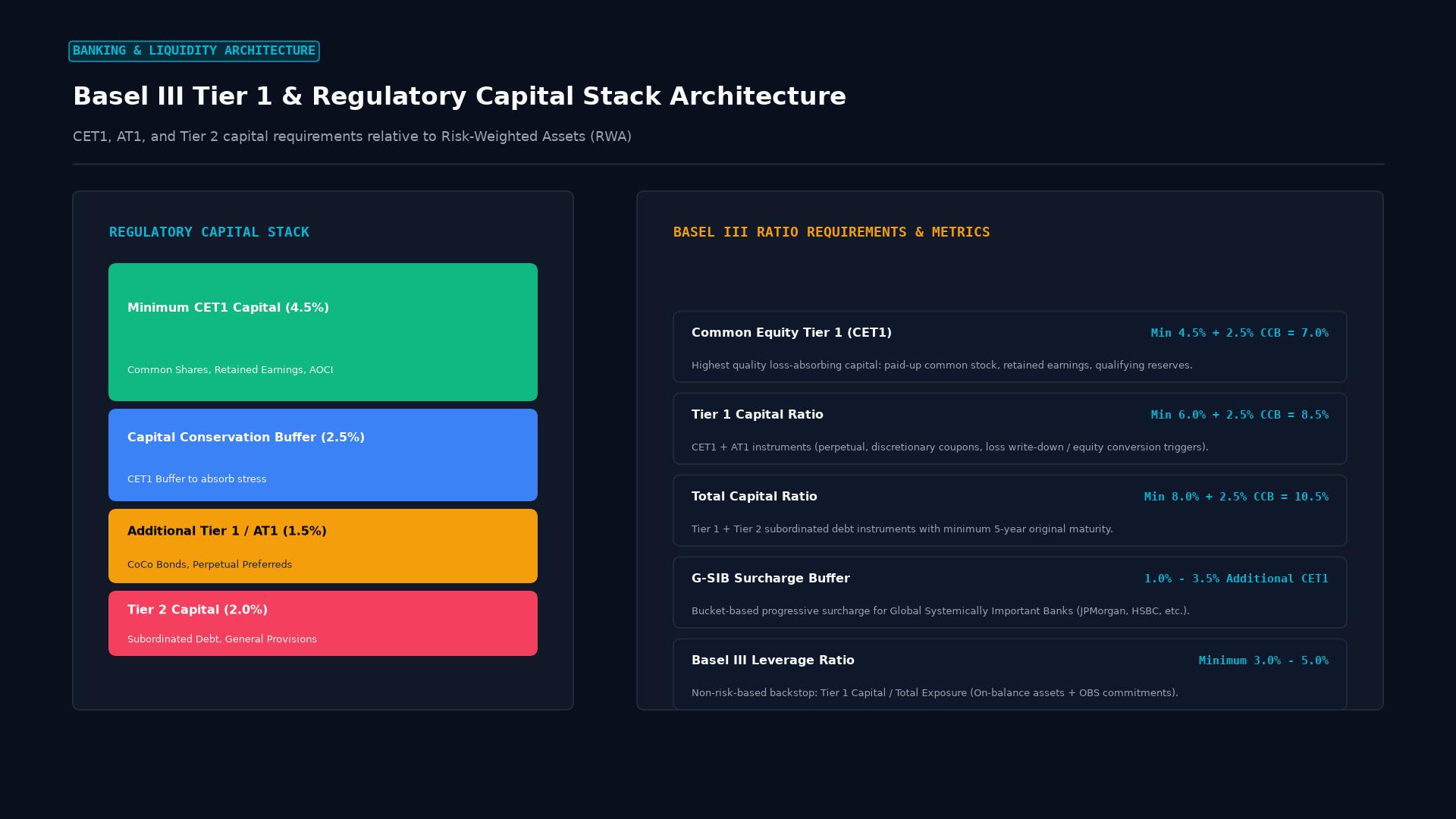 Figure: Basel III regulatory capital adequacy stack: Common Equity Tier 1 (CET1), Additional Tier 1 (AT1) CoCo instruments, Tier 2 subordinated debt, and leverage backstops.
Mathematical Formulation: Basel III Capital Adequacy Ratios
To prevent commercial banks from excessive leverage and balance-sheet insolvency, international banking regulators mandate strict minimum capital ratios calibrated against Risk-Weighted Assets (RWA):
1. Common Equity Tier 1 (CET1) Ratio
$$\text{CET1 Ratio} = \left( \frac{\text{Common Equity Tier 1 Capital}}{\text{Total Risk-Weighted Assets (RWA)}} \right) \times 100 \ge 4.5%$$
2. Tier 1 Capital Ratio
$$\text{Tier 1 Ratio} = \left( \frac{\text{Tier 1 Capital (CET1 + AT1)}}{\text{Total Risk-Weighted Assets (RWA)}} \right) \times 100 \ge 6.0%$$
3. Total Capital Ratio (Tier 1 + Tier 2)
$$\text{Total Capital Ratio} = \left( \frac{\text{Total Regulatory Capital}}{\text{Total RWA}} \right) \times 100 \ge 8.0%$$
Regulatory Buffers Above the Minimum
In addition to the 4.5% baseline CET1 ratio, Basel III mandates two mandatory protective layers:
- Capital Conservation Buffer (CCB): An additional 2.5% in CET1 equity, bringing the effective operational minimum to 7.0%. If a bank breaches this buffer, regulators legally restrict executive bonuses and dividend distributions.
- G-SIB Surcharge: Globally Systemically Important Banks (G-SIBs) must hold an additional systemic surcharge ranging from 1.0% to 3.5% depending on their systemic interconnectedness.
Tier 1 vs. Tier 2 vs. Tier 3 Capital
| Regulatory Tier | Capital Classification | Loss Absorption Horizon | Financial Instruments Included | Basel III Minimum Requirement |
|---|---|---|---|---|
| Tier 1 (CET1) | Pure Core Equity | Going-Concern (Absorbs daily losses while fully operational) | Common voting stock, retained earnings, statutory capital reserves | Minimum 4.5% (Effective 7.0%+ with buffer) |
| Tier 1 (AT1) | Hybrid Equity | Going-Concern (Converts or writes down if CET1 breaches trigger) | Contingent Convertible Bonds (CoCos), perpetual preferred stock | Up to 1.5% of RWA |
| Tier 2 | Supplementary Capital | Gone-Concern (Protects depositors after legal liquidation begins) | Subordinated term debt (min 5-year maturity), general loan-loss reserves | Up to 2.0% of RWA |
| Tier 3 | Short-Term Debt | Abolished (Eliminated under Basel III) | Historically covered short-term market risk | 0.0% (Prohibited in modern banking) |
Real-World Institutional Case Study: The Credit Suisse AT1 Wipeout (March 2023)
The fragility and structural complexity of Tier 1 capital instruments was exposed in March 2023 during the emergency acquisition of Credit Suisse by UBS:
       CREDIT SUISSE EMERGENCY RESOLUTION (MARCH 19, 2023)

 The Crisis:
 - Facing catastrophic client deposit runs ($100B+ outflow in days),
   Credit Suisse was forced into an emergency acquisition by UBS,
   brokered by the Swiss Financial Market Supervisory Authority (FINMA).

 The Historic AT1 Inversion:
 1. Traditional Insolvency Waterfall:
    Equity Shareholders take first loss ──► Junior Debt (AT1) takes second loss.
 2. FINMA's Emergency Decree:
    FINMA activated contractual "Viability Event" clauses inside Credit Suisse's
    Additional Tier 1 (AT1) Contingent Convertible bond prospectuses.
 3. Outcome:
    - $17.3 BILLION in AT1 Tier 1 Capital was completely WRITTEN DOWN TO ZERO.
    - Meanwhile, common equity shareholders received $3.25 billion in UBS stock.
The write-down sent shockwaves through the global $275 billion AT1 market, triggering legal challenges and forcing global central banks (including the ECB and Bank of England) to issue public assurances that within their jurisdictions, common equity would always be wiped out before Tier 1 AT1 debt.
Tier-1 Liquidity in Foreign Exchange: The Prime of Prime Bridge
For retail forex traders, understanding Tier-1 institutions is essential to understanding execution quality:
                      THE FOREX LIQUIDITY CASCADE

 [ Tier-1 Interbank Market ]  ──► JPMorgan, Citi, Deutsche Bank, Barclays
                                  (Trades in $10M - $50M minimum blocks)
                                           │
                                           ▼
 [ Prime Brokers / PoP Desks ] ──► Saxo Bank, Sucden Financial, Invast
                                  (Aggregates Tier-1 feeds into multi-asset API)
                                           │
                                           ▼
 [ Retail Forex Brokers ]      ──► MetaTrader / cTrader Brokerages
                                  (Provides fractional lots: 0.01 micro lots to retail)
Retail traders do not trade directly with Tier-1 banks. Instead, Prime of Prime (PoP) institutions bridge the gap, taking the wholesale multi-million-dollar liquidity streams from Tier-1 banks and slicing them into the micro-lot increments executed by everyday retail speculators.
Frequently Asked Questions
What happens if a commercial bank fails to meet its Tier 1 capital requirements?
If a bank’s CET1 or Tier 1 ratio dips below statutory regulatory minimums, central bank regulators intervene immediately with Prompt Corrective Action (PCA). Regulators legally block all dividend payments to shareholders, halt share buybacks, prohibit executive discretionary bonuses, and mandate that the bank execute an emergency rights issue to raise fresh equity. If the bank fails to recapitalize, it is placed into regulatory receivership or forced into an acquisition.
What is the difference between Tier 1 capital and book value equity?
While both originate from shareholders’ equity, Tier 1 capital applies severe regulatory deductions. Regulators subtract intangible assets (such as goodwill), deferred tax assets (DTAs), and defined benefit pension obligations from standard accounting book value to ensure that Tier 1 capital reflects purely tangible, immediate loss-absorbing liquidity.
Are all major commercial banks considered Tier-1 liquidity providers?
No. While many banks hold compliant Tier 1 regulatory capital, only a select group of approximately ten to twelve massive multinational investment banks with global dealing desks and multi-billion-dollar balance sheets are recognized by the financial industry as true Tier-1 interbank liquidity providers in foreign exchange and interest rate derivatives.
Ready to trade forex?
Open a free demo account with a regulated broker. Practice with virtual funds before risking real money.