Tokyo Interbank Offered Rate (TIBOR)
A daily benchmark interest rate published by the JBA TIBOR Administration, reflecting the average interest rate at which prime banks offer to lend unsecured Japanese Yen funds to other institutions in the Tokyo interbank market.
What Is TIBOR?
The Tokyo Interbank Offered Rate (TIBOR) is the foundational reference interest rate for Japanese Yen money markets. Published daily by the JBA TIBOR Administration (JBATA)—an affiliate of the Japanese Bankers Association—TIBOR serves as the primary benchmark rate used to price syndicated corporate loans, commercial mortgages, floating-rate notes, and interest rate derivatives denominated in Japanese Yen (JPY).
Established in November 1995, TIBOR was created to provide a transparent, standardized index for the cost of unsecured wholesale funds in Tokyo’s financial center, functioning as the Japanese equivalent of London’s LIBOR and Europe’s EURIBOR.
Historically, TIBOR was published across two distinct sub-benchmarks:
- Japanese Yen TIBOR (Domestic JPY TIBOR): Reflects the prevailing lending rates in the onshore domestic Tokyo interbank market.
- Euroyen TIBOR: Reflected rates in the offshore Euroyen market, where Yen-denominated transactions occurred outside Japan’s domestic regulatory framework.
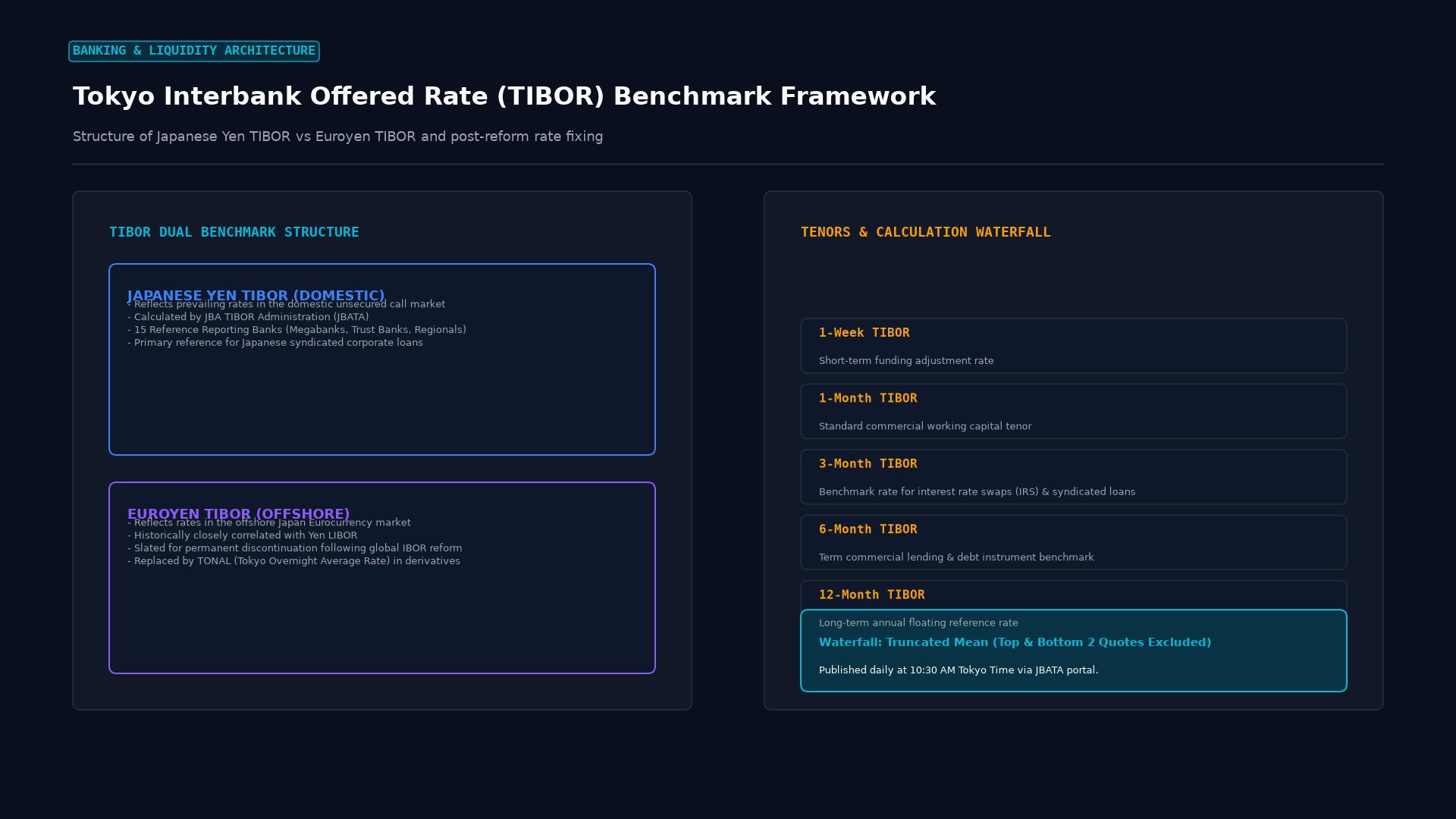 Figure: Dual-rate benchmark structure: Japanese Yen TIBOR (domestic call market) versus Euroyen TIBOR (offshore market), calculation waterfall, and tenor tenures.
Calculation Methodology and Governance
To maintain integrity and protect the benchmark against manipulation, JBATA enforces a strict trimmed-mean statistical framework:
$$\text{TIBOR} = \frac{1}{N - 4} \sum_{i=3}^{N-2} R_{(i)}$$
Where:
- $N$: The number of reporting reference banks (typically 15).
- $R_{(i)}$: The submitted quotes sorted in ascending numerical order ($R_{(1)} \le R_{(2)} \le \dots \le R_{(N)}$).
- The two highest quotes ($R_{(N-1)}, R_{(N)}$) and the two lowest quotes ($R_{(1)}, R_{(2)}$) are automatically trimmed out to eliminate potential collusion or statistical distortion.
Following the global LIBOR manipulation scandals, JBATA modernized its governance in 2017 by implementing the “Waterfall Methodology”, compelling reference banks to base rate submissions on actual interbank transactions rather than subjective dealer estimates whenever possible.
TIBOR vs. TONAR vs. Euroyen TIBOR
The global reform of benchmark interest rates fundamentally reshaped the Japanese lending landscape:
| Benchmark Rate | Administrator | Underlying Market | Transaction Basis | Current Regulatory Status |
|---|---|---|---|---|
| Japanese Yen TIBOR | JBA TIBOR Administration | Domestic Onshore Tokyo Interbank | Expert quotes grounded in transaction data | Active (Standard benchmark for domestic Japanese corporate loans) |
| Euroyen TIBOR | JBA TIBOR Administration | Offshore Euroyen Interbank | Expert quotes grounded in transaction data | Permanently Discontinued (Retired in December 2024) |
| TONAR (Tokyo Overnight Average Rate) | Bank of Japan (BOJ) | Unsecured Overnight Money Market | 100% Actual Cleared Overnight Transactions | Primary Risk-Free Rate (RFR) (Japan’s equivalent to U.S. SOFR) |
Real-World Institutional Case Study: The Negative Interest Rate Era (2016–2024)
In January 2016, under Governor Haruhiko Kuroda, the Bank of Japan shocked global financial markets by introducing a negative interest rate policy (-0.10%) and Yield Curve Control (YCC):
       JAPANESE YEN 3-MONTH TIBOR IN THE NEGATIVE RATE ERA

 0.40% ──┐ (Pre-2016 Baseline)
         │\
 0.20% ──┼─\
         │  \
 0.05% ──┼───\___ (Jan 2016: BOJ Imposes -0.10% Policy Rate)
         │       \
 0.00% ──┼────────*───────────────────────────────────────────────
         │         \___ TIBOR Flattens into Sub-Zero / Near-Zero Ground
-0.10% ──┴────────────────────────────────────────────────────────
2015 2016 2018 2020 2022 2024- The Distortion: With the BOJ penalizing excess reserves, short-term money market yields collapsed into negative territory.
- The Banking Dilemma: Commercial Japanese megabanks (Mitsubishi UFJ, Sumitomo Mitsui, Mizuho) could not easily charge negative interest rates to domestic retail depositors without triggering public runs on physical cash.
- The TIBOR Floor: While offshore Euroyen rates and government bond yields traded deeply negative, domestic Yen TIBOR hovered stubbornly between 0.05% and 0.08%, reflecting an artificial floor imposed by commercial banks to protect net interest margins on corporate loans.
- The 2024 Exit: In March 2024, when the BOJ executed its first rate hike in 17 years to 0.10% (and later to 0.25%), TIBOR climbed above 0.25%, ending eight years of unprecedented monetary distortion.
The Retirement of Euroyen TIBOR and Migration to TONAR
Following the total shutdown of USD and GBP LIBOR, financial regulators mandated the phase-out of benchmarks vulnerable to manipulation:
- The Euroyen TIBOR Cessation: In March 2024, JBATA confirmed that Euroyen TIBOR would be permanently terminated at the end of December 2024, completing the unification of the Japanese interbank market.
- The Rise of TONAR: For interest rate swaps and institutional cross-currency derivatives, the market transitioned en masse to TONAR (Tokyo Overnight Average Rate). Calculated directly by the Bank of Japan from actual cleared overnight wholesale transactions, TONAR provides a risk-free, manipulation-proof foundation.
Frequently Asked Questions
What was the historical reason for having two separate TIBOR rates?
The division originated during Japan’s postwar financial regulations. Japan maintained strict domestic capital controls and banking regulations that did not apply to offshore funds. Consequently, interest rates for Japanese Yen held inside Japan (Domestic Yen TIBOR) diverged significantly from Yen held in London or Singapore (Euroyen TIBOR), requiring two independent rate fixings.
How does TIBOR affect foreign exchange traders trading USD/JPY?
While retail traders monitor spot USD/JPY exchange rates, institutional currency desks trade cross-currency basis swaps and FX forward points. Forward points are derived directly from the interest rate differential between U.S. SOFR and Japanese TIBOR/TONAR. Shifts in TIBOR immediately alter the cost of rolling USD/JPY positions overnight (the rollover/swap rate).
What maturities are quoted for Japanese Yen TIBOR?
JBATA publishes Japanese Yen TIBOR across five standardized maturities: 1-week, 1-month, 3-month, 6-month, and 12-month. The 3-month fixing is the most liquid and widely referenced tenor for commercial loan contracts and derivatives.
Ready to trade forex?
Open a free demo account with a regulated broker. Practice with virtual funds before risking real money.