XPD
The ISO 4217 financial currency code representing one troy ounce of physical fine palladium, traded globally as a precious and industrial metal on international commodities and foreign exchange markets.
XPD (Palladium - Troy Ounce)
Under the international standard ISO 4217, the ticker XPD designates one troy ounce (31.1034768 grams) of pure palladium (atomic number 46, symbol Pd). While palladium is primarily an industrial platinum group metal (PGM), ISO 4217 assigns it a three-letter currency code prefixed with “X” (alongside gold XAU, silver XAG, and platinum XPT) to enable standardized pricing, multi-currency electronic clearing, physical bullion settlement, and cross-asset portfolio allocation across global financial trading platforms.
In global macroeconomics and commodities finance, palladium represents one of the most volatile and geographically concentrated commodities on Earth. Dominated by demand from the automotive manufacturing sector for internal combustion engine (ICE) catalytic converters to neutralize toxic exhaust emissions, the price of XPD is driven by strict environmental emissions mandates, acute supply concentration in Russia and South Africa, and structural technological substitution risks posed by platinum and battery electric vehicles (BEVs).
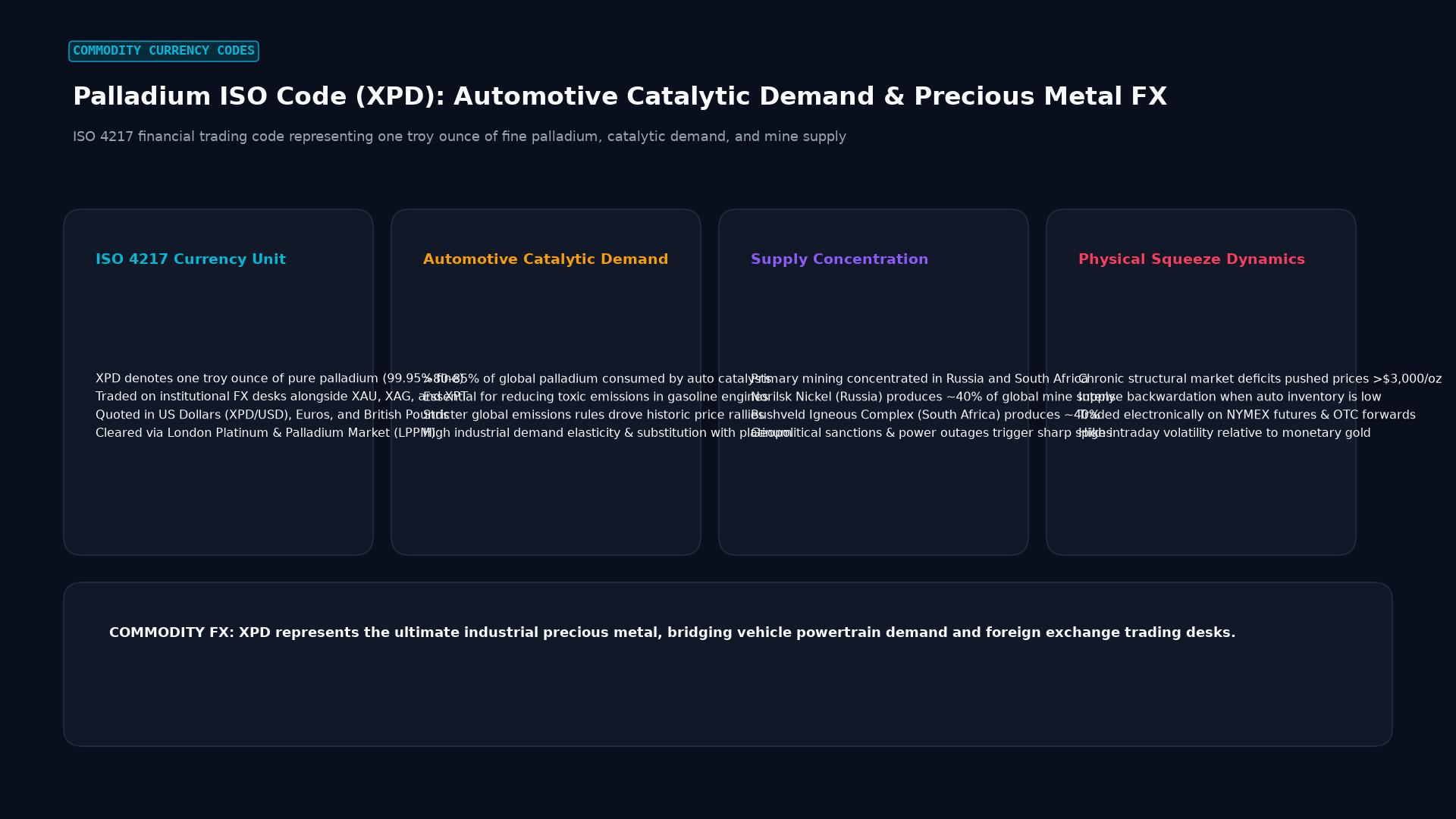 Figure: ISO 4217 financial trading code representing one troy ounce of fine palladium, catalytic demand, and mine supply
Physical Properties and Industrial Fundamentals
Discovered in 1803 by English chemist William Hyde Wollaston and named after the newly discovered asteroid Pallas, palladium possesses exceptional physical and catalytic attributes:
- Catalytic Efficiency: Palladium has the unique ability to absorb up to 900 times its own volume of hydrogen at room temperature. Its primary industrial application lies in autocatalysts, where it accelerates the chemical oxidation of harmful hydrocarbons (HC) and carbon monoxide (CO) into harmless water vapor and carbon dioxide.
- Gasoline Engine Concentration: Unlike diesel engines, which historically favored platinum (XPT) due to its resistance to sulfur poisoning, gasoline engines operate at higher exhaust temperatures where palladium exhibits superior catalytic stability and durability. Consequently, over 80% to 85% of total annual global palladium output is consumed by the automotive industry.
- Secondary Applications: Palladium is used in multilayer ceramic capacitors (MLCCs) for telecommunications hardware, dental restorative alloys, jewelry alloys (white gold), and hydrogen purification membranes.
Supply-Side Geography: Extreme Duopoly Concentration
The global production of mined palladium is characterized by extreme geographic concentration, exposing the XPD market to severe geopolitical and operational supply disruptions:
| Country | Primary Production Facilities | Global Share (%) | Mine Extraction Characteristics |
|---|---|---|---|
| Russia | MMC Norilsk Nickel (Polar Division, Taimyr) | ~40% to 43% | Low-cost byproduct of copper and nickel sulfide ores |
| South Africa | Anglo American Platinum, Sibanye, Impala | ~36% to 39% | Deep underground reef mining (Merensky, UG2, Platreef) |
| North America | Sibanye-Stillwater (US), Impala Canada | ~10% to 12% | Primary PGM shaft mining |
| Recycling | Global autocat recycling refineries | (~30% of total supply) | Secondary recovery from scrapped end-of-life vehicles |
       Global Mined Supply Duopoly Concentration:

       Russia (~42%) + South Africa (~38%) = 80% of All Primary Mined Palladium
The Russian Asymmetry (Byproduct Economics)
In Russia’s Norilsk mining basin in northern Siberia, palladium is extracted as a byproduct of high-grade nickel and copper mining. Because the operational costs are covered by nickel and copper sales, Norilsk can produce palladium at negative cash costs after byproduct credits. However, geopolitical friction, shipping sanctions, and aviation airspace closures can abruptly choke Russian physical deliveries into Western vault hubs in Zurich and London.
South African Deep-Reef Vulnerability
In contrast to Russia, South African PGMs are mined from deep, labor-intensive underground shafts within the Bushveld Igneous Complex. These operations face operational vulnerabilities, including chronic electricity load-shedding by state utility Eskom, union wage strikes, and rising water table extraction costs.
Trading Mechanics: Spot, Futures, and Fixing
XPD is traded across institutional over-the-counter (OTC) bullion markets and regulated derivative exchanges:
1. London Platinum and Palladium Market (LPPM)
The LPPM serves as the global center for physical and unallocated precious metal clearing:
- LPPM Fixing: Two electronic auctions are conducted daily at 09:45 and 14:00 London time by the London Metal Exchange (LME) on behalf of the LPPM, establishing the benchmark global spot settlement price.
- Loco London / Zurich Settlement: Institutional trades settle through physical London/Zurich vault delivery of Good Delivery bars (minimum fineness 99.95%, weighing between 1 and 6 kilograms / 32 to 192 troy ounces).
2. NYMEX / CME Futures (Ticker: PA)
- Contract Size: 100 troy ounces.
- Quotation: US dollars and cents per troy ounce ($0.05 per ounce minimum tick = $5.00 per contract).
- Physical Delivery: Grade 99.95% palladium bars delivered to approved depository vaults in New York.
3. Spot Spreads and Trading Liquidity
Unlike gold (XAU/USD), which features deep interbank liquidity and penny-wide spreads, palladium is relatively illiquid. Spot bid-ask spreads on retail forex platforms often span $5.00 to $20.00 per ounce, reflecting wide inventory holding costs and volatile borrowing lease rates.
       Palladium Lease Rate Formula and Market Backwardation:

       Lease Rate = USD Interest Rate (SOFR) - Forward Rate Differential

       When Physical Metal is Scarce in Vaults:
       Borrowing Demand Surges -> Lease Rates Spike to 15% - 30%+
       Spot Price Trades at a Massive Premium Over Futures -> Extreme Backwardation
Historical Price Cycles: The Epic 2018–2022 Bull Run and Deflation
Between 2018 and early 2022, the palladium market experienced one of the most dramatic commodity price rallies in modern financial history:
+------------------------------------------------------------------------+
|          Historical Price Trajectory of Palladium (XPD/USD)            |
+------------------------------------------------------------------------+
| Period / Event      | Price Level (USD/oz) | Core Fundamental Catalyst |
| 2016 (Base Level)   | ~$500 - $600         | Stable global automotive  |
| 2018–2019 Tightness | $1,000 -> $1,900     | Euro 6d / China 6 vehicle |
|                     |                      | emissions mandates ramp up|
| February 2020 Peak  | ~$2,800              | Acute physical deficit    |
| March 2022 (Record) | **$3,440 (All-time)**| Russian invasion fears;   |
|                     |                      | supply panic at Norilsk   |
| 2023–2024 Retracement| $950 - $1,150       | BEV market share growth;  |
|                     |                      | platinum substitution     |
+------------------------------------------------------------------------+
Drivers of the Surge: The Emissions Clampdown
Implementation of the European Union’s Euro 6d and China’s China 6b automotive emissions standards mandated higher loadings of palladium per catalytic converter to eliminate cold-start emissions. With auto manufacturers legally unable to sell non-compliant vehicles, carmakers paid record premiums to secure physical metal, driving the market into structural deficit.
Drivers of the Subsequent Decline: The EV Threat and Platinum Substitution
- Battery Electric Vehicles (BEVs): Pure electric vehicles (such as Tesla, BYD, and European EV platforms) require zero exhaust catalytic converters, entirely eliminating demand for palladium in that segment.
- Reverse Substitution to Platinum: With palladium trading at a $1,500+ premium over platinum in 2020–2021, automotive engineers developed tri-metal catalysts capable of substituting cheaper platinum (XPT) for palladium in gasoline vehicles, eroding palladium’s pricing premium.
Applied Hedging Case Study: Automotive Parts Manufacturer
Consider Rhineland Catalytic Systems (RCS), a Tier-1 automotive supplier based in Stuttgart producing exhaust systems for European automakers.
Commercial Exposure
- RCS secures an order to produce 500,000 catalytic converters for delivery over the next 12 months.
- Each converter requires 0.06 troy ounces of palladium.
- Total physical metal commitment: $$\text{Required Palladium} = 500,000 \times 0.06 = 30,000 \text{ troy ounces}$$
- Current Spot Price: $1,100 per ounce. Total current budget: $33,000,000.
- The sales contract with the carmaker locks in fixed converter delivery prices based on $1,100 XPD. If palladium spikes to $1,500 due to mining strikes, RCS incurs a catastrophic unhedged loss of: $$30,000 \times ($1,500 - $1,100) = $12,000,000$$
Derivative Hedging Execution
To neutralize commodity price risk, RCS executes a long hedging program on the CME:
- Futures Position: RCS purchases 300 NYMEX Palladium Futures contracts (each contract covers 100 troy ounces; $300 \times 100 = 30,000 \text{ oz}$) for forward delivery matching its manufacturing production run.
- Outcome Analysis:
- If XPD Surges to $1,500: RCS pays an additional $12,000,000 for physical sponge from bullion dealers, but gains exactly $12,000,000 on its CME futures position, preserving its target manufacturing margin.
- If XPD Drops to $900: The loss on futures is offset by cheaper physical metal procurement, ensuring stable production costs.
Frequently Asked Questions
Why does palladium have an ISO 4217 currency code like a national currency?
ISO 4217 includes codes for major precious metals (XAU, XAG, XPT, XPD) because international banks, clearinghouses, and treasury desks treat unallocated physical bullion as monetary assets. Assigning standard three-letter currency codes allows global electronic interbank systems (such as SWIFT, Bloomberg, and FIX protocols) to process bullion trades, collateral pledges, and foreign exchange conversions alongside fiat pairs like EUR/USD or USD/JPY.
Can retail investors hold physical palladium bars?
Yes. Retail investors can purchase physical 99.95% pure palladium bullion bars and coins (such as the Canadian Palladium Maple Leaf or American Palladium Eagle) minted by sovereign mints and accredited private refiners. However, investors should account for physical dealer premiums, storage and insurance expenses, and potential value-added tax (VAT) applied to industrial metals in certain jurisdictions (such as the UK and EU).
How does the rise of electric vehicles impact the long-term outlook for XPD?
The transition toward battery electric vehicles (BEVs) represents a structural headwind for palladium demand because pure electric cars produce zero tailpipe emissions and require no catalytic converters. While hybrid vehicles (PHEVs and HEVs) still require catalytic converters (and often higher metal loadings due to frequent engine restarts), long-term secular growth in BEV market share is projected to shift the global palladium balance into structural surplus over the coming decade.
Ready to trade forex?
Open a free demo account with a regulated broker. Practice with virtual funds before risking real money.