Zero Balance Account (ZBA)
A corporate cash management account maintaining a perpetual balance of zero, automatically drawing exact funds from a central master concentration account when debits are presented and sweeping incoming receipts back at the close of business.
What Is a Zero Balance Account (ZBA)?
A Zero Balance Account (ZBA) is a specialized corporate demand deposit account (checking account) designed to maintain an ending ledger balance of exactly zero ($0.00) at all times. ZBAs are established by corporate treasury departments at commercial transaction banks to streamline cash concentration, centralize corporate liquidity, and eliminate idle balances across decentralized operational units.
In a ZBA structure, the account has no independent funding base. When checks, automated clearing house (ACH) debits, or wire transfers are presented against the ZBA for payment (such as for employee payroll, vendor accounts payable, or tax disbursements), the bank automatically transfers the exact dollar amount needed to cover the debits from a central master concentration account.
Conversely, if a ZBA is configured as a depository account receiving customer payments or retail branch collections, all incoming credits are automatically swept out of the ZBA and consolidated into the master account at the close of each banking business day. Through this automated target-balancing mechanism, corporate treasurers prevent cash fragmentation, reduce borrowing costs, and maximize overnight investment yields.
Architecture of a Corporate ZBA Structure
A comprehensive corporate treasury liquidity structure arranges multiple specialized ZBAs hierarchically beneath a single primary concentration account:
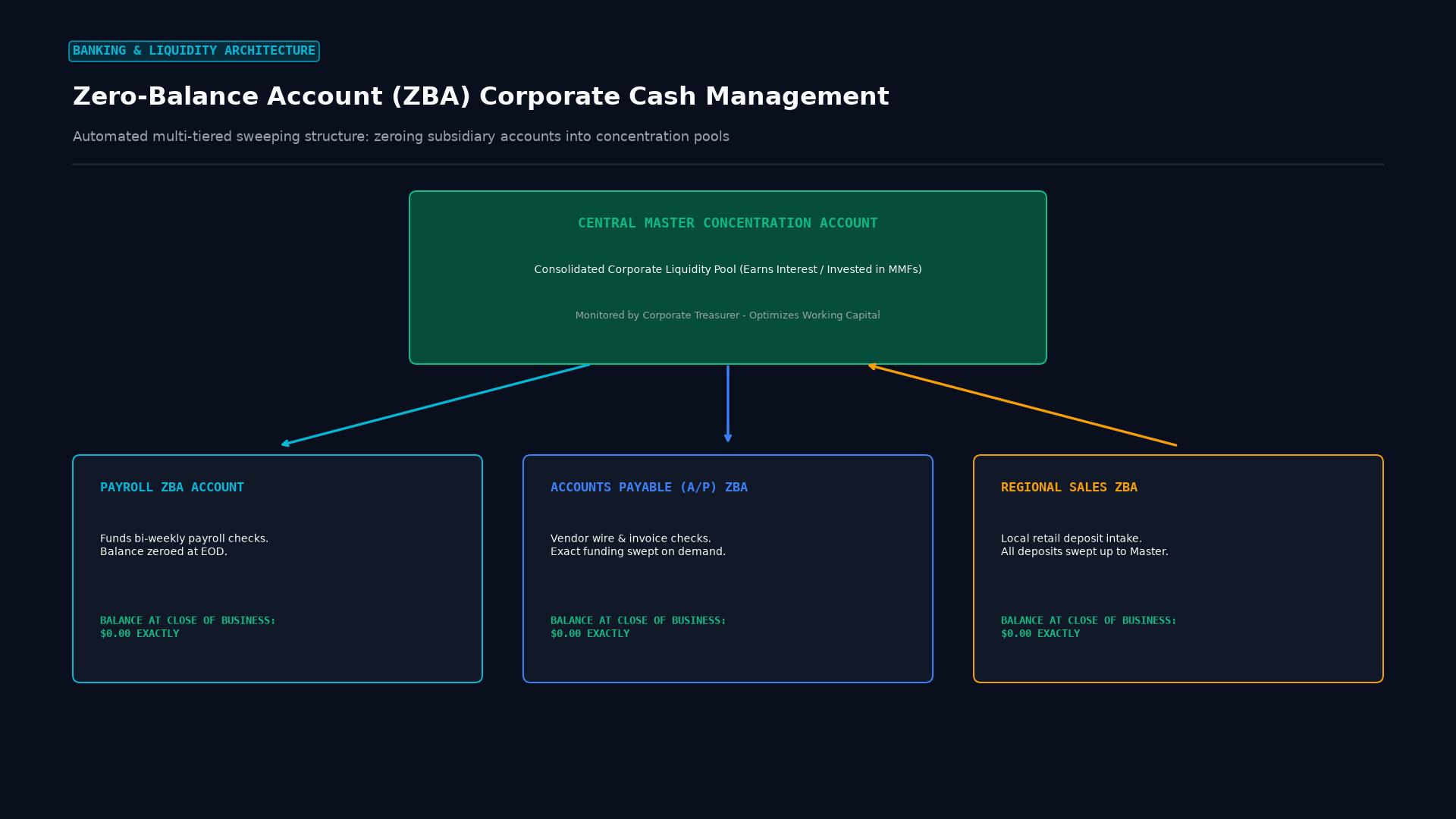 Figure: Corporate liquidity optimization: multi-tiered account sweeping where subsidiary disbursement accounts maintain a $0 balance via automatic master account sweeps.
In this architecture:
- Disbursement ZBAs: Accounts dedicated exclusively to outgoing payments (such as accounts payable, payroll, healthcare benefit claims, or dividend distributions). These accounts start the day at $0.00, process outgoing debits, and are funded from the master account at day-end reconciliation.
- Collection ZBAs: Accounts set up to collect customer deposits across regional business units or retail store locations. Funds deposited into these accounts are swept into the master account at the close of business, restoring the collection account to $0.00.
- Master Concentration Account: The centralized repository where corporate cash is held, monitored, and deployed into short-term yield instruments (such as repurchase agreements, commercial paper, or money market funds).
Daily Operational Lifecycle and Settlement Workflow
The operational management of a ZBA relies on automated two-way bank clearing protocols that execute across three distinct daily phases:
[Phase 1: Intraday Processing]
Cheques and ACH debits are presented against the ZBA throughout the day.
The ZBA ledger balance turns negative intraday (provisional ledger debit).
                    │
                    ▼
[Phase 2: End-of-Day Settlement Calculation]
The bank core clearing system tallies total debits and credits on the ZBA.
Net funding requirement = Total Debits - Total Credits.
                    │
                    ▼
[Phase 3: Automated Ledger Sweep Execution]
The exact net requirement is transferred from the Master Account to the ZBA.
Closing Balance of ZBA returns precisely to $0.00.
                    │
                    ▼
[Phase 4: Surplus Cash Deployment]
Remaining consolidated liquidity in Master Account is swept to overnight yield.- Intraday Presentation: Throughout the banking day, incoming settlement files arrive via Fedwire, ACH, or check clearing networks. Checks and debits are accepted and cleared against the specific ZBA account number. The intraday ledger shows a temporary negative balance covered by daylight overdraft lines agreed between the corporation and the bank.
- Batch Netting: After transaction clearing cut-off times, the bank’s core accounting system calculates the net funding deficit or surplus for each subsidiary ZBA.
- Automated Zero-Balance Transfer: The bank executes an internal book transfer. If the Payroll ZBA processed $1,425,500 in direct deposits, exactly $1,425,500 is debited from the master concentration account and credited to the Payroll ZBA.
- Final Reconciliation: The ZBA ledger closes the day at $0.00. The corporate treasury workstation receives an automated MT940 or BAI2 bank statement reporting all transaction items and confirming zero closing balances.
Strategic Advantages of Zero Balance Accounts
Corporate treasury teams implement ZBA networks to capture critical financial, administrative, and risk-mitigation benefits:
1. Elimination of Idle Cash Balances
Without a ZBA structure, decentralized operating entities must maintain buffer balances in individual checking accounts to avoid overdraft fees. In an enterprise with 50 operational subsidiaries holding a precautionary buffer of $100,000 each, $5,000,000 of corporate capital sits trapped in non-interest-bearing demand accounts. With ZBAs, this capital remains consolidated in the master account, earning overnight investment yields or reducing commercial paper borrowing.
2. Enhanced Fraud Prevention and Segregation of Duties
By isolating financial workflows into distinct accounts (such as one ZBA strictly for corporate payroll and another for freight logistics), corporate treasuries restrict exposure. If a fraudulent check is forged against the payroll ZBA, the bank’s fraud detection system flags unauthorized corporate payments instantly. Likewise, authorized check signers on the accounts payable ZBA have zero access or signatory power over central treasury assets.
3. Protection Against Overdraft Penalties
Because transfers from the master account occur programmatically, subsidiary accounts never experience returned checks or nonsufficient funds (NSF) charges, maintaining excellent credit relationships with commercial vendors and employees.
4. Administrative Simplicity and Audit Trails
Manual wire transfers between corporate accounts are completely eliminated. Every dollar transferred corresponds exactly to clearing items, creating an immutable audit trail for external auditors and internal compliance teams.
Comparative Analysis: ZBA vs. Alternative Cash Structures
Treasury departments choose among several liquidity structures depending on multi-entity regulations, currency regimes, and tax jurisdictions.
| Dimension / Feature | Zero Balance Account (ZBA) | Target Balance Account (TBA) | Notional Pooling | Controlled Disbursement Account (CDA) |
|---|---|---|---|---|
| Ending Account Balance | Exactly $0.00 every day | Pre-agreed target (e.g., $10,000) | Retains distinct positive/negative balances | Typically $0.00 (specialized for checks) |
| Physical Cash Transfer | Yes (automatic bank book transfer) | Yes (funds swept above/below target) | No physical movement (interest calculated on net) | Yes (funded daily based on early morning notifications) |
| Primary Objective | Complete cash centralization | Maintenance of required compensating balances | Multi-entity interest optimization without intercompany loans | Early notification of daily check clearing amounts |
| Intercompany Loan Creation | Creates legal intercompany loan entries | Creates legal intercompany loan entries | Avoids intercompany debt creation in many jurisdictions | Creates legal intercompany loan entries |
| Regulatory Complexity | Low across domestic bank networks | Low across domestic bank networks | High (restricted in the US, Germany, Japan) | Low (primarily used within US check clearing) |
Practical Corporate Case Study: Manufacturing Enterprise
A multinational manufacturing firm operates four regional divisions across North America: Division North, South, East, and West. Each division issues approximately $2,000,000 in monthly vendor payments and $1,500,000 in bi-weekly payroll checks.
Pre-ZBA Decentralized Model:
- Each division maintained two separate commercial bank accounts (one AP, one Payroll).
- To safeguard against unexpected vendor presentations, each division kept a permanent safety cushion of $300,000 per account across 8 accounts: $$\text{Total Trapped Cash} = 8 \times $300,000 = $2,400,000$$
- This $2.4 million remained idle in non-interest-bearing checking accounts. The company concurrently drew $2,000,000 on its revolving credit line at an interest rate of 6.50% to fund raw material purchases.
- Annual Line-of-Credit Interest Cost: $$2,000,000 \times 6.50% = $130,000$.
Post-ZBA Centralized Implementation:
- The corporate treasurer transitions all eight divisional accounts into Zero Balance Accounts linked to a single Master Treasury Concentration Account.
- Precautionary buffers are removed entirely, freeing the $2,400,000 in trapped capital.
- The company immediately pays down its $2,000,000 revolving credit facility, saving $130,000 annually in interest expense.
- The remaining $400,000 surplus is swept overnight into short-term Treasury bills yielding 5.00%, generating an additional $20,000 in annual interest income.
- Total Annual Economic Benefit: $$130,000 + $20,000 = $150,000$, achieved with zero operational disruption to payroll or vendor payments.
Frequently Asked Questions
Can an individual retail customer open a Zero Balance Account?
Zero Balance Accounts are corporate banking products designed for institutional, commercial, and government entities with high transaction volumes. While some consumer fintech accounts offer automated sweep capabilities between savings and checking balances, classical ZBA systems with automated intraday overdraft coverage and concentration netting are tailored specifically for corporate treasury cash management.
How are intercompany loans handled when using ZBAs across corporate subsidiaries?
When a master account owned by a corporate parent funds a debit for a legally distinct subsidiary through a ZBA, that transfer legally constitutes an intercompany advance or loan. Modern enterprise resource planning (ERP) systems and treasury management software (TMS) automatically record offsetting intercompany receivables and payables, applying appropriate transfer pricing interest rates to comply with tax regulations and transfer pricing rules.
What is the primary difference between a ZBA and a sweep account?
A ZBA is an account structure whose balance is strictly reset to zero at the close of every business day via physical fund transfers from a master account. A sweep account is a broader investment mechanism that monitors an account’s cash balance and automatically sweeps funds exceeding a predetermined threshold into yield-generating instruments (such as money market funds or repos) or pulls funds back when needed. A ZBA frequently utilizes a sweep mechanism to execute its daily funding transfers.
Ready to trade forex?
Open a free demo account with a regulated broker. Practice with virtual funds before risking real money.