Zero-Based Budgeting (ZBB)
A strategic budgeting methodology in which all organizational expenses must be justified and approved from a baseline of zero for each new financial period, eliminating historical spending inertia and legacy resource allocations.
What Is Zero-Based Budgeting (ZBB)?
Zero-Based Budgeting (ZBB) is a rigorous management accounting and financial planning methodology that requires every corporate expenditure, operational expense, and capital allocation to be justified from a baseline of zero ($0.00) at the start of each new budgeting period. Unlike conventional budgeting frameworks that take the prior year’s actual expenditures and apply an incremental percentage increase or decrease, ZBB treats every operational department and line item as if it were a newly formed business enterprise.
The concept was pioneered in the late 1960s by Peter Pyhrr at Texas Instruments and gained global prominence during the 1970s when Georgia Governor Jimmy Carter adopted the methodology for state government operations, later implementing it across federal agencies during his presidency. In modern corporate finance, ZBB experienced a major resurgence driven by private equity firms (most notably 3G Capital in their management of Kraft Heinz, Anheuser-Busch InBev, and Burger King), where aggressive cost rationalization unlocked substantial operating cash flows.
In a comprehensive ZBB framework, no operational cost is considered sacred or grandfathered in. Managers must demonstrate the operational necessity, direct return on investment (ROI), and strategic alignment of every salary, travel expense, software license, marketing campaign, and consulting engagement before funding is authorized.
Traditional Budgeting vs. Zero-Based Budgeting
The core conceptual divide between traditional incremental budgeting and ZBB centers on baseline assumptions regarding historical spending:
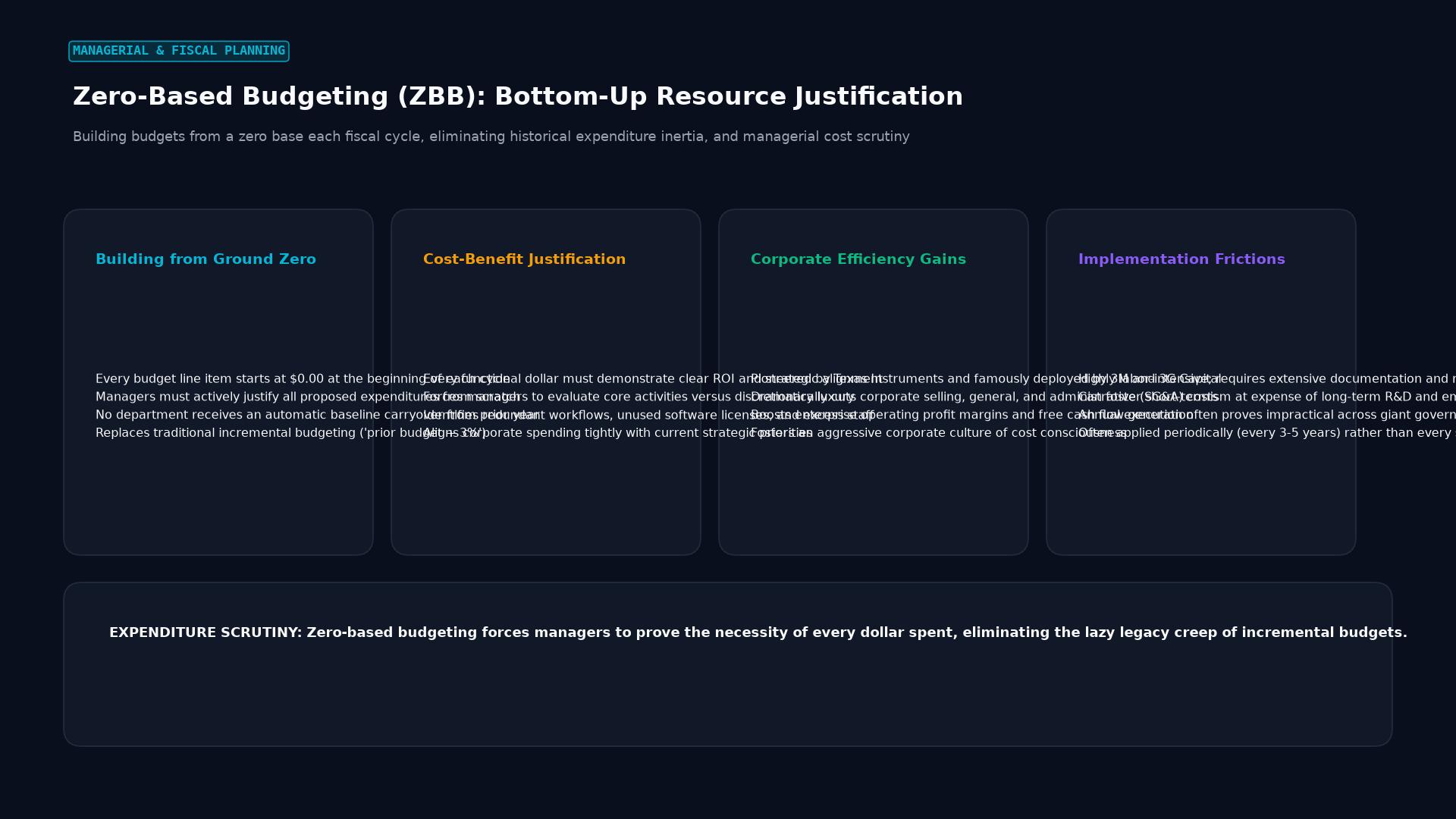 Figure: Building budgets from a zero base each fiscal cycle, eliminating historical expenditure inertia, and managerial cost scrutiny
| Operational Dimension | Traditional Incremental Budgeting | Zero-Based Budgeting (ZBB) |
|---|---|---|
| Starting Baseline | Prior period’s actual or budgeted expenditures | Exactly zero dollars ($0.00) |
| Focus of Analysis | Incremental dollar changes (variance from last year) | Total expenditure justification and operational purpose |
| Management Incentive | “Use it or lose it” mentality to protect next year’s allocation | Incentive to streamline processes and eliminate redundancies |
| Handling of Legacy Costs | Implicitly assumed necessary; rarely scrutinized | Rigorously challenged and evaluated against alternatives |
| Resource Allocation | Backward-looking, reflecting historic organizational inertia | Forward-looking, directing capital toward high-ROI priorities |
| Time and Effort | Fast, simple, and administratively inexpensive | Labor-intensive, requiring extensive cross-functional data |
The Four Stages of the ZBB Process
Implementing a zero-based budget involves a disciplined four-stage operational cycle that connects strategic corporate objectives to individual functional expenses:
  [Stage 1: Identify Decision Units]
  Deconstruct the organization into discrete functional activities or cost centers.
                    │
                    ▼
  [Stage 2: Formulate Decision Packages]
  Managers document operational objectives, costs, KPIs, and alternative delivery methods.
                    │
                    ▼
  [Stage 3: Cross-Functional Ranking & Prioritization]
  Executive leadership ranks decision packages strictly by strategic value and ROI.
                    │
                    ▼
  [Stage 4: Capital Allocation & Cut-Off Determination]
  Resources are assigned down the ranked list until available revenue/capital is exhausted.
Stage 1: Identification of Decision Units
The organization is segmented into distinct operational clusters known as decision units. A decision unit can be a geographic business unit, an IT support team, a manufacturing line, a legal compliance group, or an individual brand marketing team.
Stage 2: Formulation of Decision Packages
For each decision unit, managers build structured documents called decision packages. Each package outlines:
- The fundamental business objective of the activity.
- The minimum base level of funding required for basic operational survival (below which the function cannot legally or operationally operate).
- Incremental layers of spending that deliver additional operational benefits, service levels, or growth.
- Alternative operational delivery mechanisms (such as outsourcing, software automation, or shared services).
- The quantitative consequences to corporate revenue and risk if the package is rejected.
Stage 3: Cross-Functional Ranking
Executive leadership and corporate financial planning and analysis (FP&A) teams gather to evaluate and rank all submitted decision packages across the entire company. A ranking matrix weights packages based on regulatory compliance, risk mitigation, direct revenue generation, and strategic alignment.
Stage 4: Capital Allocation and Budget Cut-Off
Management establishes the total corporate expenditure ceiling based on projected revenue and targeted operating margins (EBITDA). Funding is assigned sequentially to decision packages in order of their rank until the financial ceiling is reached. Packages falling below the cut-off line are eliminated or deferred.
Strategic Advantages of Zero-Based Budgeting
When executed effectively, ZBB delivers substantial competitive and financial improvements:
- Elimination of Entrenched Organizational Waste: Legacy projects, unused software seats, redundant consulting arrangements, and obsolete marketing campaigns that escape review under incremental budgeting are systematically exposed and eliminated.
- Capital Redeployment to Strategic Growth Areas: ZBB is not merely an austerity exercise; it frees up trapped operational liquidity, allowing corporate leaders to redeploy millions of dollars into high-growth digital transformation, R&D innovation, and accretive M&A.
- Culture of Cost Accountability and Ownership: Department managers transition from passive administrative budget holders into active enterprise owners who must critically evaluate the cost-to-benefit ratio of every vendor and hiring decision.
- Enhanced Operational Transparency: Senior executives gain granular insight into cost drivers across global subsidiaries, identifying operational best practices and benchmark disparities between regions.
Criticisms, Risks, and Cultural Pitfalls
Despite its theoretical purity and potential for rapid cost reduction, aggressive ZBB implementation carries significant organizational risks:
- Heavy Administrative and Operational Friction: Drafting hundreds of detailed decision packages and reviewing them across cross-functional committees consumes thousands of management hours, frequently distracting leadership from day-to-day commercial execution.
- Short-Term Myopia and Underinvestment: Because operational survival packages are easy to quantify while long-term investments (such as basic R&D, brand equity advertising, employee training, and corporate culture) have intangible or delayed payoffs, aggressive ZBB often leads to deep cuts in capabilities that sustain long-term enterprise value.
- Cultural Strain and Talent Attrition: Extreme zero-based regimes can create demoralizing corporate environments characterized by micromanagement (such as policing office supplies or travel allowances), leading to high employee turnover and burnout among high-performing personnel.
- Gaming the System: Savvy department heads often learn to manipulate decision packages, packaging popular or essential services together with pet discretionary projects to force committee approval.
Practical Case Study: Global Consumer Goods Turnaround
A consumer packaged goods (CPG) conglomerate with $5,000,000,000 in global revenues faced declining operating margins (falling from 18% to 12%) due to rising raw material inflation and decentralized overhead costs. The board replaced the management team and mandated a comprehensive Zero-Based Budgeting restructuring across all non-manufacturing operational expenditures (SG&A).
The ZBB Intervention:
- Scope: The company applied ZBB to $800,000,000 of indirect operational spending across marketing, travel and entertainment (T&E), IT infrastructure, and facilities.
- Findings from Decision Packages:
- Software Licensing: The enterprise was paying for 12,000 enterprise software licenses, but audit data revealed only 6,500 active monthly users, wasting $8,000,000 annually.
- Marketing Agencies: Regional marketing units were employing 45 separate creative agencies globally with massive duplication of creative assets.
- Travel & Entertainment: Internal corporate meetings accounted for 35% of all commercial flight expenses.
- Restructuring Actions:
- Consolidated global marketing into two primary agency networks, cutting external agency fees by $45,000,000.
- Enacted mandatory virtual meetings for internal cross-functional reviews, reducing annual travel expenditure by $25,000,000.
- Re-negotiated and right-sized software contracts, saving $12,000,000.
- Results:
- The company excised $160,000,000 in recurring annual overhead costs (a 20% reduction in indirect SG&A).
- Re-invested $60,000,000 of the savings into direct-to-consumer e-commerce infrastructure and digital advertising.
- Operating margin rebounded from 12% to 17% within 24 months, generating $250,000,000 in incremental free cash flow.
Frequently Asked Questions
Is Zero-Based Budgeting applied to every department every year?
In practice, full enterprise-wide ZBB is rarely executed annually because of its extensive administrative burden. Many modern corporations adopt a rolling ZBB model, subjecting one or two functional areas (such as procurement or IT) to comprehensive zero-based reviews each year on a rotating three-year cycle, while maintaining streamlined budgeting frameworks for the remaining operations.
How does Zero-Based Budgeting differ from Activity-Based Budgeting (ABB)?
While both frameworks reject traditional incrementalism, they approach allocation differently. ZBB focuses on evaluating the justification, strategic necessity, and alternative delivery models of entire functional activities from zero. Activity-Based Budgeting (ABB) uses activity-based costing (ABC) data to determine the precise volume of activities required to produce targeted outputs (such as the number of customer service inquiries expected) and calculates the exact resource inputs needed based on cost-per-activity metrics.
Can government and non-profit institutions use Zero-Based Budgeting?
Yes. Governments and non-profit institutions frequently employ ZBB to evaluate public programs and grant distributions. In the public sector, ZBB forces agencies to prove that continuing a legacy social or administrative program yields measurable societal benefits compared to emerging public priorities, preventing obsolete bureaucratic divisions from consuming tax revenues indefinitely.
Ready to trade forex?
Open a free demo account with a regulated broker. Practice with virtual funds before risking real money.