Zero-Floor Limit
A payment card processing rule where the floor limit is set to zero, requiring merchants to obtain electronic real-time authorization from the card issuer for every single transaction regardless of transaction value.
What Is a Zero-Floor Limit?
A zero-floor limit is a payment card processing security standard enforced by major payment networks (such as Visa, Mastercard, American Express, and Discover) and merchant acquiring banks. Under a zero-floor limit rule, the threshold below which a merchant is permitted to accept a card transaction without prior authorization is set to exactly zero dollars ($0.00).
Consequently, every single payment card transaction, whether for a $0.50 digital micropayment or a $5,000 luxury purchase, must be transmitted electronically across the card payment network to obtain an instantaneous real-time authorization approval from the card-issuing bank before the merchant can complete the sale.
In contemporary global commerce, zero-floor limits are universal across all e-commerce (Card-Not-Present) transactions, cross-border payments, contactless mobile wallets, and high-risk retail merchant categories. By requiring authorization for every transaction, card payment networks have virtually eradicated offline counterfeit card fraud and unauthorized overdrafts.
Historical Context: From Paper Bulletins to Real-Time Networks
To appreciate the significance of the zero-floor limit, one must examine the operational history of payment card acceptance:
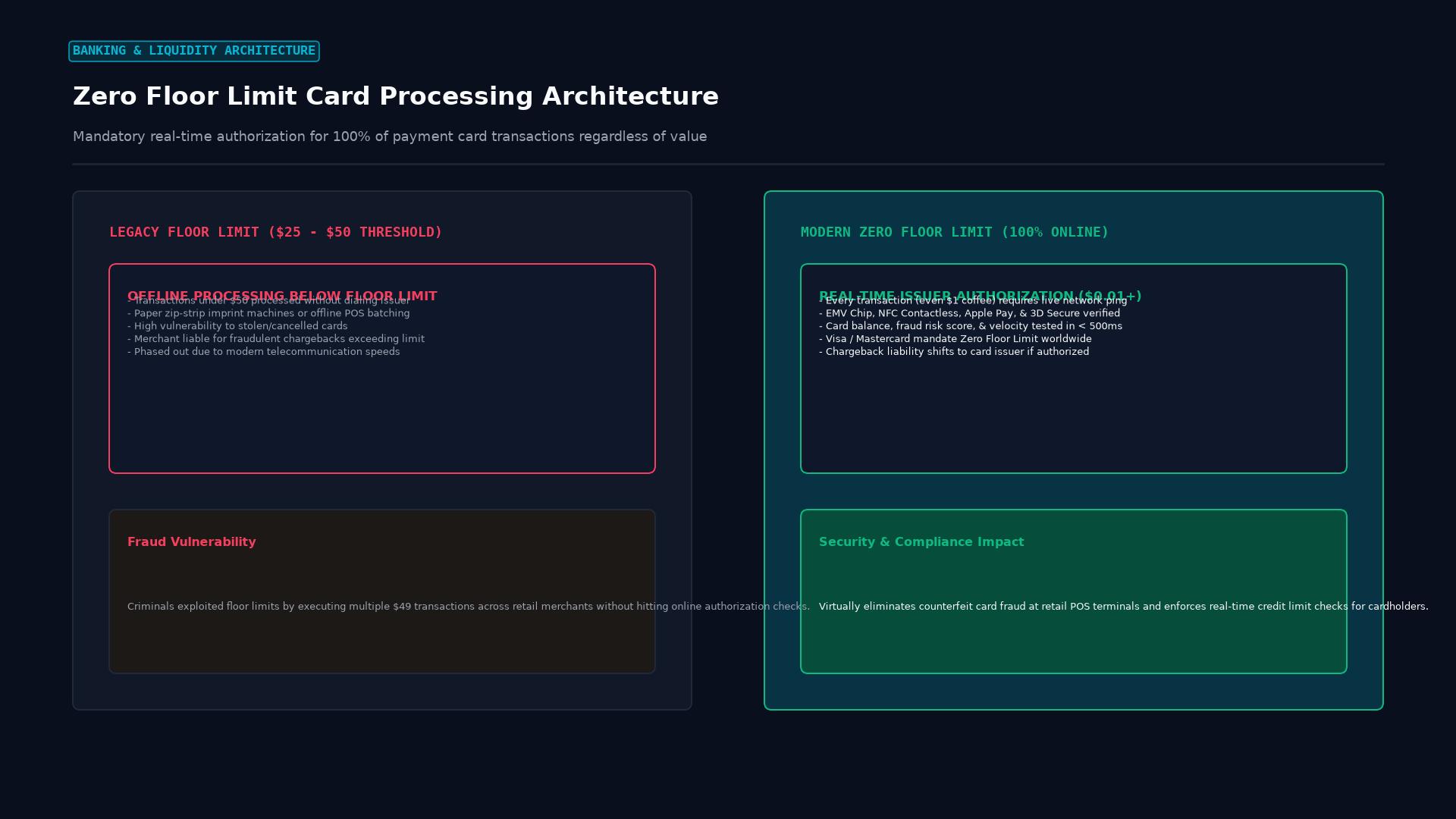 Figure: Payment security standard: elimination of offline floor limits in favor of mandatory 100% online real-time cardholder authorization for all payment amounts.
During the non-zero floor limit era, criminals engaged in split ticketing, a fraud technique where a stolen card was used to make multiple consecutive purchases (e.g., four $20 purchases at the same store) to remain below the $25 floor limit, circumventing telephone verification. Setting the floor limit to zero closed this systemic vulnerability.
The Real-Time Authorization Workflow
Under a zero-floor limit, every card swipe, chip insertion, contactless tap, or online checkout initiates an automated four-party authorization sequence that completes in milliseconds:
                     ZERO-FLOOR LIMIT AUTHORIZATION SEQUENCE

 [Customer at POS / Web]
            │
            ▼
     [Merchant POS] ──────► Transmits Card Data + Transaction Amount ($12.50)
            │
            ▼
    [Acquiring Bank / Gateway] ──► Encrypts and routes message to network
            │
            ▼
    [Payment Network: Visa / MC] ──► Validates security tokens, routes to Issuer
            │
            ▼
     [Issuing Bank] ──────► 1. Checks available credit / account balance
                            2. Evaluates fraud risk score & EMV cryptogram
                            3. Generates 6-digit Approval Code
            │
            ▼
    [Return Path: Network ──► Acquirer ──► Merchant POS]
            │
            ▼
[Transaction Approved] ──► Receipt printed / Order finalized (<500 ms)- Transaction Request: The customer presents a card or mobile wallet at a point-of-sale (POS) terminal for $4.25. Because the floor limit is $0.00, the terminal cannot approve the transaction offline.
- Network Routing: The POS encrypts the cardholder data and transmits an authorization request through the merchant’s acquiring bank and payment processor.
- Issuer Evaluation: The payment network (such as Mastercard or Visa) routes the request to the card-issuing bank. The issuer’s core processing system checks:
- Does the account have sufficient funds or available credit?
- Is the card reported lost, stolen, or expired?
- Does the dynamic EMV cryptogram match cryptographic expectations?
- Does behavioral AI flag the purchase as anomalous?
- Approval Response: The issuing bank generates an alphanumeric authorization code and returns the message down the pipeline. The merchant terminal logs the code and displays “Approved.”
Merchant and Institutional Implications
Enforcing a zero-floor limit introduces structural trade-offs for commercial merchants and financial institutions:
1. Shift of Financial Liability
Under payment network operating regulations, if a merchant completes a transaction without obtaining valid issuer authorization, the merchant bears 100% financial liability if the charge is disputed or fraudulent. With a zero-floor limit, obtaining an electronic authorization code shifts fraudulent transaction liability to the card issuer (provided EMV chip or 3D-Secure protocols were utilized).
2. Transaction Latency and Network Resilience
Because every transaction requires real-time network connectivity, merchants become fully dependent on high-speed internet infrastructure. If a retailer’s telecommunications line drops, the terminal cannot complete transactions unless configured with temporary offline fallback permissions (store-and-forward mode), which exposes the merchant to unpaid charge risk.
3. Authorization Fee Economics
Merchant acquiring contracts often include an authorization fee (typically $0.05 to $0.15 per attempt) regardless of whether the transaction is approved or declined. In high-frequency, low-ticket businesses (such as vending machines or automated parking gates), authorization fees represent a meaningful percentage of gross operating revenue.
Exceptions to the Rule: Specialized Offline Environments
While zero-floor limits are the global default, specific micro-environments require exceptions where real-time electronic communication is technically impossible or causes unacceptable delay:
| Operational Environment | Authorization Mechanism | Rationale for Bypassing Zero-Floor Limit |
|---|---|---|
| Mass Transit Turnstiles | Offline EMV Data Authentication (ODA) | Turnstiles must process passenger taps in under 300 milliseconds. Terminals verify chip authenticity offline and submit clearing batches post-commute. |
| In-Flight Cabin Sales | Store-and-Forward (SaF) Batching | Commercial aircraft without satellite broadband store passenger transactions securely and upload authorization batches upon landing. |
| Maritime Cruise Vessels | Onboard Offline Accounting | Deep-sea passenger ships process onboard charges offline against internal ship cards, settling against external credit cards during port connectivity windows. |
| Remote Highway Toll Booths | Pre-authorized Micro-caps | Remote toll plazas without redundant cellular links authenticate card tokens offline up to statutory low-value caps ($15 to $30). |
In all offline exception cases, the merchant or transit operator absorbs the residual credit risk if a passenger’s card is later declined when submitted for clearing.
Frequently Asked Questions
What happens if a merchant terminal loses internet connectivity under a zero-floor limit?
If internet connectivity is lost, modern POS terminals configured with a strict zero-floor limit will display an error message and refuse to process payments. Some merchant systems can be switched manually into “offline mode” (store-and-forward), where the terminal accepts card details and queues them for processing once connectivity is restored. However, if any of those queued cards are expired, over-limit, or stolen, the merchant bears full financial loss for the uncollectible sales.
Why do unattended vending machines require a zero-floor limit?
Unattended kiosks and vending machines are prime targets for automated fraud testing, where criminals run thousands of stolen card numbers to see which cards are active. Enforcing a zero-floor limit ensures that every purchase attempt is authorized in real time, preventing automated card-testing fraud rings from exploiting unattended hardware.
How does a zero-floor limit affect debit card cardholders?
For consumers, a zero-floor limit provides immediate financial protection. Because every debit card transaction requires real-time balance verification, funds are deducted or placed on hold instantly. This prevents the cardholder from accidentally overdrawing their checking account and incurring bank overdraft fees through delayed offline transaction postings.
Ready to trade forex?
Open a free demo account with a regulated broker. Practice with virtual funds before risking real money.