Zero-Prepayment Assumption
A baseline benchmark in mortgage-backed security cash flow modeling that assumes borrowers make only contractual scheduled amortization payments with zero unscheduled prepayments over the entire loan life, establishing the maximum extension risk profile.
What Is the Zero-Prepayment Assumption?
The zero-prepayment assumption, commonly designated in structured finance as 0% CPR (Constant Prepayment Rate) or 0% PSA (Public Securities Association benchmark), is a baseline quantitative modeling scenario used by fixed-income analysts to project cash flows for mortgage-backed securities (MBS) and collateralized mortgage obligations (CMOs).
Under the zero-prepayment assumption, it is postulated that no homeowner or commercial borrower in the underlying collateral pool will ever prepay any portion of their mortgage debt ahead of schedule. Borrowers are assumed to make only their exact monthly contractual principal and interest payments, without refinancing, selling the mortgaged property, or making partial curtailments until final contractual maturity (e.g., 30 full years).
In reality, an empirical prepayment rate of zero never occurs across a diversified mortgage pool, as demographic events (divorce, job relocation, death) and property sales continually generate baseline prepayments. However, structured finance desks utilize the zero-prepayment assumption as a vital analytical benchmark to establish the maximum extension boundary, calculate the theoretical upper limit of a bond’s weighted average life (WAL), and stress-test the structural integrity of subordinate and derivative tranches.
The PSA Prepayment Benchmark Context
To contextualize the zero-prepayment assumption, one must understand how Wall Street models mortgage prepayment speeds through the standard PSA Prepayment Model (established by the Public Securities Association, now SIFMA):
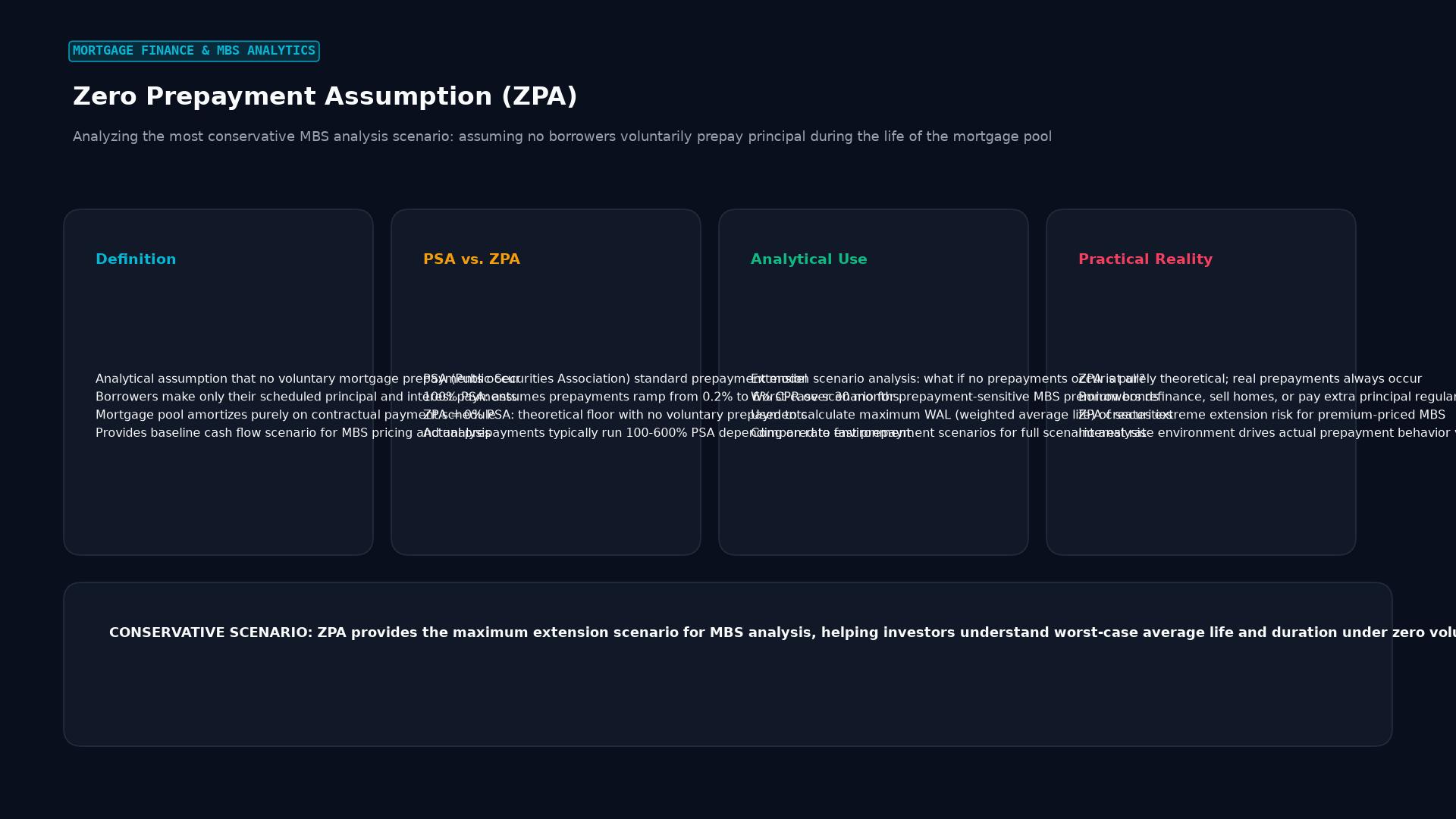 Figure: Analyzing the most conservative MBS analysis scenario: assuming no borrowers voluntarily prepay principal during the life of the mortgage pool
The Standard PSA Benchmark (100% PSA):
The baseline 100% PSA convention assumes:
- Prepayments begin at an annualized CPR of 0.2% in Month 1 of loan origination.
- CPR increases by 0.2% each consecutive month as the loan pool matures (seasoning).
- At Month 30, the prepayment rate reaches 6.0% CPR and remains constant at 6.0% for the remaining 330 months of a 30-year mortgage pool.
The Zero-Prepayment Baseline (0% PSA / 0% CPR):
In contrast, the zero-prepayment model assumes the prepayment rate is identically equal to zero throughout the entire 360-month lifecycle ($CPR_t = 0$ for all $t$). Cash flows are dictated entirely by the standard mathematical amortization formula of the host mortgages.
Cash Flow and Amortization Dynamics
When prepayments are modeled at zero, the cash flow distribution across a mortgage pool shifts radically into the distant future:
            MORTGAGE POOL PRINCIPAL RUNOFF PROFILES (30-YEAR LOAN)

   Remaining Balance ($)
         ▲
    $100M├─────────────\
         │              \   [0% PSA: Zero Prepayments]
         │               \  Slow, concave amortization path
     $50M│                \
         │                 \    [100% PSA: Normal Prepayments]
         │                  \   Moderate convex runoff path
         │                   \
      $0M└────────────────────\────────────────────────────────► Time (Years)
         0         5          10         15         20         25         30
Under normal market conditions (100% to 200% PSA), a 30-year fixed-rate mortgage pool experiences substantial unscheduled principal liquidations, reducing the pool’s effective Weighted Average Life (WAL) from 30 years down to approximately 6 to 9 years.
Under the zero-prepayment assumption, the absence of early principal returns stretches the pool’s WAL to its theoretical maximum of approximately 18 to 22 years. Cash flows during the first decade consist overwhelmingly of interest, with minimal principal repayment until the later years of the amortization curve.
Institutional Analytical Applications
Fixed-income quantitative analysts and risk managers rely on the zero-prepayment assumption for three specialized institutional functions:
1. Quantifying Maximum Extension Risk
When interest rates rise aggressively (as in 2022-2023), mortgage refinancing activity collapses, pushing prepayment speeds near zero. Portfolio managers must know the worst-case scenario: how long will the bond remain outstanding, and how far will its duration extend if prepayments completely vanish? Modeling at 0% PSA establishes the hard outer ceiling for duration and price sensitivity.
2. Conservative Pricing of Discount MBS
When an investor purchases an agency or non-agency mortgage bond trading at a steep discount to par (for example, at 75 cents on the dollar), rapid prepayments generate high returns because prepaid principal is redeemed at 100 cents (full par).
To ensure conservative underwriting, institutional investors compute the bond’s yield-to-maturity (YTM) under a zero-prepayment assumption. If the bond’s yield remains attractive even assuming zero prepayments, any future unscheduled prepayment provides an immediate bonus return.
3. Stress-Testing Structured CMO Tranches
Collateralized mortgage obligations divide pool cash flows into complex prioritized classes:
- Planned Amortization Class (PAC) Tranches: Protected by upper and lower prepayment collars (e.g., 80% to 300% PSA). Modeling at 0% PSA tests whether the PAC tranche experiences a structural payment break when support tranches fail to provide protection.
- Principal-Only (PO) Strips: PO investors purchase principal cash flows at a steep discount. At 0% PSA, PO cash flows are deferred for decades, causing the market value of PO strips to collapse.
- Interest-Only (IO) Strips: IO investors receive monthly interest on the outstanding pool balance. At 0% PSA, the collateral balance declines at the slowest possible rate, maximizing total dollar interest collections and delivering peak returns for IO holders.
Comparative Cash Flow Analysis: Impact on CMO Structures
The behavior of different mortgage securities under varying prepayment scenarios illustrates why the 0% PSA stress test is essential:
| Security / Tranche Type | 0% PSA (Zero Prepayment) | 100% PSA (Base Case) | 300% PSA (Fast Refinancing) |
|---|---|---|---|
| Pass-Through 30-Year Pool | WAL ~19.5 Years; Max Duration | WAL ~7.2 Years; Moderate Duration | WAL ~3.1 Years; Short Duration |
| Sequential Tranche A (Front) | WAL extends significantly | Retires in 2 to 3 years | Retires in under 12 months |
| Z-Tranche (Accretion Bond) | Accretion phase extends for decades; extreme price drop | Normal accretion; cash payout begins at Year 8 | Accretion ends early; rapid cash payout |
| Principal-Only (PO) Strip | Minimum possible yield; severe capital impairment | Expected baseline yield | Maximum possible yield; massive capital gain |
| Interest-Only (IO) Strip | Maximum possible yield; total cash flow maximized | Expected baseline yield | Minimum yield; potential capital loss |
Practical Limitations and Modeling Realities
While mathematically essential for stress-testing, treating the zero-prepayment assumption as a realistic forecasting tool is flawed:
- Baseline Demographic Inevitability: Even in periods of historic interest rate surges where refinancing is economically irrational, approximately 2% to 4% of homeowners prepay their mortgages annually due to mandatory relocations, divorce, probate sales, or insurance casualty settlements (known as the demographic baseline turnover).
- Default and Foreclosure Interventions: In non-agency residential MBS, financially distressed borrowers who default are liquidated through foreclosure or short sales. These property liquidations return principal to the mortgage pool, functioning economically as involuntary prepayments. Consequently, realized principal cash flows rarely drop to absolute zero.
Frequently Asked Questions
Why do fixed-income analysts run models at 0% PSA if real-world prepayments never hit zero?
Analysts use 0% PSA as a stress test to determine a bond’s theoretical maximum risk boundaries. By modeling cash flows at zero prepayments, an institutional portfolio manager identifies the maximum possible duration, the longest possible weighted average life, and the minimum expected yield for bonds purchased at a discount, ensuring the fund can survive extreme macroeconomic shifts.
Which mortgage security performs best under a zero-prepayment assumption?
An Interest-Only (IO) strip performs best under a zero-prepayment assumption. Because IO holders collect interest based on the remaining unpaid principal balance of the collateral pool, zero prepayments keep the principal balance high for the longest possible duration, maximizing cumulative interest distributions to the investor.
What is the difference between 0% CPR and 0% PSA?
Both represent a zero-prepayment environment. Constant Prepayment Rate (CPR) is an annualized percentage rate measuring the proportion of outstanding principal prepaid in a given period. The PSA model is a standardized prepayment benchmark curve that scales CPR over time. A 0% CPR and a 0% PSA yield the identical result: exactly zero unscheduled principal prepayments.
Ready to trade forex?
Open a free demo account with a regulated broker. Practice with virtual funds before risking real money.