Forex Markets and Global Equity Markets: How They Connect
How global stock market indices like the Dow, S&P 500, Nikkei, DAX, and Hang Seng relate to currency pair movements, and how equity market flows create currency demand across economies.
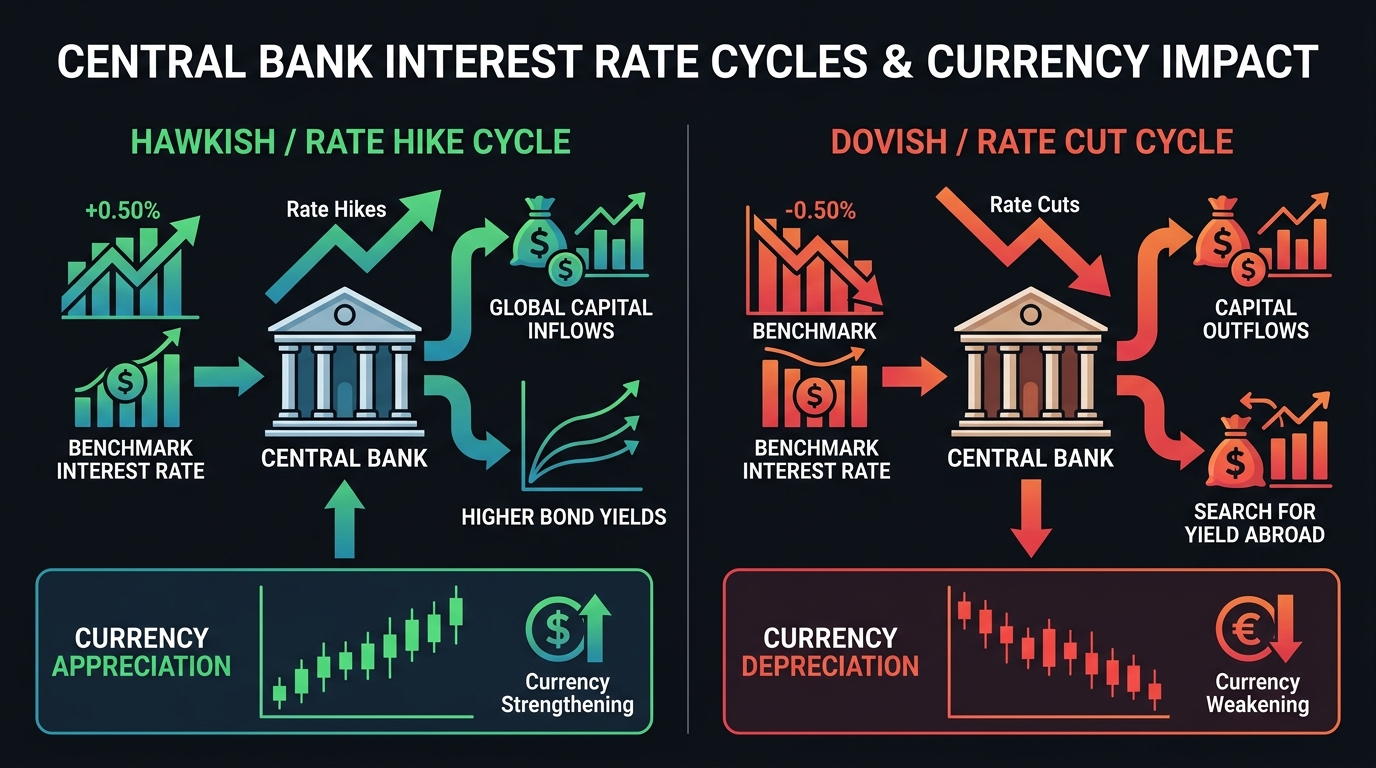
Most retail forex traders treat currency markets as a closed system. Price moves because of interest rates, CPI data, central bank statements. True enough. But experienced traders know that currency markets don’t exist in isolation. They are part of a larger financial ecosystem where equity markets, commodity prices, and bond yields all feed into each other.
Understanding the major global equity indices, and how they connect to currency flows, gives you a layer of macro context that purely technical traders simply don’t have.
Why Equity Markets Move Currencies
The mechanism is capital flows. When foreign investors want to buy equities in a particular country, they first need to acquire that country’s currency. This purchase creates demand for the local currency, pushing its exchange rate up. When those investors exit equities and repatriate capital, they sell the local currency, pushing it back down.
Consider a practical example: A European pension fund decides to increase its allocation to US equities following a strong earnings season. To buy those US stocks, it must convert euros to dollars. That conversion is a demand-side event for USD, adding upward pressure to the dollar. Multiply this by thousands of institutional participants making similar decisions, and you have a sustained currency trend driven by equity market sentiment.
This is why periods of strong global equity performance often coincide with weakness in safe-haven currencies like JPY and CHF. Risk appetite is up, capital flows into higher-yielding or growth-sensitive markets, and safe-haven demand falls.
The Major Equity Indices and Their Currency Connections
Understanding the world’s key stock indices helps you interpret cross-market signals more accurately.
Dow Jones Industrial Average (DJIA)
The Dow Jones Industrial Average, commonly called the Dow or Dow 30, tracks 30 large, publicly traded US companies. While only 30 companies, it remains one of the most widely followed global sentiment barometers because of its history (founded 1896) and its visibility in financial media.
The Dow’s composition includes companies like Apple, Goldman Sachs, Walmart, and Caterpillar. Changes are made when necessary: Boeing replaced United Technologies in 2020, for example, and Salesforce, Amgen, and Honeywell entered in the same restructuring. When the Dow rises strongly, it typically signals positive US economic sentiment, which can support USD through increased foreign investment into US assets.
S&P 500
The S&P 500 is the more comprehensive benchmark for the US stock market, tracking 500 large-cap companies across all major sectors. It’s market capitalization weighted, meaning larger companies (Apple, Microsoft, Amazon) have greater influence on the index level.
For currency traders, the S&P 500 is more relevant than the Dow as a measure of broad US market health. Sustained S&P 500 gains attract global capital into US equities, creating consistent USD demand. A rising S&P 500 alongside a falling USD, however, is a divergence worth noting: it may indicate foreign buyers of US equities who are choosing to hedge their currency exposure rather than carry it unhedged.
NASDAQ Composite
NASDAQ was founded in 1971 as the world’s first electronic stock exchange and is traditionally home to technology and growth companies. Microsoft, Apple, Alphabet (Google), Meta, and Nvidia are among its largest components. With over 3,000 actively traded companies listed today, it offers the broadest coverage of any major US index.
The NASDAQ is most relevant for currency correlation purposes during technology sector cycles. A strong NASDAQ rally driven by AI or semiconductor themes can attract specific capital flows into USD that may be more concentrated and thematic than broader S&P 500 moves.
Nikkei 225
The Nikkei 225 is Japan’s primary stock market index, tracking 225 leading companies on the Tokyo Stock Exchange. It includes major multinationals like Toyota, Sony, SoftBank, and MUFG.
The Nikkei has a particularly interesting relationship with JPY. Many large Japanese exporters (Toyota, Honda, Panasonic) benefit from a weaker yen because their overseas revenues are worth more when converted back to JPY. When the Nikkei rises significantly, particularly if driven by exporters, it’s sometimes due to or accompanied by JPY weakness rather than genuine economic optimism. USD/JPY often rises alongside the Nikkei for this reason.
DAX (Deutscher Aktienindex)
The DAX tracks 40 of the largest and most liquid companies trading on the Frankfurt Stock Exchange. Major components include BASF, Volkswagen, Siemens, and Deutsche Bank. The index was restructured in 2021 to expand from 30 to 40 components.
As Germany is the Eurozone’s largest economy, DAX performance is often used as a proxy for broader European economic health. A sustained DAX rally can support EUR through increased foreign investment into European equities. DAX weakness, particularly relative to other global indices, often signals concerns about German or broader European economic conditions and can weigh on EUR.
FTSE 100
The FTSE 100 tracks the 100 most highly capitalized companies listed on the London Stock Exchange. It’s a global index as much as a UK one: many of its largest components (Shell, HSBC, Unilever, AstraZeneca) derive the majority of their revenue outside the UK.
This international revenue exposure creates an interesting dynamic: the FTSE 100 often rises when GBP weakens, because a weaker pound makes foreign revenue worth more in sterling terms when consolidated into UK-listed company accounts. A falling GBP can therefore coincide with a rising FTSE 100, which is the opposite of the relationship you’d see in more domestically focused indices.
Hang Seng Index
The Hang Seng tracks 82 companies on the Hong Kong Stock Exchange (as of its recent expansions) and serves as the primary indicator for Chinese and broader Asian market conditions. Major components include Alibaba, Tencent, Meituan, and HSBC.
For forex traders, the Hang Seng’s movements are most relevant to AUD and NZD. Australia’s largest trading partner is China, meaning Chinese economic expansion or contraction significantly influences Australian commodity exports. A rising Hang Seng driven by Chinese growth optimism often correlates with AUD strength. A sharp Hang Seng sell-off, as occurred during Chinese regulatory crackdowns in 2021, can weaken AUD meaningfully even without a direct Australian economic driver.
BSE Sensex (India)
The BSE Sensex is India’s oldest and most recognized equity index, comprising 30 large actively traded stocks on the Bombay Stock Exchange. India’s equity market has grown significantly in global importance, and the Sensex’s performance influences INR and to some extent broader emerging market currency sentiment.
Strong Sensex performance can attract foreign portfolio investment into India, increasing demand for INR. For traders interested in USD/INR or broader emerging market currency exposure, Indian equity market trends are increasingly relevant macro context.
Putting It Together: Intermarket Analysis
The most practical application of equity-forex relationships is intermarket analysis, looking at how movements in one asset class (equities) inform likely directions in another (currencies).
A simple framework:
- Global equities rising broadly → risk-on environment → AUD, NZD, CAD tend to strengthen; JPY, CHF tend to weaken
- Global equities falling sharply → risk-off environment → JPY, CHF, USD tend to strengthen; commodity currencies weaken
- US equities rising while international equities lag → relative USD support through capital concentration in US assets
- Emerging market equities rallying → risk appetite improving in higher-beta assets → commodity currencies and EM currencies benefit
These are tendencies, not rules. They work until a new dominant driver overrides them. The 2022 period, when US equities fell sharply while USD strengthened dramatically, was an exception driven by aggressive Fed rate hikes that overrode the normal risk-off USD weakness pattern.
Key Takeaways
- Global equity markets and forex are linked through capital flows: buying foreign equities requires buying local currency first.
- The S&P 500 is the most globally influential equity benchmark for USD flows.
- The Nikkei and JPY have a unique relationship: Nikkei rallies often coincide with JPY weakness due to exporter dynamics.
- The FTSE 100 can rise as GBP weakens because of its international revenue composition.
- The Hang Seng is particularly relevant to AUD and NZD through the China-commodity linkage.
- Use equity market direction as a macro confirmation layer alongside central bank policy and technical analysis.
Continue this module: Currency Correlations With the Stock Market | What Is the US Dollar Index?

Ready to Practice This Strategy?
Test what you learned on a free, risk-free demo account before risking real money.