Political and Economic Performance as Currency Drivers
How a country's political stability and economic performance directly affect its currency value: from Zimbabwe's hyperinflation to Brexit, and how traders position around geopolitical risk.
Every currency is ultimately a proxy for confidence in the country that issues it. The yen, the dollar, the euro — these aren’t just units of account. They represent investor confidence in the stability of governments, the soundness of economic policy, and the long-term prospects of entire economies. When that confidence is high, capital flows in and the currency strengthens. When it collapses, the results can be extreme.
What Happens When Political Confidence Breaks Down
The most dramatic modern example of political risk destroying a currency is Zimbabwe. When the Zimbabwean dollar was introduced in 1980 following independence from Rhodesia, it was one of the stronger currencies in the region — trading at approximately 1.47 ZWD to 1 USD.
Less than three decades later, the same currency was worthless. Land reform programs beginning in 2000 led to the collapse of agricultural production (which had been Zimbabwe’s primary foreign exchange earner), fiscal deficits spiraling out of control, and money printing to cover government spending. By 2008-2009, Zimbabwe experienced hyperinflation exceeding 89.7 sextillion percent per month — a number essentially beyond comprehension. The government issued 100 trillion dollar notes that couldn’t buy a loaf of bread. On April 12, 2009, Zimbabwe officially abandoned its currency, switching to the US Dollar and other foreign currencies for transactions.
This is an extreme case. But the underlying dynamic — political instability leading to loss of institutional confidence, poor fiscal policy, currency devaluation, inflation, and eventual crisis — has played out in varying degrees in Argentina, Venezuela, Turkey, Lebanon, and others in recent decades.
Political Risk in Developed Markets
Political risk in developed economies is less dramatic but still moves markets meaningfully.
Brexit (2016-2019) is the clearest recent example among major currencies. When the UK voted to leave the European Union on June 24, 2016, GBP/USD fell from approximately 1.50 to below 1.32 within 24 hours — one of the largest single-day moves in cable’s modern history. The uncertainty about the UK’s future trade relationships, access to the European Single Market, and economic trajectory caused investors to reduce sterling exposure for years. GBP didn’t recover its pre-Brexit levels against EUR for several years.
Italian political crises have repeatedly pressured EUR despite Italy being a large member economy. Whenever populist governments threatened to run large budget deficits in violation of EU fiscal rules, or when there was talk of an Italian exit from the euro (“Italexit”), EUR fell and Italian government bond spreads over German bunds widened sharply.
US election cycles create periods of uncertainty that can affect USD. Markets prefer predictability. A tight election with contested results (as in 2000 and 2020) increases uncertainty and can suppress USD temporarily until the political outcome is resolved.
Japanese political stability is one reason JPY has historically been considered a safe-haven currency. Japan’s political system, despite frequent prime ministerial changes, has maintained consistent economic and monetary policy frameworks, which contributes to yen credibility.
Economic Performance and Currency Strength
Political stability creates the conditions for economic performance, but economic output itself is an independent driver of currency strength.
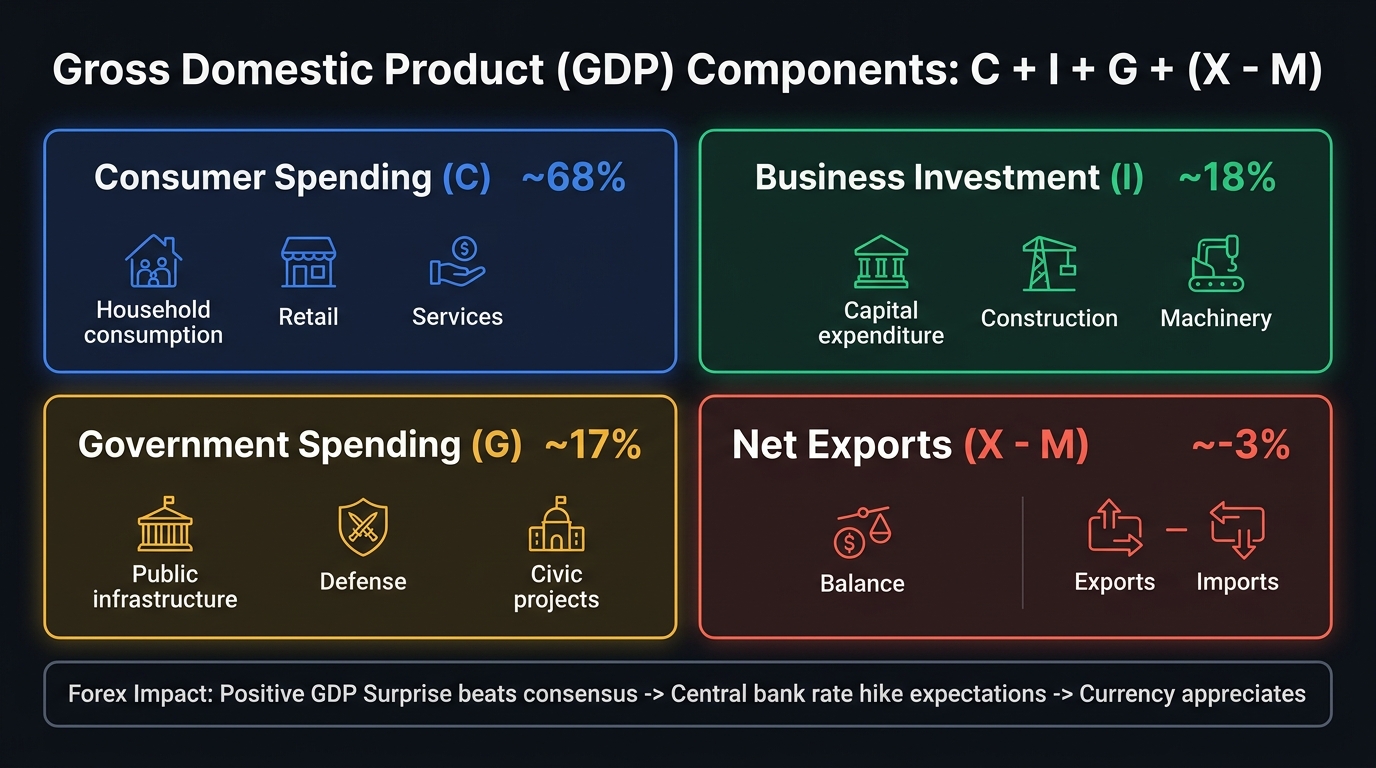
GDP growth signals that a country’s economy is expanding. More economic activity means more corporate profits, more employment, higher tax revenues, and greater investor confidence. Strong GDP growth attracts foreign direct investment and portfolio investment, both of which require purchasing the local currency.
The sequence that supports a currency:
- Strong GDP growth and employment
- Rising wages and consumer spending
- Modest inflation within central bank targets
- Central bank keeps rates stable or raises them
- Foreign investors attracted by stable/rising yields and growth prospects
- Capital inflows → currency appreciation
The sequence that weakens a currency:
- Weak GDP growth or recession
- Rising unemployment, falling consumer spending
- Deflation risk or fiscal stress
- Central bank cuts rates or implements quantitative easing
- Yield differentials favor competing currencies
- Capital outflows → currency depreciation
The Hierarchy of Market-Moving Economic Data
Not all economic data is created equal in terms of market impact. The United States occupies a special position because the US Dollar serves as the global reserve currency and is used in over 50% of international trade settlements. This means US economic data moves markets globally, even for currency pairs that don’t directly involve USD.
The rough hierarchy of economic data importance for currency markets:
- Interest rate decisions and central bank guidance — the most immediate mover
- Employment data (NFP for the US) — monthly, high impact
- Inflation data (CPI, Core PCE) — determines central bank trajectory
- GDP growth figures (quarterly) — the broadest measure of economic performance
- Trade balance — shows currency demand/supply from trade flows
- Industrial production and PMI — leading indicators of near-term growth
- Retail sales and consumer confidence — domestic demand health
- Producer price indices, wage data — inflation pressure indicators
This hierarchy shifts with market psychology. During the 2021-2022 inflation cycle, CPI data became temporarily the most market-moving release because everything else (employment was already strong; growth was recovering) depended on whether inflation was accelerating or decelerating. In recessions, employment data becomes paramount because it signals the depth and duration of the downturn.
Consumer, Business, and Government Confidence
Economic performance feeds into a virtuous or vicious cycle depending on sentiment:
Positive cycle: When consumers feel economically secure, they spend money. Rising consumer spending increases business revenues. Profitable businesses invest, hire, and expand. Government tax revenues improve, reducing deficit pressure. This cycle creates genuine economic momentum and attracts foreign capital, supporting the currency.
Negative cycle: Economic uncertainty causes consumers to save rather than spend. Falling business revenues lead to hiring freezes and layoffs. Government deficits widen as tax revenues fall and social spending rises. Investors anticipate rate cuts or fiscal problems and reduce exposure to the currency.
Consumer confidence indices (like the Conference Board Consumer Confidence Index in the US or the GfK Consumer Climate in Germany) serve as leading indicators of which direction this cycle is heading. Traders watch them as early signals before the harder economic data confirms the trend.
Government Stability and Policy Predictability
Markets don’t require perfect governments. They require predictable ones. Investors can price risk into a currency even in challenging economic environments, as long as they can forecast what policy will look like six months from now.
Sudden changes in government — through elections, coups, or referendums — introduce uncertainty that markets dislike. Even the anticipation of a close election can suppress currency strength as investors hedge against multiple possible outcomes.
Policy continuity, clear rule of law, and institutional stability (independent central banks, transparent fiscal policy) are what makes currencies like the Swiss Franc, Japanese Yen, and US Dollar trusted as safe havens even when those economies face their own challenges.
Key Takeaways
- Political stability and sound economic policy are the foundation of currency credibility.
- Extreme political instability (Zimbabwe, Venezuela) can produce hyperinflation and complete currency collapse.
- In developed markets, political risk events like Brexit or elections produce large, sometimes multi-year currency moves.
- Economic performance drives currency strength through the investment flows mechanism: growth attracts capital, which buys the local currency.
- US economic data has outsized global impact because USD is the global reserve currency.
- Markets prefer predictability over perfection; policy uncertainty creates temporary currency weakness even in otherwise healthy economies.
Continue this module: Factors That Affect Exchange Rates | Exchange Rates and Supply and Demand

Ready to Practice This Strategy?
Test what you learned on a free, risk-free demo account before risking real money.