Base premium
The fundamental actuarial charge assessed on an insurance or reinsurance contract reflecting pure expected loss frequency and severity before applying risk surcharges, policyholder discounts, or commercial expense loads.
What is Base Premium?
A base premium is the initial benchmark price calculated by an insurer or reinsurer to provide coverage for a defined class of risk before tailoring that price to the unique attributes of an individual policyholder. Derived through statistical and actuarial modeling across large historical loss databases, the base premium reflects the fundamental loss cost required to cover expected claims arising from a homogeneous pool of insured entities.
In property and casualty (P&C) underwriting, life insurance, and corporate risk management, the base premium forms the foundation of commercial rate manuals. Once the base premium is determined for a given classification territory or asset type, underwriters apply multiplying factors, including geographic modifiers, experience modification ratings (EMR), safety credits, and deductible adjustments, to compute the final written premium billed to the insured.
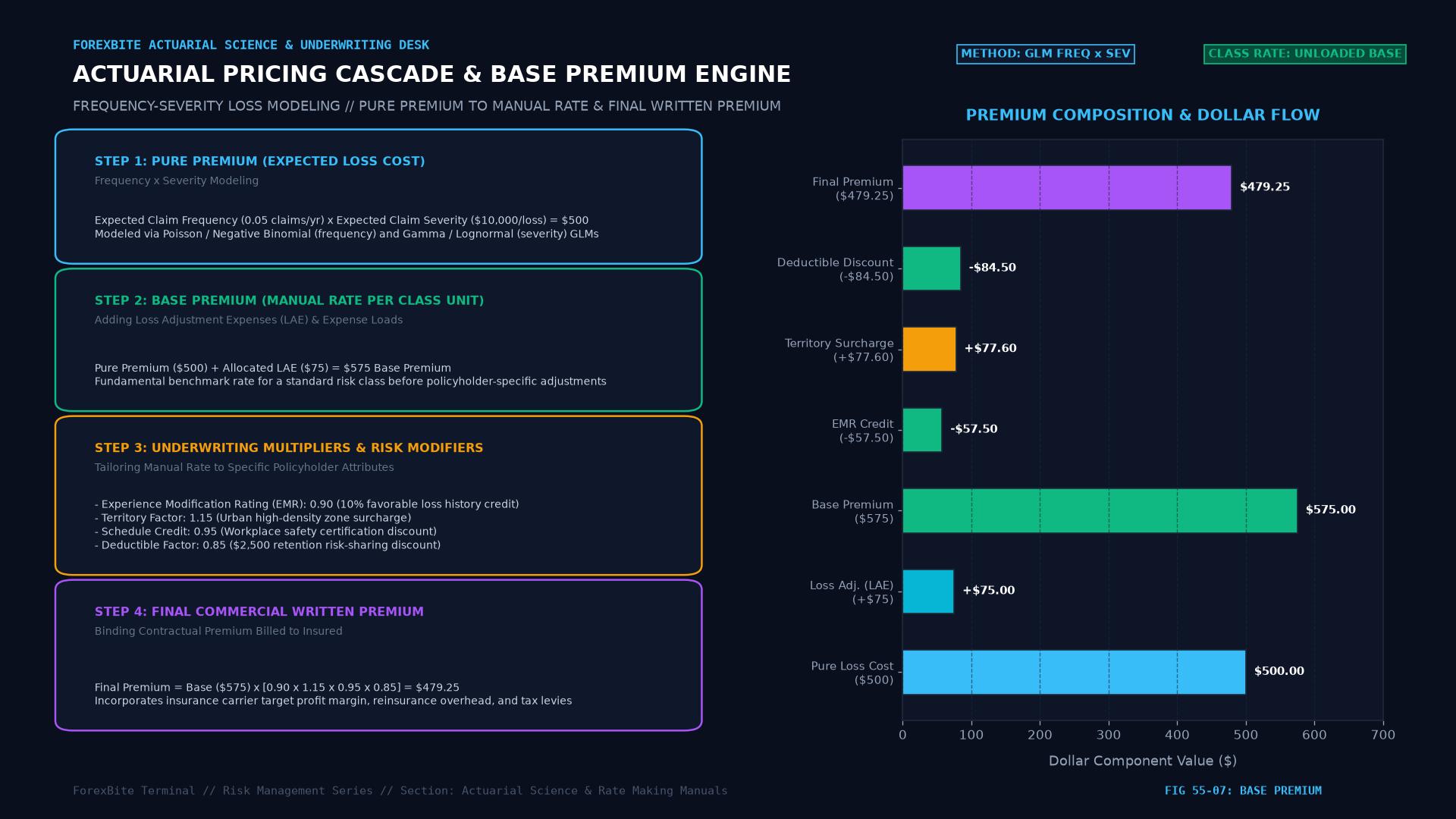 Figure: The actuarial pricing cascade from pure premium (frequency × severity) and loss adjustment expenses (LAE) to base manual rates and final written premium.
Actuarial Derivation: The Pure Premium Foundation
Actuaries employ historical claims data, generalized linear models (GLMs), and credibility theory to construct the base premium. The mathematical starting point is the pure premium:
$$\text{Pure Premium} = \text{Expected Frequency} \times \text{Expected Severity}$$
Where:
- Expected Frequency: The probability that a claim occurs per unit of exposure (e.g., claims per vehicle-year or per $1,000 of payroll).
- Expected Severity: The average dollar payout of a claim once incurred, including indemnity and legal defense costs.
To convert pure loss costs into a functional base premium rate, actuaries add an allowance for Allocated Loss Adjustment Expenses (ALAE), representing direct legal, medical, and investigative expenses incurred while resolving claims:
$$\text{Base Premium Rate} = \frac{\text{Pure Premium} + \text{ALAE}}{1.0 - \text{Target Expense Loading Ratio} - \text{Target Underwriting Profit Ratio}}$$
If an actuarial review of 100,000 commercial delivery vans projects 2,500 accidents per year (frequency = 0.025) with an average claim cost of $12,000 (severity = $12,000):
- Pure Premium: $0.025 \times $12,000 = $300$ per vehicle.
- Assuming an administrative expense load of 25% and a target underwriting profit margin of 5%:
- $\text{Base Premium} = \frac{$300}{1.0 - 0.25 - 0.05} = \frac{$300}{0.70} = $428.57$ per commercial van.
Underwriting Modification Factors
The base premium applies to an average risk within an actuarial class. In practice, no corporate client or policyholder is precisely average. Underwriters transform the base manual premium into an individualized price through structural modifiers:
+------------------------------------+------------------------------------+
| Modifier Category                  | Commercial Pricing Function        |
+------------------------------------+------------------------------------+
| Experience Modification Rate (EMR) | Compares past three-year claims of |
|                                    | a firm against the industry mean.  |
|                                    | EMR > 1.0 surcharges base rate;    |
|                                    | EMR < 1.0 grants premium discounts.|
|                                    |                                    |
| Territorial Rating Factors         | Adjusts base rates for regional    |
|                                    | litigation climate, hail risks, or |
|                                    | urban traffic congestion patterns. |
|                                    |                                    |
| Schedule Rating Credits            | Underwriter adjustments for safety |
|                                    | protocols, telematics monitoring,  |
|                                    | or on-site security guards.        |
+------------------------------------+------------------------------------+
The mathematical relationship follows a multiplicative rating algorithm:
$$\text{Final Premium} = \text{Base Premium} \times \text{Territorial Factor} \times \text{EMR} \times (1.0 - \text{Schedule Credits}) \times \text{Deductible Factor}$$
If a logistics fleet operates in an area with a 1.20 territorial risk factor, maintains an exemplary safety record yielding an EMR of 0.85, earns a 10% credit for telematics speed limiters, and chooses a higher deductible reducing the rate by 15%:
$$\text{Multiplier} = 1.20 \times 0.85 \times (1.0 - 0.10) \times (1.0 - 0.15) = 1.20 \times 0.85 \times 0.90 \times 0.85 = 0.7803$$
$$\text{Final Rate per Van} = $428.57 \times 0.7803 = $334.41$$
Reinsurance Applications: Subject Premium and Burning Cost
In treaty reinsurance, global reinsurers (such as Swiss Re or Munich Re) contract to absorb catastrophic excess losses from primary insurance companies. Reinsurance contracts anchor their fee calculations to the primary insurer subject premium, which represents the aggregate base premium collected across the reinsured book of business.
Reinsurers structure treaties using two principal methods:
- Flat Rate Reinsurance: The primary carrier remits an agreed fixed percentage of its gross base subject premium to the reinsurer in exchange for quota-share coverage.
- Burning Cost Pricing: In excess-of-loss treaties, the reinsurer calculates pure historical burning cost, which is the historical ratio of excess claims to the primary base subject premium over a 5 to 10 year lookback window. The base reinsurance premium rate is derived by loading the burning cost with a catastrophe loading factor and an administrative expense margin.
Insurer Solvency and The Combined Ratio
Base premium rates directly influence insurer capital adequacy and profitability. Insurance regulators, such as state insurance commissioners in the United States and the European Insurance and Occupational Pensions Authority (EIOPA) under Solvency II, require carriers to file manual base rates to verify that premiums are neither excessive, inadequate, nor unfairly discriminatory.
Financial analysts evaluate whether an insurer base premium pricing is adequate by calculating the combined ratio:
$$\text{Combined Ratio} = \frac{\text{Incurred Losses} + \text{Loss Adjustment Expenses}}{\text{Earned Base Premiums}} + \frac{\text{Underwriting Expenses}}{\text{Written Base Premiums}}$$
- Combined Ratio < 100%: Demonstrates underwriting profitability. Base premiums collected exceed claims and operational expenses.
- Combined Ratio > 100%: Demonstrates an underwriting loss. Claims and overhead exceed base premiums, requiring the insurer to rely on investment income from invested float to remain solvent.
When competitive market pressures drive base premiums below true actuarial loss costs, combined ratios surge above 105%, ultimately triggering corporate insolvency or abrupt market withdrawals.
Frequently Asked Questions
Can an insurance company change its manual base premium without regulatory approval?
In most jurisdictions, no. For admitted insurance lines (such as personal auto, homeowners, and statutory workers’ compensation), state insurance departments require prior approval or file-and-use compliance. An insurance carrier must submit actuarial justifications demonstrating loss cost trends before increasing or decreasing baseline manual rates.
What is the distinction between earned base premium and written base premium?
Written base premium is the total baseline contract value billed for all insurance policies issued during a financial accounting period. Earned base premium is the portion of that written premium that corresponds to the expired portion of the policy term during which the carrier has fulfilled its coverage obligation.
How does an increasing deductible affect the base premium calculation?
A higher policyholder deductible absorbs smaller, high-frequency claims, shifting the loss burden away from the insurance company. Actuaries apply a deductible credit factor (such as 0.80 for a $2,500 deductible versus 1.00 for a $250 deductible) that proportionally reduces the calculated base premium.
Ready to trade forex?
Open a free demo account with a regulated broker. Practice with virtual funds before risking real money.