Premium
In financial markets, premium refers to: (1) the upfront cash price paid to purchase an option contract; (2) the condition where a forward exchange rate exceeds the spot rate (forward premium); or (3) the amount by which a bond's secondary market price trades above its nominal par value.
What Does “Premium” Mean in Financial Markets?
In institutional trading, derivatives pricing, and macroeconomics, the term premium describes a price, rate, or cash flow that exceeds a baseline benchmark. Depending on the financial market context, premium carries three distinct technical meanings:
- Derivatives & Options Trading: The option premium is the total upfront cash payment made by an option buyer (holder) to the option seller (writer) to acquire the contractual rights of a call or put option.
- Foreign Exchange Markets: A forward premium occurs when a currency’s forward exchange rate trades higher than its current spot exchange rate, reflecting national interest rate differentials under Covered Interest Parity.
- Fixed Income & Bonds: A bond premium occurs when a debt security trades in the secondary market at a price exceeding its nominal face value (e.g., trading at $1,060 for a $1,000 par bond).
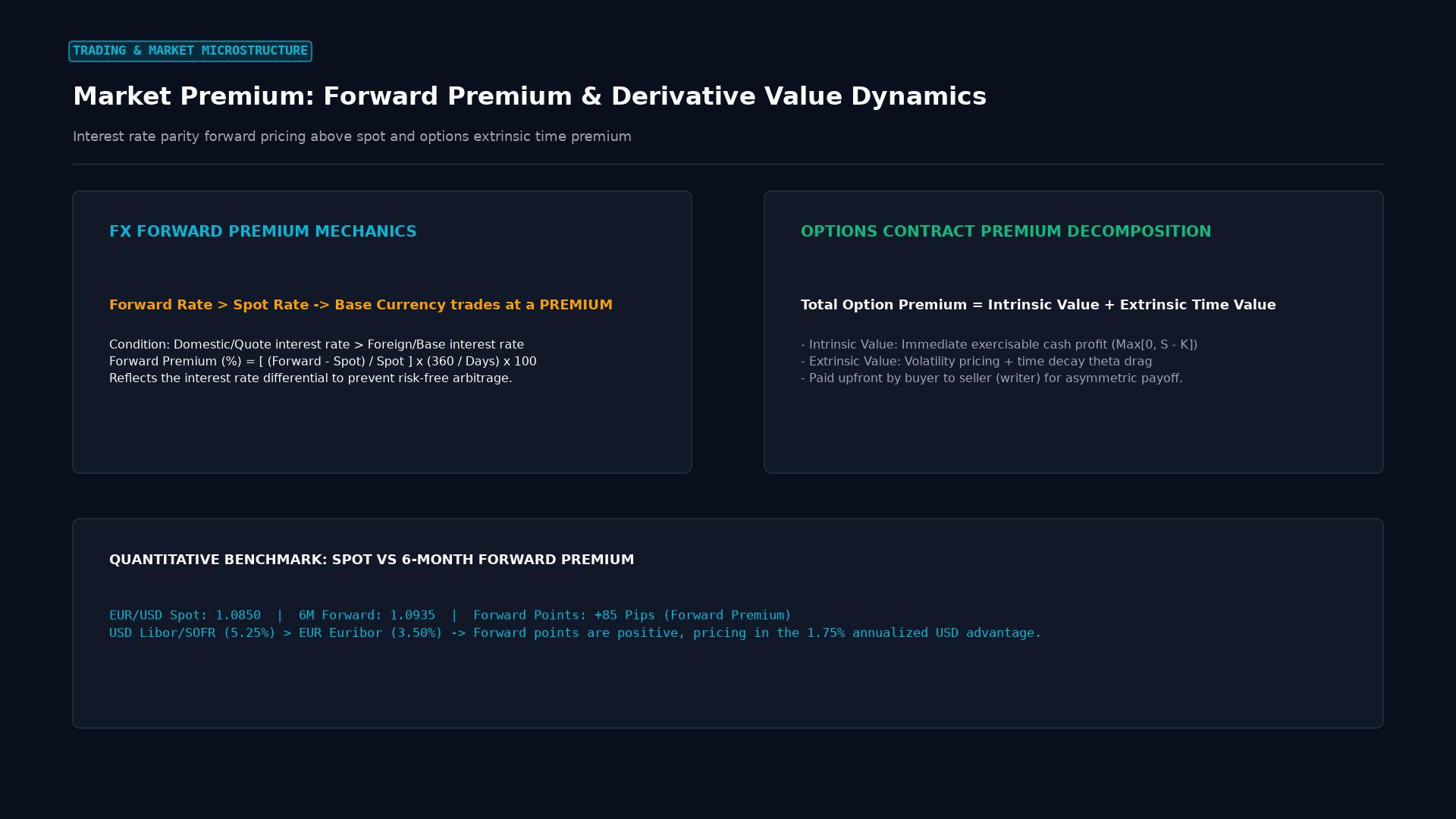 Figure: Quantitative premium dynamics: forward FX premiums derived from covered interest rate parity and options extrinsic time-decay value.
1. The Option Premium: Intrinsic vs. Extrinsic Value
In listed and OTC options markets, the premium represents the complete cost of entry for the buyer and the maximum potential reward for the writer. Mathematically, every option premium decomposes into two core components:
$$\text{Option Premium} = \text{Intrinsic Value} + \text{Extrinsic (Time) Value}$$
Components Breakdown:
- Intrinsic Value: The tangible economic profit if the contract were exercised immediately. For calls: $\max(0, S - K)$; for puts: $\max(0, K - S)$. If an option is out-of-the-money, intrinsic value is exactly zero.
- Extrinsic Value (Time Value): The premium premium paid for the probability that the option will move into (or deeper into) the money before expiration. Extrinsic value depends directly on:
- Time to Expiration ($T$): Erodes non-linearly via Theta decay ($\Theta$).
- Implied Volatility ($\sigma$): Higher expected market turbulence inflates extrinsic value (Vega, $\nu$).
- Risk-Free Interest Rate ($r$): Affects carry costs (Rho, $\rho$).
2. Foreign Exchange: Forward Premium and CIP
In currency dealing rooms, an exchange rate trades at a forward premium when the forward rate is higher than the prevailing spot rate:
$$\text{Forward Premium} = F - S > 0$$
$$\text{Annualized Forward Premium (%)} = \left(\frac{F - S}{S}\right) \times \left(\frac{360}{\text{Days to Maturity}}\right) \times 100%$$
According to Covered Interest Parity (CIP), forward rates are not speculative predictions; they are mathematical offsets to interest rate differentials:
$$\frac{F - S}{S} \approx r_{\text{quote}} - r_{\text{base}}$$
- Rule of Thumb: The currency with the lower nominal interest rate always trades at a forward premium against the currency with the higher interest rate. This ensures that cross-border investors cannot execute riskless interest rate arbitrage.
3. Fixed Income: Trading at a Bond Premium
In secondary bond markets, debt securities are issued with a fixed par value (typically $1,000) and a fixed contractual coupon rate.
| Pricing State | Bond Price vs. Par | Coupon vs. Market Yield | Investor Yield (YTM) |
|---|---|---|---|
| Trading at a Premium | Price > $1,000 (e.g., $1,080) | Coupon Rate > Current Market Yield | YTM < Coupon Rate (Premium erodes to par at maturity). |
| Trading at Par | Price = $1,000 ($100.00) | Coupon Rate = Current Market Yield | YTM = Coupon Rate |
| Trading at a Discount | Price < $1,000 (e.g., $940) | Coupon Rate < Current Market Yield | YTM > Coupon Rate (Capital gain realized at maturity). |
When an investor purchases a premium bond, they receive higher annual interest coupons than currently available in the open market, but they must absorb a gradual capital loss as the bond price steadily converges downward to par ($1,000) by its final maturity date.
Real-World Case Study: Harvest of Option Premium via Covered Calls
In January 2023, an institutional wealth manager managed a portfolio holding 10,000 shares of Microsoft (MSFT) trading at $240 per share ($2,400,000 capital value). Expecting mild sideways consolidation over the coming month, the manager deployed a Covered Call Strategy to generate income:
- The Execution: The manager wrote (sold to open) 100 Call contracts (covering 10,000 shares) with a strike price of $250 expiring in 30 days.
- Premium Collected: The market priced the $250 Call at a premium of $4.50 per share: $$\text{Gross Premium Collected} = 10{,}000 \ \text{shares} \times $4.50 = \mathbf{$45{,}000 \ \text{USD}}$$
- The Underlying Move: Over the next 30 days, MSFT drifted slightly higher, closing at $248 on expiration Friday.
- The Result:
- Because the closing price ($248) was below the $250 strike, the options expired out-of-the-money with zero intrinsic value.
- The wealth manager kept 100% of the $45,000 cash premium as realized net income (a 1.875% cash return in 30 days) while retaining complete ownership of all 10,000 shares.
Frequently Asked Questions
Why does an option buyer pay a premium?
An option buyer pays a premium because they acquire an asymmetric financial right without any downside obligation. The buyer’s potential loss is strictly capped at the premium paid, while their potential profit can be substantial or unlimited. The premium compensates the option writer for assuming this asymmetric risk.
What is the difference between a forward premium and a forward discount?
- A forward premium means the forward rate is higher than the spot rate ($F > S$), occurring when the base currency has a lower interest rate than the quote currency.
- A forward discount means the forward rate is lower than the spot rate ($F < S$), occurring when the base currency has a higher interest rate than the quote currency.
How is a bond premium amortized for tax purposes?
In most tax jurisdictions (including under US IRS rules), an investor who buys a taxable bond at a premium can elect to amortize the premium over the remaining life of the bond. The annual amortized premium is used to offset taxable interest income received from the bond coupons.
Ready to trade forex?
Open a free demo account with a regulated broker. Practice with virtual funds before risking real money.