BGN
The ISO 4217 currency code for the Bulgarian Lev, the national currency of the Republic of Bulgaria, anchored to the Euro under a strict Currency Board Arrangement.
What is the BGN (Bulgarian Lev)?
BGN is the three-letter international currency code assigned under ISO 4217 to the Bulgarian Lev, the official national currency of the Republic of Bulgaria. Represented domestically by the Cyrillic symbol лв and subdivided into 100 stotinki, the Lev has been issued by the Bulgarian National Bank (BNB), founded in 1879, making it one of the oldest central banks in Europe.
In modern European financial markets, the Bulgarian Lev is recognized as one of the most stable and rigidly managed currencies on the continent. Operating under a strict Currency Board Arrangement (CBA) since 1997, the Lev has zero independent floating exchange rate against the single European currency. By statutory law, it is permanently locked at the exact parity of 1.95583 BGN per 1.00 EUR, serving as the transitional monetary bridge toward Bulgaria eventual full accession to the Eurozone.
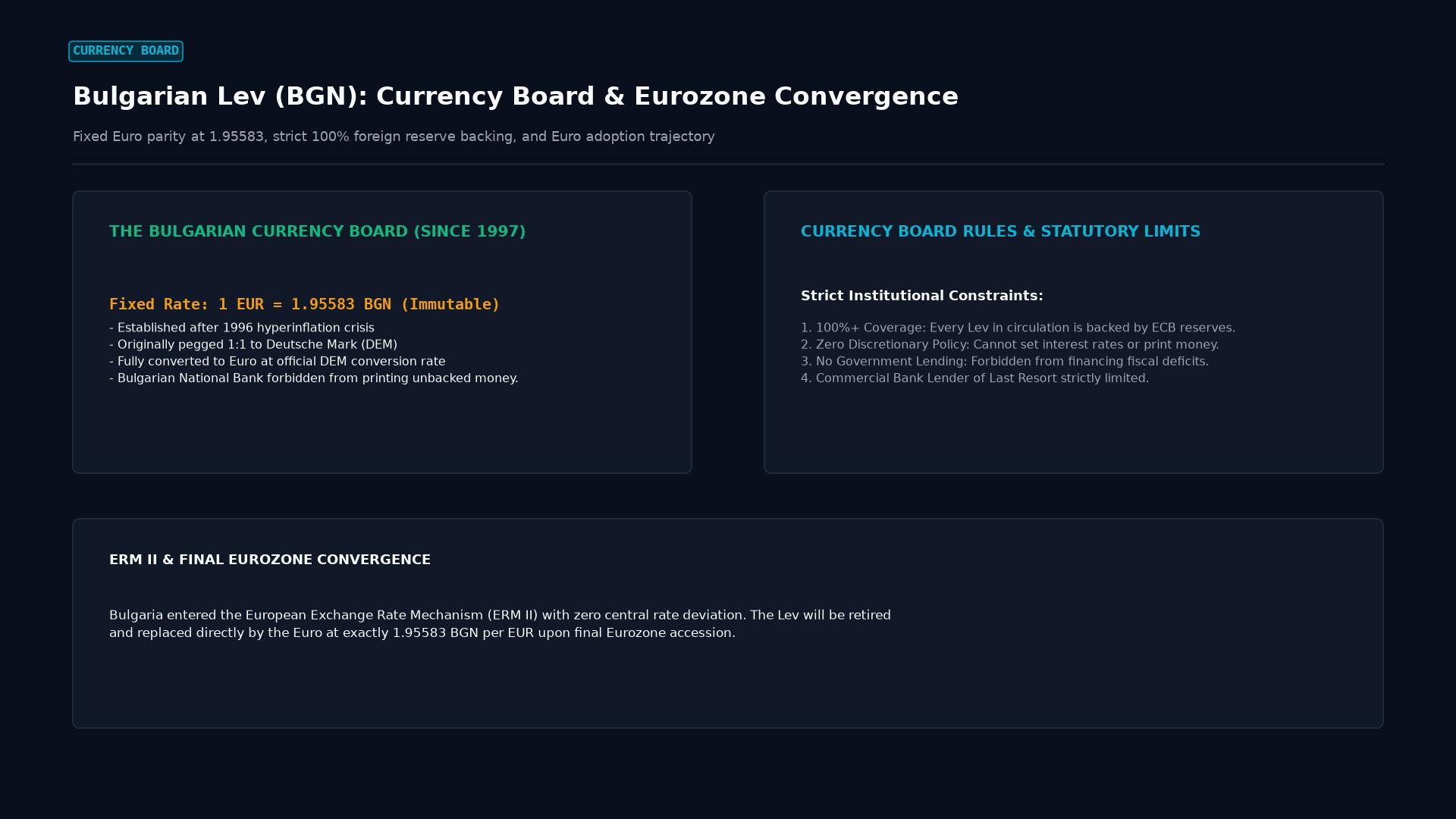 Figure: Statutory currency board: fixed parity at 1.95583 BGN per Euro, 100% ECB reserve backing, zero deficit financing rules, and ERM II convergence.
Historical Origins: The 1997 Crisis and Currency Board Creation
The rigid structure of the modern Lev emerged directly from catastrophic economic collapse. In late 1996 and early 1997, Bulgaria suffered a devastating banking and economic crisis:
- Monthly inflation topped 240% in February 1997, crossing into hyperinflation.
- The historical exchange rate collapsed from roughly 70 Leva per US Dollar in early 1996 to nearly 3,000 Leva per USD in early 1997.
- A massive banking panic wiped out one-third of the nation financial institutions.
To restore economic stability, the Bulgarian government and the International Monetary Fund negotiated the Law on the Bulgarian National Bank, enacted on July 1, 1997. The legislation stripped the central bank of its discretionary monetary powers and established a Currency Board.
The Lev was initially pegged to the Deutsche Mark (DEM) at an exact 1:1 ratio. In 1999, Bulgaria completed a denomination reform, rebasing the currency code from BGL to BGN by striking three zeroes (1,000 old Leva = 1 new Lev). When the Deutsche Mark was retired on January 1, 1999 upon the introduction of the Euro, the statutory peg converted automatically to the Deutsche Mark official Euro conversion rate:
$$1.00 \text{ EUR} = 1.95583 \text{ BGN}$$
This exact mathematical conversion rate has governed all Bulgarian financial accounting and banking transactions ever since.
Institutional Mechanics of the Currency Board
Under the Law on the Bulgarian National Bank, the central bank operates with a segmented structural balance sheet divided into the Issue Department and the Banking Department:
+------------------------------------+------------------------------------+
| Traditional Central Bank Model     | Bulgarian Currency Board Model     |
+------------------------------------+------------------------------------+
| Discretionary money supply         | Monetary liabilities must be 100%+ |
| creation via open market purchases.| backed by gross foreign reserves.  |
|                                    |                                    |
| Direct monetization of government  | Complete legal ban on central bank |
| deficits and Treasury bond issues. | lending to government or budget.   |
|                                    |                                    |
| Unlimited discretionary lender of  | Lender of last resort strictly     |
| last resort to troubled banks.     | restricted to systemic liquidity.  |
|                                    |                                    |
| Domestic interest rate targeting   | Domestic interest rates driven     |
| via overnight policy corridors.    | entirely by ECB policy & liquidity.|
+------------------------------------+------------------------------------+
1. Mandatory 100%+ Foreign Reserve Backing
The Issue Department must hold gross foreign currency reserves that equal or exceed 100% of all domestic monetary liabilities (the monetary base, M0, which includes all currency in circulation plus commercial bank reserve balances). If foreign reserves contract, the domestic money supply must automatically contract by law; if capital flows into Bulgaria, the domestic money supply expands.
2. Prohibition of Government Monetization
The central bank is strictly prohibited by law from extending credit lines, buying government debt in the primary market, or financing fiscal shortfalls. The Ministry of Finance must maintain its Treasury cash balances inside the central bank Fiscal Reserve account, eliminating budget-driven inflationary cycles.
3. Restricted Lender of Last Resort
The BNB cannot print money to bail out individual insolvent commercial banks. It is permitted to provide emergency liquidity assistance only to solvent banks facing systemic liquidity stress, funded solely through segregated excess capital held within the central bank Banking Department.
ERM II and The Euro Adoption Trajectory
In July 2020, Bulgaria achieved a historic milestone by simultaneously joining the Exchange Rate Mechanism II (ERM II) and the European Banking Union:
  Maastricht Convergence Criterion    Bulgarian Performance Benchmark
  -----------------------------------------------------------------------------------
  Exchange Rate Stability             Compliant: Pegged at 1.95583 BGN for >25 years
  Price Stability (Inflation Rate)    Variable: Periodic cyclical challenges
  Fiscal Deficit (< 3.0% of GDP)      Compliant: Consistent fiscal conservatism
  Public Debt-to-GDP (< 60.0%)        Super-Compliant: Under 25% of GDP (lowest in EU)
  Long-Term Interest Rates            Compliant: Closely tracking German Bund baselines
Admission to ERM II required Bulgaria to place its largest domestic banking institutions under the direct banking supervision of the European Central Bank (ECB) through the Single Supervisory Mechanism (SSM). While Bulgaria easily satisfies the public debt and fiscal deficit criteria, periodic inflation differentials compared to the three lowest-inflation EU member states have guided the exact date of final Euro accession. Upon full Euro adoption, the Bulgarian Lev will be officially retired, and all BGN cash balances will convert to Euro at the fixed 1.95583 parity.
Commercial and Treasury Implications
Operating with an unyielding currency board introduces unique operational dynamics for corporate treasurers, foreign direct investors, and retail banking operations:
- Elimination of EUR/BGN FX Risk: Businesses operating in Bulgaria experience zero exchange rate volatility when conducting commerce with Germany, France, Italy, or other Eurozone trading partners. Cross-currency hedging instruments are unnecessary for Euro-denominated invoicing.
- ECB Interest Rate Transmission: The Bulgarian National Bank does not set a policy interest rate. Interest rates on domestic mortgages, business loans, and bank deposits reflect ECB monetary policy directives, adjusted for domestic bank liquidity margins and local credit risk spreads.
- Non-Euro Cross Currency Hedging: Because the BGN is locked to the Euro, cross rates against other major currencies (such as USD/BGN, GBP/BGN, or CHF/BGN) mirror EUR/USD, EUR/GBP, and EUR/CHF price movements tick-for-tick:
$$\text{USD/BGN Spot} = \frac{1.95583}{\text{EUR/USD Spot}}$$
Frequently Asked Questions
Can the Bulgarian National Bank devalue the Lev?
No. Devaluing the Lev is impossible through unilateral administrative decisions by central bankers. The parity of 1.95583 BGN per 1.00 EUR is written directly into national statutory law. Changing the exchange rate requires an act of the Bulgarian National Assembly (Parliament), an event with virtually zero political support given the broad consensus behind preserving the Currency Board.
What will happen to outstanding Lev contracts when Bulgaria adopts the Euro?
Under standard European Union transition law, all existing contracts, commercial leases, mortgages, debt securities, and bank account balances denominated in BGN will automatically convert into Euro at the statutory rate of 1.95583 with zero fees, altering none of the underlying contractual terms or agreed interest rates.
How did Bulgaria maintain the peg during the 2008 global financial crisis?
Bulgaria entered the 2008 financial crisis with substantial fiscal reserves, strong foreign reserve coverage, and exceptionally low public debt. The Currency Board functioned precisely as designed, forcing rapid domestic price and wage adjustments that restored external competitiveness without requiring currency depreciation.
Ready to trade forex?
Open a free demo account with a regulated broker. Practice with virtual funds before risking real money.