Euro
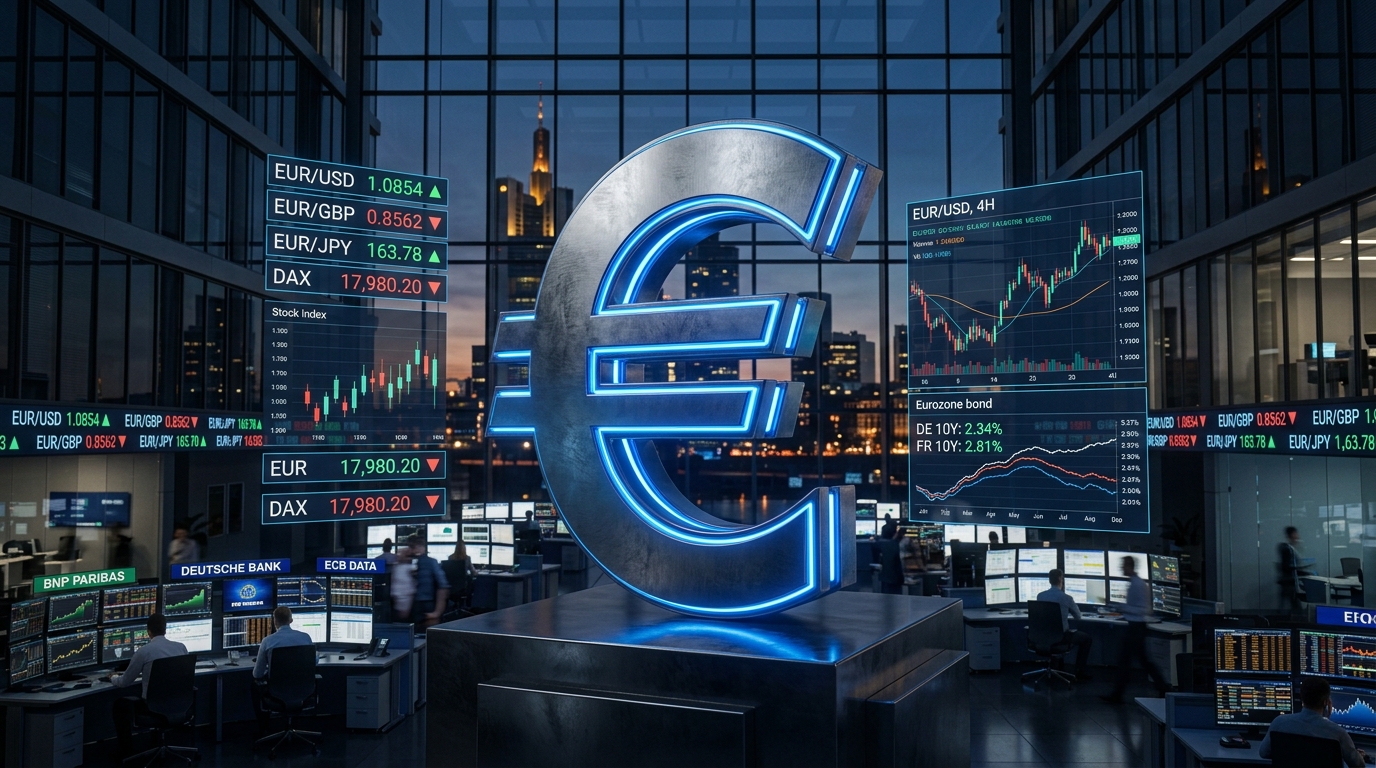
The Euro (currency code: EUR, symbol: €) is the official sovereign currency of the Eurozone, comprising 20 member states of the European Union, managed by the European Central Bank, and representing the world's second most traded currency and second largest reserve asset.
What Is the Euro?
The Euro (ISO 4217 code: EUR; symbol: €) is the single official currency shared by 20 of the 27 member states of the European Union, a geographic and economic bloc collectively known as the Eurozone. Introduced non-physically for electronic interbank accounting and financial markets on January 1, 1999, and physically launched as banknotes and coins on January 1, 2002, the Euro replaced historic national currencies such as the German Deutsche Mark, French Franc, Italian Lira, and Spanish Peseta.
In global finance and foreign exchange, the Euro stands as the second most influential currency on Earth, trailing only the United States Dollar. According to the Bank for International Settlements (BIS) Triennial Central Bank Survey, the Euro appears on one side of approximately 31% of all daily foreign exchange transactions, with the EUR/USD currency pair serving as the undisputed global benchmark for foreign exchange liquidity.
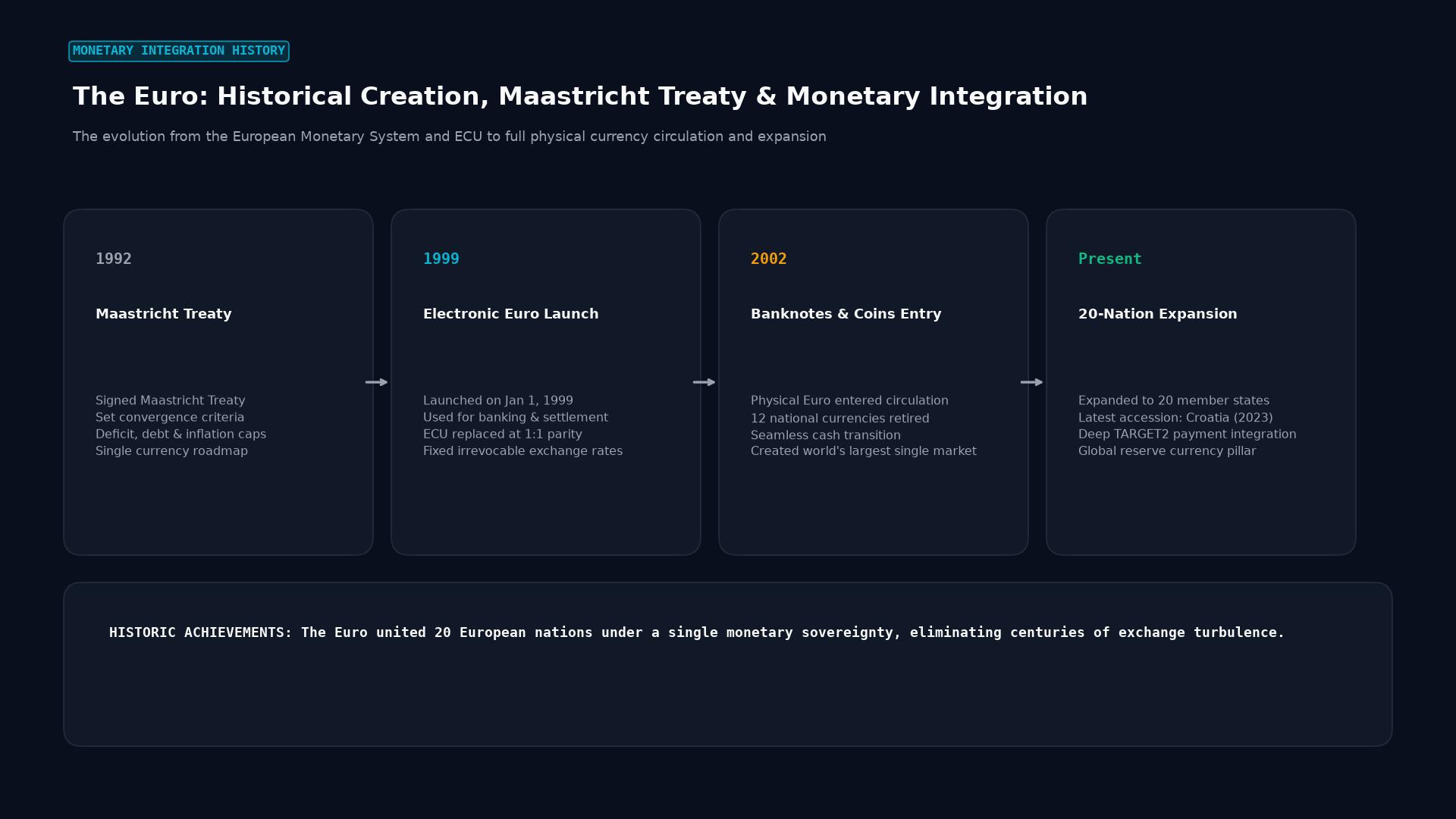 Figure: The evolution from the European Monetary System and ECU to full physical currency circulation and expansion
Key Takeaways
- Second Global Reserve Currency: The Euro accounts for roughly 20% of global central bank allocated foreign exchange reserves, second only to the U.S. Dollar.
- Governed by the ECB: Sovereign monetary policy for all Eurozone member nations is determined exclusively by the European Central Bank (ECB) Governing Council based in Frankfurt, Germany.
- Standard Base Currency: In interbank currency quotations, the Euro is virtually always quoted as the base currency (e.g., EUR/USD, EUR/GBP, EUR/JPY), with rare historical exceptions.
- The Sovereign Debt Architecture: Because the Euro unites 20 distinct national fiscal governments under a single central bank, sovereign bond yield spreads (e.g., the German Bund vs. Italian BTP spread) serve as a primary barometer of Euro systemic risk.
History and Convergence: The Maastricht Treaty
The blueprint for the Euro was formalized in the 1992 Maastricht Treaty, which established strict economic convergence criteria for countries seeking membership:
- Price Stability: Inflation rate within 1.5 percentage points of the three best-performing member states.
- Fiscal Discipline: Annual government budget deficit capped at 3% of national Gross Domestic Product (GDP).
- Public Debt Limits: Gross government sovereign debt capped at 60% of national GDP (or demonstrably declining toward that ratio).
- Exchange Rate Stability: Participation in the Exchange Rate Mechanism (ERM II) for at least two years without severe devaluations.
- Long-Term Interest Rate Convergence: Long-term bond yields within 2 percentage points of the three lowest-inflation member states.
The physical rollout on January 1, 2002, represented the largest currency conversion operation in human history, withdrawing billions of legacy banknotes across twelve founding European nations within weeks.
Euro Key Facts & Characteristics
| Dimension | Specification |
|---|---|
| ISO 4217 Currency Code | EUR |
| Numeric Code | 978 |
| Currency Symbol | € |
| Subunits | 100 Cents |
| Central Bank | European Central Bank (ECB) |
| Primary Trading Sessions | London Session (08:00–16:00 GMT) & New York Overlap (13:00–17:00 GMT) |
| Global FX Turnover Share | ~31% of all OTC foreign exchange trades (BIS) |
| Major Currency Crosses | EUR/USD, EUR/JPY, EUR/GBP, EUR/CHF, EUR/AUD, EUR/CAD |
The Eurozone Sovereign Debt Crisis (2010–2012)
The fundamental structural flaw of the Euro is that it established a monetary union without a fiscal union—individual member nations control their own spending and tax policies, but cannot devalue their currency or print money during economic crises.
Following the 2008 global financial crisis, peripheral Eurozone nations (Greece, Ireland, Portugal, Spain, and Italy) faced severe sovereign debt and banking crises. Greek and Italian bond yields spiked to unsustainable double-digit levels, sparking market speculation of a potential Eurozone breakup.
The crisis reached its turning point on July 26, 2012, in London, when ECB President Mario Draghi made his historic pledge:
“Within our mandate, the ECB is ready to do whatever it takes to preserve the euro. And believe me, it will be enough.”
The ECB backed this promise with the Outright Monetary Transactions (OMT) framework, establishing the central bank as the ultimate liquidity backstop and permanently securing the Euro’s institutional integrity.
Trading Dynamics of the Euro in Foreign Exchange
Foreign exchange traders focus on several key fundamental drivers when trading the Euro:
- ECB Policy Announcements: The ECB Governing Council meets every six weeks to announce policy rate decisions (Deposit Facility Rate, Main Refinancing Operations Rate) followed by a live press conference that triggers high volatility.
- Eurozone Core Inflation & German Data: Because Germany represents the economic powerhouse of the Eurozone, German GDP, industrial production, and Ifo Business Climate reports carry disproportionate weight in moving the Euro.
- Sovereign Bond Spreads: Widening yield spreads between 10-year Italian BTPs and 10-year German Bunds indicate political fragmentation or sovereign risk, historically putting downward pressure on EUR/USD.
Frequently Asked Questions
Which countries use the Euro as their official currency?
As of 2026, 20 EU member nations comprise the Eurozone: Austria, Belgium, Croatia, Cyprus, Estonia, Finland, France, Germany, Greece, Ireland, Italy, Latvia, Lithuania, Luxembourg, Malta, Netherlands, Portugal, Slovakia, Slovenia, and Spain. Additionally, European microstates (Andorra, Monaco, San Marino, and Vatican City) use the Euro under formal monetary agreements with the EU.
Why is EUR almost always quoted as the base currency?
Under international interbank market convention established by the European Central Bank and the British Bankers’ Association upon the Euro’s launch, EUR takes quoting precedence over virtually all global currencies (e.g., EUR/USD, EUR/JPY, EUR/GBP). The only rare exception is when quoted against historical supranational accounting units like the IMF Special Drawing Right (SDR).
What is the difference between the Eurozone and the European Union?
The European Union (EU) is a political and economic union of 27 member states. The Eurozone is a monetary subset consisting of the 20 EU member states that have adopted the Euro as legal tender. Non-Eurozone EU countries (such as Poland, Sweden, Hungary, Czechia, Romania, Bulgaria, and Denmark) retain their own independent national currencies.
Ready to trade forex?
Open a free demo account with a regulated broker. Practice with virtual funds before risking real money.