CD-Ratio
The Credit-Deposit Ratio (also known as Loan-to-Deposit Ratio or LDR), a fundamental banking liquidity metric measuring total advances extended as a percentage of total customer deposits.
What is the CD-Ratio (Credit-Deposit Ratio)?
The Credit-Deposit Ratio (CD-Ratio), also referred to globally as the Loan-to-Deposit Ratio (LDR), is a core structural metric used by bank regulators, equity analysts, and corporate treasurers to evaluate a commercial bank liquidity profile, asset-liability management (ALM), and lending capacity. The ratio calculates the proportion of a bank total customer deposit base that has been deployed into loans, mortgages, overdrafts, and commercial credit advances.
Because deposits represent the primary, lowest-cost source of funding for traditional fractional-reserve banks, the CD-Ratio illustrates how aggressively an institution is converting customer savings into interest-earning credit assets. A balanced CD-Ratio indicates that a bank is generating healthy net interest income while maintaining sufficient liquid cash buffers to honor unexpected customer deposit withdrawals.
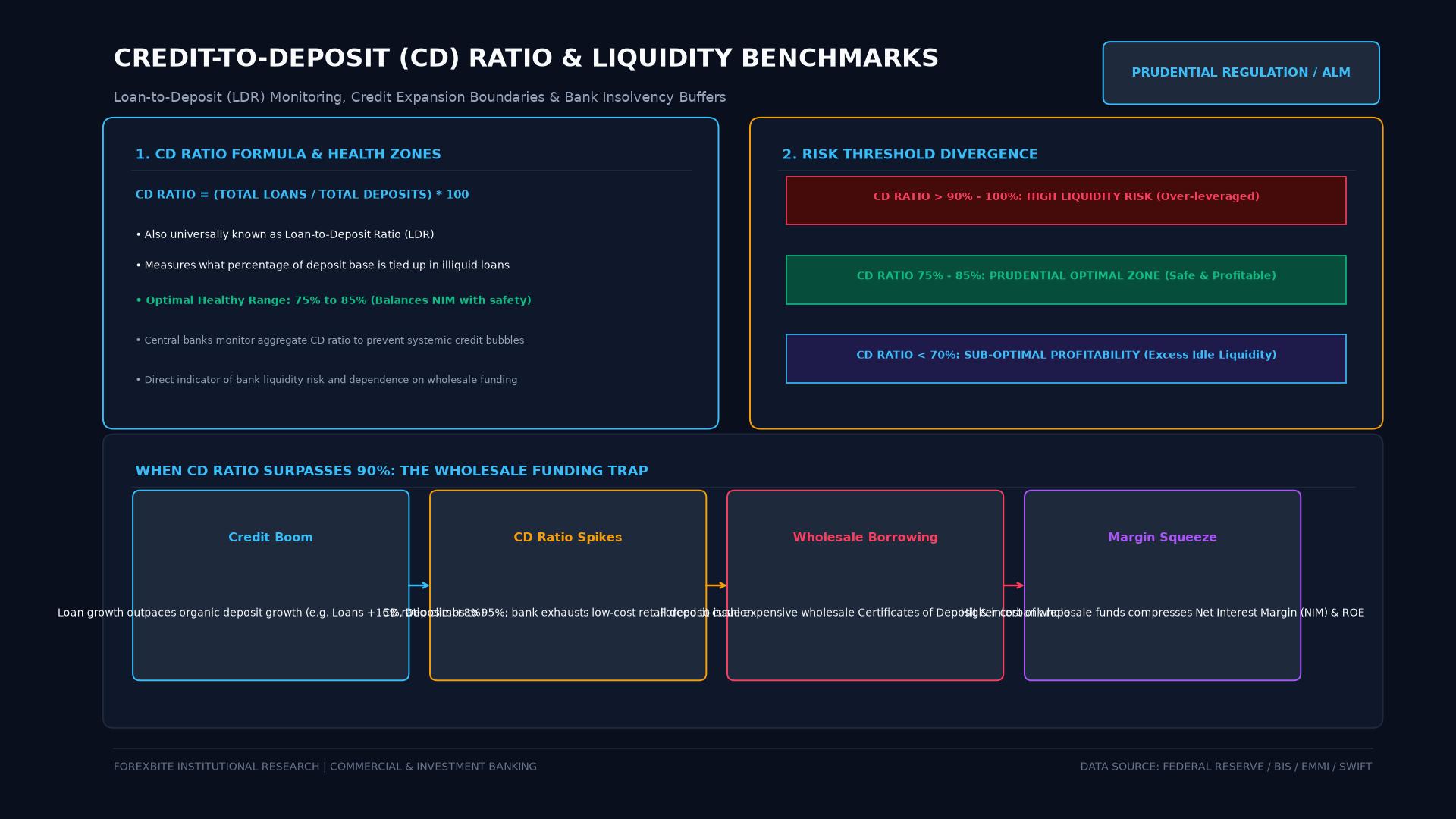 Figure: Credit-Deposit Ratio risk spectrum: underutilization, optimal regulatory lending corridor (70%-75%), and illiquid overheating zones triggering statutory caps.
Mathematical Formulation and Components
The standard formula for calculating the Credit-Deposit Ratio is:
$$\text{CD-Ratio} = \left( \frac{\text{Total Gross Advances}}{\text{Total Customer Deposits}} \right) \times 100$$
Where:
- Total Gross Advances: The aggregate sum of all funded credit extended by the bank, including commercial loans, retail consumer loans, residential mortgages, credit card balances, and agricultural advances before deducting loan loss provisions.
- Total Customer Deposits: The aggregate liabilities owed to retail depositors, small businesses, and corporations across Current Account Savings Accounts (CASA) and fixed-term term deposits. It generally excludes wholesale interbank borrowings and subordinated bond issuances.
Regulatory Variations and Incremental CD-Ratio
Regulators also track the Incremental Credit-Deposit Ratio to evaluate lending behavior across recent quarters:
$$\text{Incremental CD-Ratio} = \left( \frac{\Delta \text{ Advances in Period}}{\Delta \text{ Deposits in Period}} \right) \times 100$$
When the incremental CD-Ratio exceeds 100%, a bank is expanding its loan book faster than its deposit growth, funding the shortfall through expensive wholesale certificates of deposit, interbank repo markets, or capital market debt.
Interpreting CD-Ratio Thresholds
Bank supervisors, including the United States Federal Reserve, the European Central Bank (ECB), and the Reserve Bank of India (RBI), monitor specific operational bands:
+------------------------------------+------------------------------------+
| Low CD-Ratio (< 65% - 70%)         | High CD-Ratio (> 80% - 85%)        |
+------------------------------------+------------------------------------+
| Excess liquidity parked in low-    | Aggressive credit deployment; bank |
| yielding government securities.    | is heavily loaned up.              |
|                                    |                                    |
| Suboptimal capital allocation;     | Vulnerable to sudden deposit runs  |
| depressed Net Interest Margin(NIM).| and structural liquidity squeezes. |
|                                    |                                    |
| High resilience during credit      | Heavy dependence on expensive,     |
| crunches and liquidity shocks.     | volatile wholesale market funding. |
+------------------------------------+------------------------------------+
The 100%+ Structural Deficit
When a bank CD-Ratio crosses 100%, it has loaned out more capital than it holds in customer deposits. While common among specialized mortgage lenders or investment-banking-heavy entities that fund portfolios via residential mortgage-backed securities (RMBS) or commercial paper, a traditional commercial retail bank operating above 100% faces severe refinancing risks if market liquidity contracts.
Macroeconomic Dynamics: Deposit Wars and NIM Compression
When systemic bank lending outpaces national deposit growth, banks compete aggressively for capital, sparking structural shifts across the financial sector:
  Stage 1: Credit Outpaces Deposits
  Corporate & retail loan demand surges; systemic CD-Ratio climbs above 80%.

  Stage 2: Retail Deposit Rate Wars
  Banks hike fixed-deposit (FD) interest rates to lure sticky retail deposits.

  Stage 3: Cost of Funds Escalation
  Weighted average cost of funds rises faster than yields on existing fixed-rate loans.

  Stage 4: Net Interest Margin (NIM) Compression
  Bank profitability contracts; regulators intervene to slow loan growth.
To prevent asset-liability mismatch (ALM), central banks routinely caution institutions against maintaining elevated CD-Ratios over consecutive quarters. When deposit growth lags, banks are forced to slow credit disbursements, cooling macro GDP expansion.
Intersection with Basel III: LCR and NSFR
The global financial crisis of 2008 revealed that looking at the CD-Ratio alone was insufficient to assess systemic bank stability. The Basel Committee on Banking Supervision (BCBS) integrated the CD-Ratio into a modern regulatory liquidity framework:
  Regulatory Standard              Primary Regulatory Objective
  -----------------------------------------------------------------------------------
  Credit-Deposit Ratio (LDR)       Structural measure of core deposit loan deployment
  Liquidity Coverage Ratio (LCR)   Mandates sufficient High-Quality Liquid Assets
                                   (HQLA) to survive a 30-day acute liquidity stress
  Net Stable Funding Ratio (NSFR)  Requires Available Stable Funding (ASF) to match
                                   the liquidity profile of Required Stable Funding (RSF)
While the CD-Ratio measures the broad funding base, the Liquidity Coverage Ratio (LCR) ensures that a bank holds sovereign debt and central bank reserves that can be converted immediately to cash during a bank run. Similarly, the Net Stable Funding Ratio (NSFR) addresses the maturity mismatch between multi-decade mortgages and short-term retail deposits.
Historical Case Studies in Structural Imbalance
The danger of an elevated CD-Ratio financed by volatile wholesale funds was illustrated in several prominent historical banking failures:
- Northern Rock (2007): The United Kingdom mortgage lender operated with an extreme CD-Ratio exceeding 300%. Rather than gathering retail deposits, Northern Rock funded long-term home mortgages through short-term wholesale money markets and securitization conduits. When the interbank credit markets froze in August 2007, Northern Rock suffered the first major retail bank run in Britain in over 140 years.
- Silicon Valley Bank (2023): While SVB possessed an ostensibly moderate loan-to-deposit ratio, its rapid deposit accumulation was concentrated in volatile venture capital deposits. Deploying those funds into long-duration hold-to-maturity bonds created an interest-rate duration mismatch that triggered an unprecedented $42 billion deposit run within 24 hours.
Frequently Asked Questions
What is considered an ideal CD-Ratio for a commercial bank?
In most jurisdictions, a CD-Ratio between 70% and 78% is considered the optimal sweet spot for a diversified commercial bank. This range allows the bank to generate profitable net interest margins while retaining adequate liquidity to meet mandatory statutory reserves (like CRR or SLR) and unexpected customer cash withdrawals.
How does the Cash Reserve Ratio (CRR) influence a bank’s effective CD-Ratio?
The Cash Reserve Ratio (CRR) dictates the percentage of a bank net demand and time liabilities (deposits) that must be maintained as unremunerated cash balances at the central bank. If statutory reserves (CRR plus mandatory government bond holdings) absorb 22% of total deposits, a bank cannot physically lend more than 78% of its deposit base without resorting to external market borrowings.
Can a bank lower its CD-Ratio without reducing its outstanding loans?
Yes. A bank can reduce its CD-Ratio by aggressively growing its customer deposit base faster than its loan book. Strategies include raising interest rates on high-yield savings accounts and term deposits, expanding retail branch footprints, or securitizing and selling loan tranches off the balance sheet to institutional investors.
Ready to trade forex?
Open a free demo account with a regulated broker. Practice with virtual funds before risking real money.