Central Bank
A central bank is the institution responsible for a country's monetary policy — controlling money supply, setting benchmark interest rates, managing foreign exchange reserves, and acting as lender of last resort to the banking system. Central bank decisions are the single most impactful scheduled events in global forex markets.
What Central Banks Do and Why Forex Traders Must Understand Them
No other institution moves currency markets the way central banks do. Not hedge funds, not multinational corporations, not even governments. When the Federal Reserve speaks, EUR/USD can move 100 pips in minutes. When the Bank of Japan intervenes in currency markets, it can reverse a months-long trend in a single session. Central banks are the single most powerful force in forex, and understanding how they think is non-negotiable for any serious trader.
Their primary mandate varies by institution. The Federal Reserve has a dual mandate: price stability (targeting 2% inflation) and maximum employment. The ECB has a single mandate: price stability only. The Bank of England targets 2% CPI inflation. The Bank of Japan adds exchange rate stability as an implicit secondary objective — making it unique among major central banks in directly managing currency values as policy.
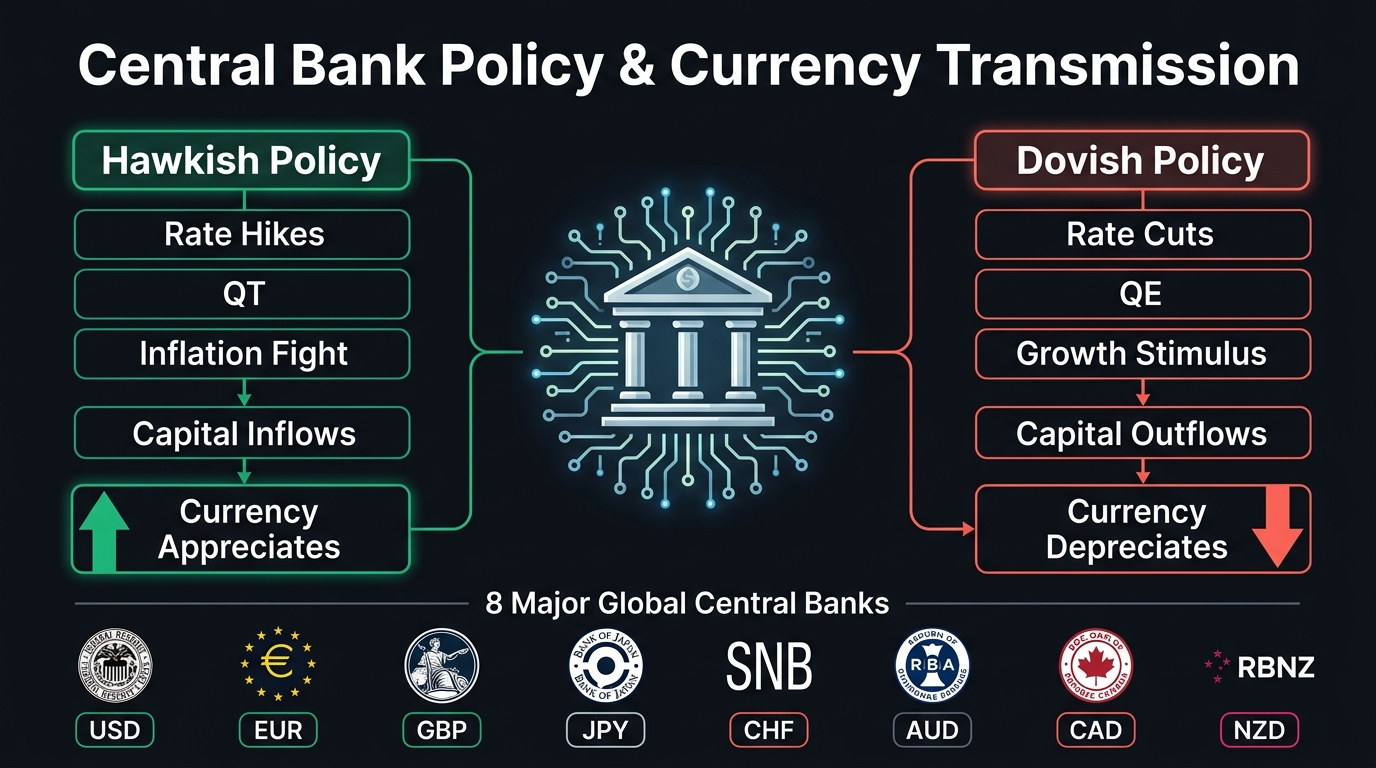
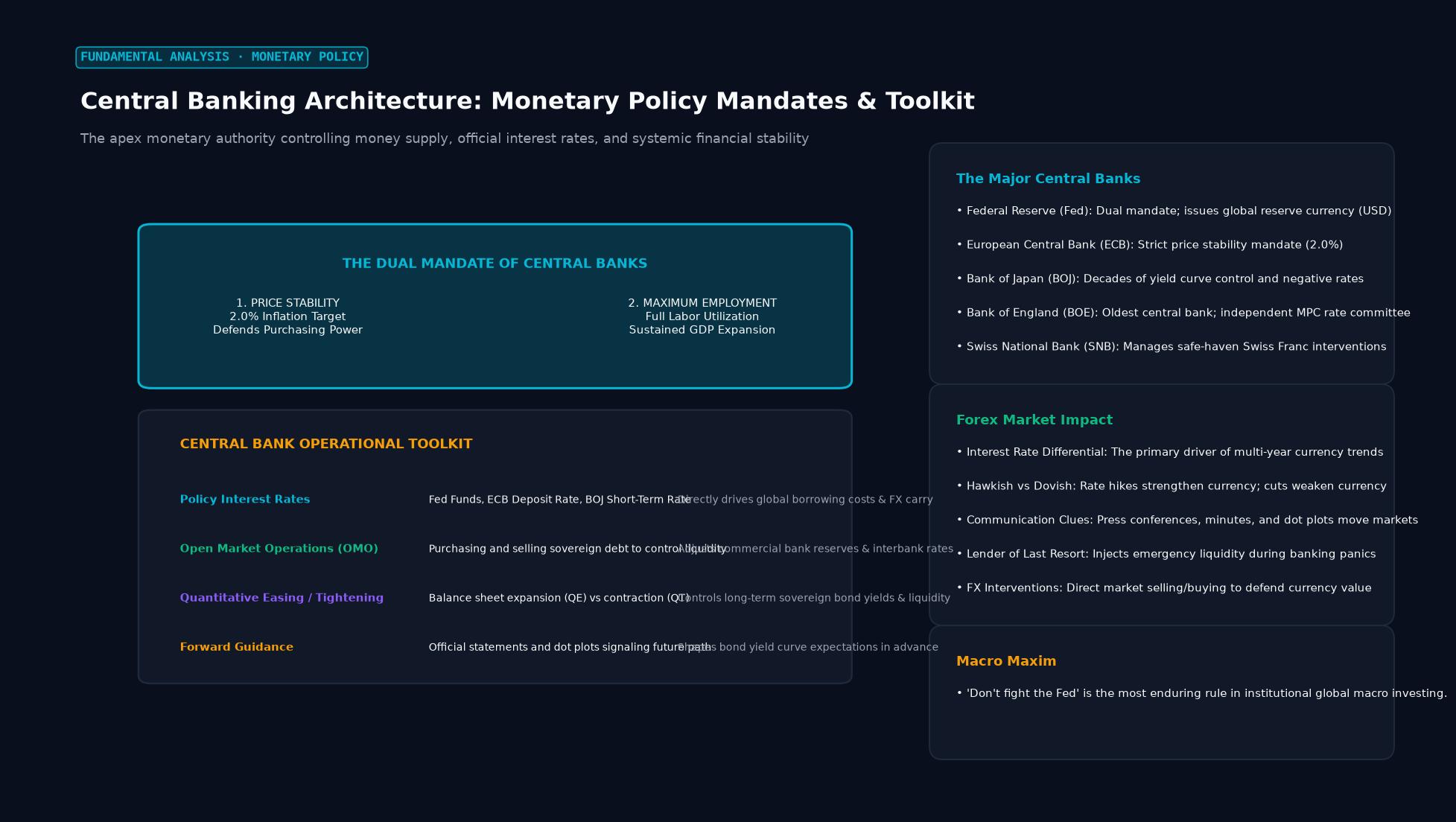 Figure: The apex monetary authority controlling money supply, official interest rates, and systemic financial stability
The Major Central Banks and Their Currencies
| Central Bank | Currency | Meeting Frequency |
|---|---|---|
| Federal Reserve (Fed) | USD | 8 times/year (FOMC) |
| European Central Bank (ECB) | EUR | 8 times/year |
| Bank of England (BOE) | GBP | 8 times/year (MPC) |
| Bank of Japan (BOJ) | JPY | 8 times/year |
| Swiss National Bank (SNB) | CHF | 4 times/year |
| Reserve Bank of Australia (RBA) | AUD | 11 times/year |
| Bank of Canada (BOC) | CAD | 8 times/year |
| Reserve Bank of New Zealand (RBNZ) | NZD | 7 times/year |
How Central Banks Move Markets
Interest rate decisions: The primary tool. Raising rates strengthens a currency by attracting yield-seeking capital flows. Cutting rates weakens it. When the Fed raised rates from 0.25% to 5.50% between March 2022 and July 2023, the dollar surged against nearly every major peer.
Forward guidance: What a central bank says about future policy often matters more than what it does today. If the Fed raises rates but signals that the hiking cycle is near its end, the dollar may actually fall on the day of the hike. Parsing the nuance of press conference language is a genuine edge in institutional trading.
Quantitative easing (QE) and tightening (QT): When conventional rate tools are exhausted (rates at zero), central banks purchase financial assets — primarily government bonds — to inject money into the financial system. QE tends to weaken a currency by expanding money supply. Quantitative tightening (selling assets or letting them mature) has the opposite effect.
Currency intervention: Central banks occasionally intervene directly in the forex market to manage their currency’s value. The Swiss National Bank famously pegged EUR/CHF at 1.20 from September 2011 to January 2015, defending it with unlimited franc selling before abruptly abandoning the peg — causing one of the largest single-day currency moves in modern history (CHF strengthened 30% against EUR in minutes).
Japan has conducted multiple intervention rounds in recent years: in 2022 when USD/JPY approached 152, and again in 2024. These interventions are most effective when unexpected and when coordinated with other central banks.
Reading the Meeting Cycle
Central bank meetings follow a predictable calendar. The 6-8 weeks between FOMC meetings, for example, create a rhythm of data analysis, positioning, and reaction. Here’s how the cycle typically flows:
- Post-meeting: The decision is made, statement released, press conference held. Immediate market reaction.
- Weeks 1-3: Economic data releases (CPI, employment, GDP) shape interpretation of the next likely decision.
- Weeks 4-5: Committee members give speeches and interviews. These “Fed-speak” events are market-moving in their own right.
- Week 6 (Jackson Hole / Pre-meeting): Annual economic symposium in August (Jackson Hole, Wyoming) where the Fed chair often signals major policy shifts. In 2022, Fed Chair Powell’s 8-minute speech at Jackson Hole signaled aggressive rate hikes — EUR/USD fell 200 pips that afternoon.
- Meeting week: Positioning adjusts, volatility spikes, new decision.
The Hawkish vs. Dovish Spectrum
Central bank language is decoded through a hawkish-dovish framework:
Hawkish: Language signaling concern about inflation, openness to rate hikes, reduced stimulus. Currency-positive.
Dovish: Language signaling concern about growth or employment, openness to rate cuts or QE. Currency-negative.
The same rate decision can read as hawkish or dovish depending on the accompanying statement and press conference. A rate hike with language emphasizing “data dependence” and “uncertainty” is more dovish than one with language about “continued tightening that may be necessary.” Markets parse these differences instantly.
Key Takeaways
- Central banks control the interest rate lever that is the primary driver of currency valuation
- The Fed, ECB, BOJ, BOE, and SNB are the most market-moving central banks in forex
- Forward guidance — what they signal about the future — often moves markets more than the current decision
- QE weakens currency; QT strengthens it; direct intervention can reverse trends temporarily
- Hawkish language is currency-positive; dovish language is currency-negative
FAQ
Can central banks run out of money to defend their currency? When defending a weak currency (selling foreign reserves to buy domestic currency), yes — reserves are finite. When weakening a currency (selling domestic currency), no — a central bank can create its own currency without limit. This asymmetry explains why the Swiss National Bank could maintain its EUR/CHF floor so long: they were selling francs, not spending reserves.
What is the “lender of last resort” function? When commercial banks face liquidity crises, central banks provide emergency lending to prevent cascading bank failures. This function was critical during the 2008 financial crisis and again during the 2020 COVID shock. It’s separate from monetary policy and is often conducted without prior announcement.
Ready to trade forex?
Open a free demo account with a regulated broker. Practice with virtual funds before risking real money.