CDA
A multi-faceted financial acronym referring primarily to Canada's Capital Dividend Account under the Income Tax Act, and secondarily to a Confidential Disclosure Agreement in corporate finance and M&A transactions.
What Does CDA Stand For in Finance?
In global finance and corporate law, the acronym CDA represents two distinct concepts depending on the institutional context:
- Capital Dividend Account (Taxation and Corporate Finance): Under Section 89(1) of the Canadian Income Tax Act (ITA), the Capital Dividend Account is a specialized, notional tax-tracking account maintained by private corporations. It records tax-free surpluses, primarily the non-taxable portion of realized capital gains, enabling the company to distribute tax-free capital dividends to resident shareholders.
- Confidential Disclosure Agreement (Mergers and Acquisitions): In investment banking, private equity, and commercial law, CDA is synonymous with a Non-Disclosure Agreement (NDA). It is a legally binding contract executed between prospective deal participants prior to the exchange of proprietary financial models, customer lists, and strategic trade secrets.
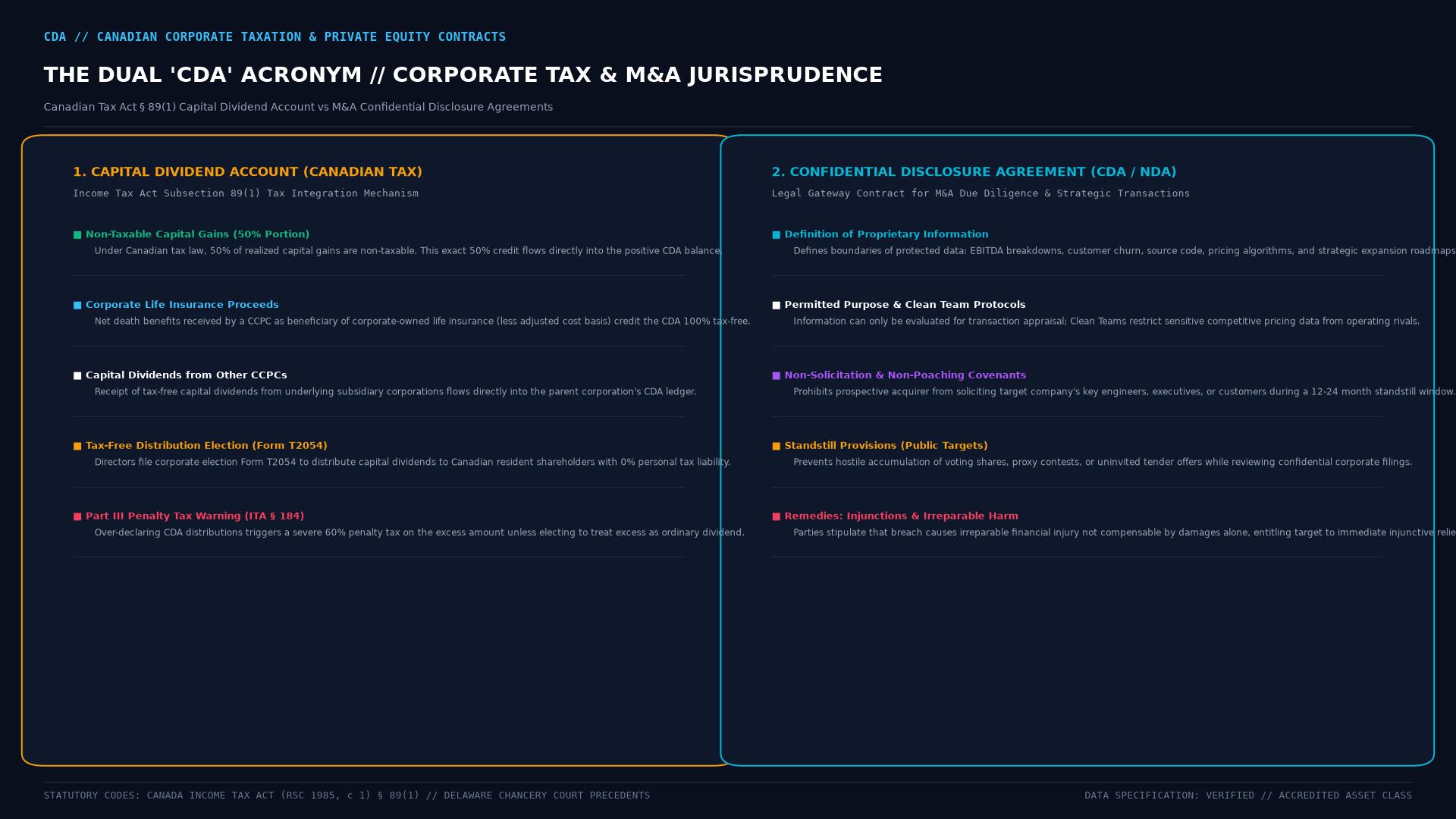 Figure: The dual financial applications of the CDA acronym: Canada’s Capital Dividend Account (ITA § 89(1)) tax integration mechanism vs. M&A Confidential Disclosure Agreements (CDA/NDA).
1. The Capital Dividend Account (Corporate Taxation)
In Canadian corporate tax planning, the Capital Dividend Account (CDA) embodies the principle of tax integration. The tax integration framework aims to ensure that an individual earning investment income through a private corporation pays roughly the same total income tax as if that income were earned directly as an individual.
Mechanical Architecture of the Account
The CDA is not a physical bank balance or a line item on standard accounting balance sheets; it is a cumulative notional ledger tracked for tax purposes. Under Subsection 89(1) of the ITA, the positive balance of the CDA is composed of specific tax-sheltered credits:
  CDA Inflow Component                             Statutory Inclusion Rule
  -----------------------------------------------------------------------------------
  Non-Taxable Capital Gains                        50% of net realized corporate capital
                                                   gains (stripping out capital losses)
  Corporate Life Insurance Proceeds                Net death benefit received exceeding
                                                   the policy Adjusted Cost Basis (ACB)
  Capital Dividends Received                       100% of tax-free capital dividends
                                                   collected from other private firms
  Eligible Capital Property Gains                  Historical distributions from sale of
                                                   cumulative intangible assets / goodwill
$$\text{CDA Balance}_t = \sum (\text{Non-Taxable Portion of Capital Gains}) + \text{Net Life Insurance Proceeds} + \text{Capital Dividends Received} - \sum \text{Historical Capital Dividends Paid}$$
              CAPITAL DIVIDEND FLOW IN A PRIVATE CORPORATION

        Realized Corporate Capital Gain: $1,000,000 (Asset Sale)
                                   │
         ┌─────────────────────────┴─────────────────────────┐
         │                                                   │
         ▼ Taxable Portion (50%): $500,000                   ▼ Non-Taxable Portion (50%): $500,000
┌─────────────────────────────────┐                 ┌─────────────────────────────────┐
│ Subject to Corporate Tax        │                 │ CREDITED TO CDA LEDGER          │
│ (Part I Tax + RDTOH Refundable) │                 │ (Tax-Free Conduit)              │
└────────────────┬────────────────┘                 └────────────────┬────────────────┘
                 │                                                   │
                 ▼                                                   ▼ Election via Form T2054:
┌─────────────────────────────────┐                 ┌─────────────────────────────────┐
│ Distributed as Taxable Dividend │                 │ DISTRIBUTED TAX-FREE TO         │
│ (Shareholder pays personal tax) │                 │ SHAREHOLDER AS CAPITAL DIVIDEND │
└─────────────────────────────────┘                 └─────────────────────────────────┘
Statutory Election and Form T2054
A corporation cannot simply issue a check and designate it as a capital dividend. Under Subsection 83(2) of the ITA, corporate directors must formally resolve to pay a capital dividend on a specific date and file Form T2054 (Election for a Capital Dividend Under Subsection 83(2)) alongside certified financial statements with the Canada Revenue Agency (CRA).
Part III Penalty Tax on Over-Distribution
Timing is critical. If a corporation declares a capital dividend of $500,000 when its actual verified CDA balance at that specific moment is only $400,000 (perhaps because an unrecorded capital loss reduced the ledger), the company has executed an excess election of $100,000.
Under Part III of the ITA (Section 184), the CRA imposes a punitive 60% penalty tax on the excess amount ($60,000 penalty on a $100,000 excess), plus compounding interest. While corporations can make an election under Subsection 184(3) with shareholder consent to re-characterize the excess as a taxable dividend to avoid the 60% penalty, doing so creates immediate personal tax liabilities for the recipient shareholders.
2. Confidential Disclosure Agreement (M&A and Dealmaking)
In corporate finance, debt syndication, and private equity buyout negotiations, a Confidential Disclosure Agreement (CDA) establishes the legal ground rules before a buyer inspects a target confidential records in a virtual data room (VDR).
+------------------------------------+------------------------------------+
| Standard CDA Contract Clause       | Institutional Purpose & Protection |
+------------------------------------+------------------------------------+
| Definition of Proprietary Data     | Identifies confidential customer   |
|                                    | pricing, software code, and margins|
|                                    |                                    |
| Non-Use Covenant                   | Prohibits bidder from using target |
|                                    | secrets to compete commercially.   |
|                                    |                                    |
| Standstill Provision               | Bars hostile stock accumulations or|
|                                    | proxy fights for 12 to 24 months.  |
|                                    |                                    |
| Non-Solicitation Covenant          | Prevents prospective acquirers from|
|                                    | poaching key corporate executives. |
+------------------------------------+------------------------------------+
Strategic Role in Mergers and Acquisitions
When an investment bank orchestrates a competitive auction to sell a corporate enterprise, it distributes an anonymous Confidential Information Memorandum (CIM) or teaser to prospective institutional buyers. To review detailed audited financial metrics, customer retention histories, pipeline contracts, and operational projections, bidders must execute the CDA.
The agreement prevents an unsuccessful bidder from utilizing sensitive pricing information or strategic customer lists to undercut the target firm if acquisition talks collapse.
Wealth Planning and Portfolio Strategy
Understanding the mechanics of both forms of CDA enables financial advisors, corporate controllers, and dealmakers to protect enterprise value:
- Monetizing Private Company Assets: Business owners holding appreciated investment portfolios or commercial real estate inside private holding companies utilize the tax CDA to extract capital gains with zero personal tax, creating efficient liquidity conduits.
- Corporate Life Insurance Planning: Wealthy founders use corporate-owned life insurance policies. Upon the death of the insured executive, the tax-free death benefit funds the CDA (net of ACB), allowing millions of dollars to flow out of the holding company to surviving heirs completely income-tax-free.
- M&A Due Diligence Sequencing: Corporate legal teams structure CDAs to ensure trade secrets are released in staggered phases. Broad financial audits occur early, while sensitive customer identities and proprietary algorithms are withheld until definitive purchase agreements are near execution.
Frequently Asked Questions
Can a publicly traded company maintain a Capital Dividend Account in Canada?
No. The Capital Dividend Account under the Canadian Income Tax Act is exclusively restricted to private corporations, primarily Canadian-Controlled Private Corporations (CCPCs). Publicly listed corporations traded on exchanges like the Toronto Stock Exchange (TSX) do not maintain a CDA and cannot distribute tax-free capital dividends to public shareholders.
What is the deadline for filing Form T2054 for a capital dividend?
Form T2054 must be filed with the Canada Revenue Agency on or before the earlier of two dates: the day the dividend becomes payable, or the day that any part of the dividend is paid. Late filings are permitted under Subsection 83(3) but trigger mandatory late-filing penalty fees based on the elapsed time.
How does a CDA differ from a Letter of Intent (LOI) in M&A?
A Confidential Disclosure Agreement (CDA) is executed at the beginning of preliminary deal discussions solely to govern information exchange and secrecy. A Letter of Intent (LOI), or Term Sheet, is executed much later after preliminary review, outlining the commercial deal structure, proposed purchase price, transaction terms, and exclusivity periods.
Ready to trade forex?
Open a free demo account with a regulated broker. Practice with virtual funds before risking real money.