Capital Gains
The financial profit realized when a capital asset—such as stocks, bonds, currencies, derivatives, or real estate—is sold for a monetary value higher than its original acquisition cost basis.
What are Capital Gains?
A capital gain is the positive financial return earned when a capital asset is liquidated or sold for a price exceeding its original purchase price. Under international accounting standards and tax law, capital assets encompass virtually all investment properties, including corporate equities, government and corporate bonds, foreign currency holdings, precious metals, cryptocurrency, and real estate.
The mathematical formula for calculating a capital gain is:
$$\text{Capital Gain} = \text{Gross Sale Proceeds} - \text{Adjusted Cost Basis}$$
Where the adjusted cost basis includes the initial purchase price plus all associated acquisition expenses, such as broker commissions, exchange transaction fees, and legal transfer costs. If an asset is sold for less than its adjusted cost basis, the investor incurs a capital loss.
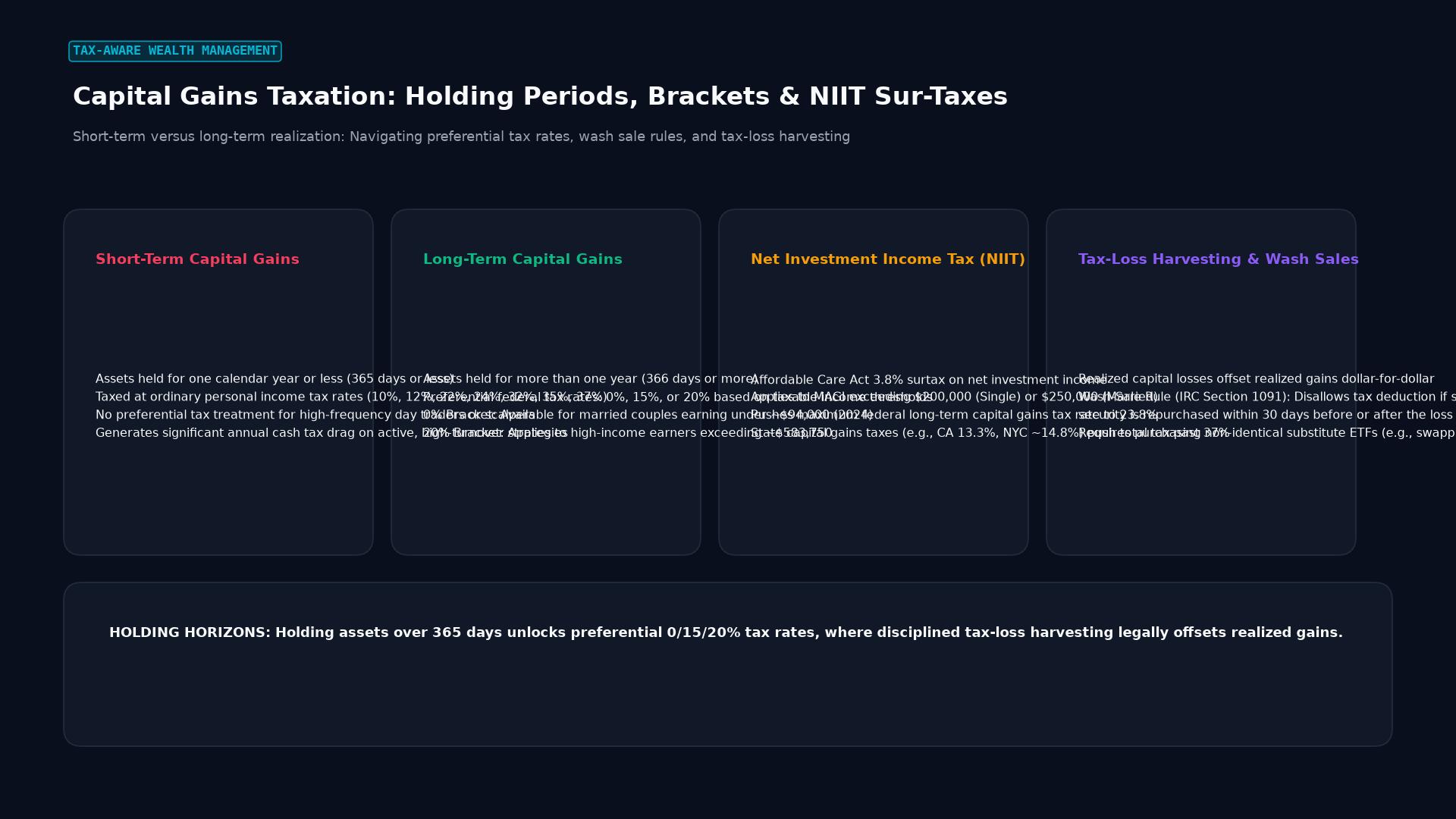 Figure: Short-term versus long-term realization: Navigating preferential tax rates, wash sale rules, and tax-loss harvesting
Realized vs. Unrealized (Paper) Capital Gains
Financial markets strictly distinguish between paper gains and cash profits:
- Unrealized Capital Gains: Occur when an open market position increases in value, but the asset has not yet been sold. The gain is reflected in real-time account equity, but because the position remains exposed to market risk, the profit can evaporate on the next tick. In most jurisdictions, unrealized gains are non-taxable until liquidated.
- Realized Capital Gains: Occur the precise microsecond an asset is sold or closed, converting the market gain into settled cash balance. Realized gains are finalized, legally immutable, and must be declared on annual tax filings.
Short-Term vs. Long-Term Capital Gains
In major financial jurisdictions (such as the United States), tax authorities apply distinct tax rates based on the investor’s holding period:
1. Short-Term Capital Gains
- Holding Period: Assets held for one year or less prior to sale.
- Tax Rate: Taxed at the investor’s ordinary income tax bracket (ranging from 10% to 37% in the U.S.). Day traders and short-term swing traders face this higher tax burden on typical retail equities and crypto trading.
2. Long-Term Capital Gains
- Holding Period: Assets held for more than one year prior to sale.
- Tax Rate: Rewarded with preferential, significantly lower tax rates (0%, 15%, or 20%, depending on taxable income). This tax structure is explicitly designed to incentivize long-term capital formation and investment.
Taxation of Foreign Exchange Trading: Section 988 vs. Section 1256
In the United States, currency traders navigate specialized provisions of the Internal Revenue Code (IRC):
1. IRC Section 988 (Standard Retail Forex Rules)
- By default, all over-the-counter (OTC) spot forex trading falls under Section 988.
- Profits and losses are treated as ordinary income or ordinary loss, rather than capital gains.
- The Advantage: Net trading losses can be deducted dollar-for-dollar against ordinary salary income without the $3,000 annual capital loss limitation.
2. IRC Section 1256 (The 60/40 Rule for Futures & Options)
- Traders operating in regulated currency futures on the CME (or spot forex traders who formally elect out of Section 988) qualify for Section 1256 treatment.
- Under the 60/40 rule, regardless of how short the holding period is (even a 5-second scalping trade):
- 60% of gains are taxed at the lower long-term capital gains rate.
- 40% of gains are taxed at the short-term ordinary income rate.
- This blended rate produces a maximum federal tax rate of 26.8%, compared to 37% under standard short-term rates, providing massive tax savings for high-volume traders.
International Tax Differences (UK Spread Betting)
In the United Kingdom, financial spread betting on currency pairs is legally classified by HMRC as gambling rather than investment. Consequently, UK retail traders pay 0% Capital Gains Tax and 0% Stamp Duty on spread betting profits, whereas Contracts for Difference (CFDs) are subject to standard Capital Gains Tax.
Tax-Loss Harvesting: Offsetting Gains with Losses
A core strategy deployed by institutional wealth managers and sophisticated private investors is tax-loss harvesting:
$$\text{Net Taxable Capital Gain} = \sum \text{Capital Gains} - \sum \text{Capital Losses}$$
Practical Example
An investor realizes +$40,000 in capital gains from selling tech equities during the year:
- Before December 31, the investor closes a losing bond position carrying an unrealized loss of -$25,000.
- The realized $25,000 capital loss offsets the gain directly: $$\text{Net Taxable Gain} = $40,000 - $25,000 = $15,000$$
- The investor saves thousands of dollars in taxes while redeploying the remaining cash into alternative assets.
(Note: In equity markets, investors must adhere to the Wash-Sale Rule, which disallows tax deductions if the identical security is repurchased within 30 days before or after the sale).
Comparative Matrix: Income Categories in Finance
| Income Classification | Source of Return | Taxation Trigger | Standard Tax Rate | Loss Deduction Rules |
|---|---|---|---|---|
| Capital Gains | Appreciation of asset sale price over cost | Moment asset is sold (Closed) | Preferential (0%–20% Long-term) | Offsets capital gains + $3,000 ordinary |
| Ordinary Income | Salary, wages, commissions, business revenue | When earned or received | Marginal brackets (10%–37%) | Subject to standard deductions |
| Dividend Income | Corporate cash distribution of profits | Payment distribution date | Ordinary or Qualified (0%–20%) | Cannot be offset by capital losses |
| Interest Income | Bond coupons, savings deposits, swaps | Settlement accrual date | Ordinary income tax rates | Treated as general income |
Key Takeaways
- A capital gain is the realized profit earned when an asset is sold for more than its adjusted cost basis.
- Unrealized gains reflect open paper profits and are generally not taxed until finalized.
- Long-term capital gains (assets held over one year) enjoy substantially lower tax rates than short-term gains.
- Currency traders in the U.S. navigate Section 988 (ordinary income) or Section 1256 (60/40 capital gains split).
- Tax-loss harvesting allows investors to offset capital gains against realized losses, minimizing annual tax liabilities.
Frequently Asked Questions
Can capital losses eliminate my entire tax bill?
In the United States, capital losses can offset an unlimited amount of capital gains. If total losses exceed total gains, an investor can deduct up to $3,000 of net capital losses against ordinary income per year, carrying forward any remaining losses indefinitely into future tax years.
How does cost basis work when buying shares at different prices?
When accumulating an asset across multiple transactions at different prices, investors determine cost basis using standard accounting conventions: FIFO (First-In, First-Out), LIFO (Last-In, First-Out), or Specific Identification (selecting the exact high-cost tax lot to minimize capital gains upon sale).
Are rollover swap fees included in forex capital gains calculations?
Yes. Overnight financing charges and rollover swap credits modify the net realized return of the trade, adjusting the final profit or loss recorded on the broker’s annual tax statement.
What is the primary difference between a capital gain and a dividend?
A capital gain is generated when you sell an asset for a higher price than you paid for it. A dividend is a periodic cash distribution paid directly from a company’s corporate earnings while you continue holding the asset.
Ready to trade forex?
Open a free demo account with a regulated broker. Practice with virtual funds before risking real money.