CDCU
A financial acronym for Community Development Credit Union, a specialized, member-owned cooperative financial institution chartered to provide affordable credit and financial services to underserved, low-income, and marginalized communities.
What Does CDCU Stand For in Finance?
In cooperative banking and social finance, the acronym CDCU stands for Community Development Credit Union. A CDCU is a specialized, non-profit, member-owned financial cooperative organized specifically to deliver affordable credit, capital, and basic banking services to low-income populations, distressed urban neighborhoods, persistent poverty rural communities, and demographic groups historically excluded from the mainstream banking sector.
Unlike conventional commercial banks that maximize shareholder return on equity, or traditional employer-based credit unions formed around corporate employee groups, a CDCU focuses on poverty alleviation, predatory lending remediation, and local wealth accumulation. Insured by the National Credit Union Share Insurance Fund (NCUSIF) and supervised by the National Credit Union Administration (NCUA), CDCUs blend cooperative principles with targeted community development lending.
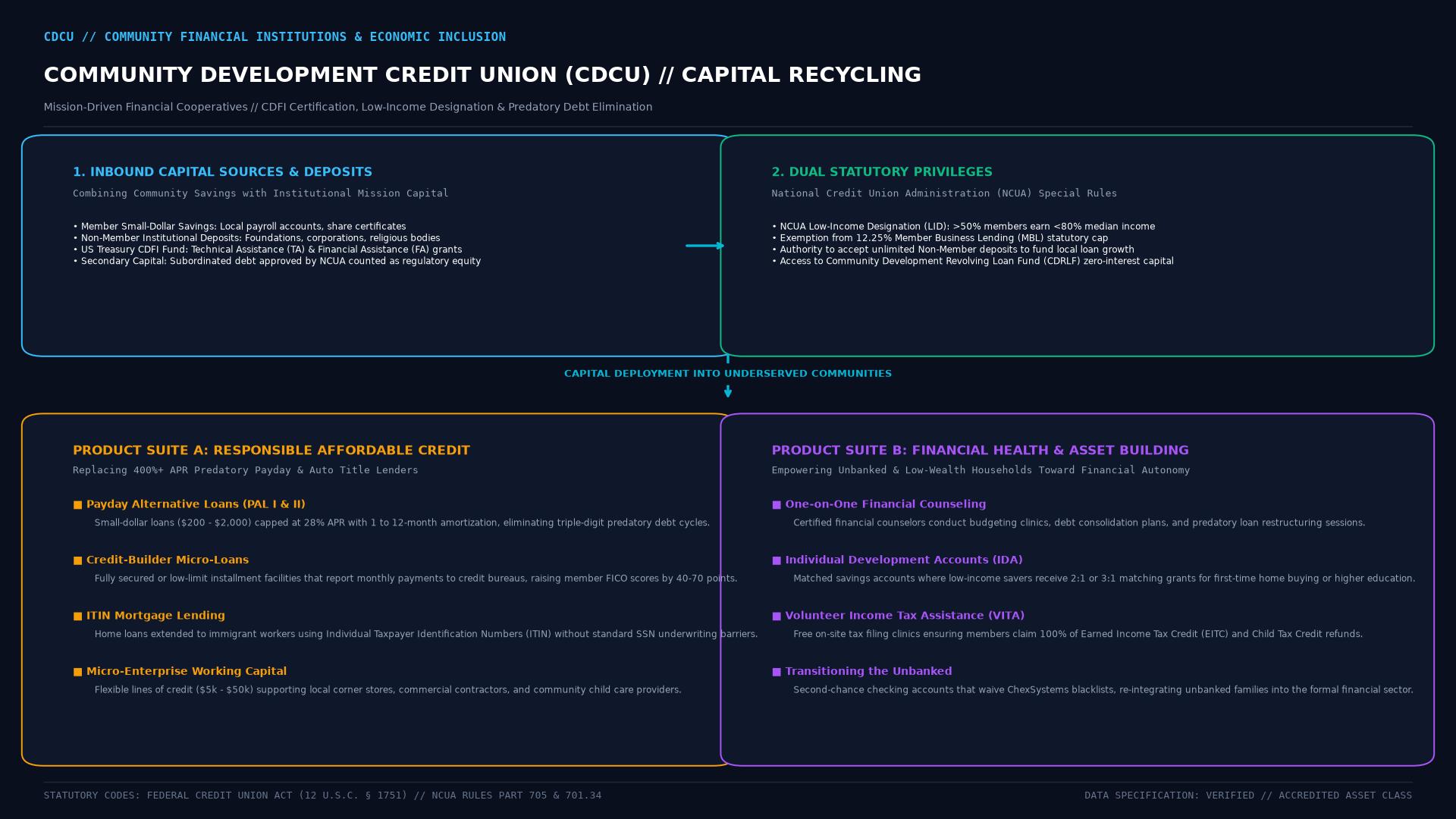 Figure: Community Development Credit Union (CDCU) capital recycling framework detailing blended external capital conduits, NCUA low-income statutory privileges, and community wealth building.
Regulatory Framework and The Low-Income Designation (LID)
In the United States, the majority of CDCUs operate under the formal regulatory designation of a Low-Income Credit Union (LICU) granted by the NCUA under Title 12 of the Code of Federal Regulations (12 C.F.R. § 701.34).
To qualify for LID status, a credit union must demonstrate that a majority (at least 50.01%) of its actual or potential membership qualifies as low-income, defined as:
- Individuals earning no more than 80% of the national median family income, or
- Individuals earning no more than 80% of the median family income for the local metropolitan area or state, or
- Residents of geographical areas designated as distressed by the US Census Bureau.
+------------------------------------+------------------------------------+
| Standard Federal Credit Union Rule | CDCU / LICU Regulatory Exemption   |
+------------------------------------+------------------------------------+
| Member Business Lending (MBL) Cap: | Statutorily EXEMPT from the 12.25% |
| Capped at 12.25% of total assets   | MBL cap under 12 U.S.C. § 1757a.   |
| under the Credit Union Membership  | Can allocate unlimited capital to  |
| Access Act of 1998 (CUMAA).        | local small business loans.        |
|                                    |                                    |
| Non-Member Deposit Limitation:     | Permitted to accept non-member     |
| Strictly prohibited or capped at   | deposits up to 20% of total shares |
| nominal thresholds.                | (or higher with regional approval).|
|                                    |                                    |
| Subordinated Debt Prohibition:     | Permitted to issue Subordinated    |
| Net worth derived solely from      | Debt (Secondary Capital) that      |
| retained earnings (reserves).      | counts directly toward regulatory  |
|                                    | net worth ratios.                  |
+------------------------------------+------------------------------------+
These three statutory exemptions are vital to CDCU solvency. Because low-income members have limited disposable savings, a CDCU cannot rely solely on member deposits to fund loan demand. The ability to import outside non-member deposits from philanthropic foundations, impact investors, and commercial banks fulfilling Community Reinvestment Act (CRA) mandates enables the CDCU to scale its local loan book.
Specialized Financial Products and Interventions
CDCUs design proprietary financial products to replace predatory financial services such as payday lenders, check-cashing storefronts, and title-pawn operators:
1. Payday Alternative Loans (PALs)
Governed by NCUA regulations, PALs provide immediate cash relief to borrowers facing emergencies without usurious interest rates:
- Loan Size: Typically $200 to $2,000.
- Interest Rate Cap: Strictly capped under federal credit union usury ceilings (typically 28% APR, compared to 400%+ charged by commercial payday storefronts).
- Underwriting: Structured with affordable amortization schedules (1 to 12 months), with an application fee capped at $20.
2. Credit-Builder and ITIN Lending
CDCUs issue secured credit-builder loans where the borrowed funds are placed into a frozen certificate account while the member makes monthly payments. Each on-time payment is reported to the major credit bureaus, establishing or repairing the member credit score. Many CDCUs also underwrite mortgages and auto loans using Individual Taxpayer Identification Numbers (ITIN), providing financing to immigrant workers lacking Social Security numbers.
3. Individual Development Accounts (IDAs)
CDCUs frequently administer IDA programs offering matched savings accounts. For every dollar a low-income member saves toward higher education, first-time homeownership, or small business capitalization, public or philanthropic funds match the contribution (e.g., 2:1 or 3:1 match ratios).
Treasury CDFI Certification and Capital Access
Nearly all CDCUs pursue formal certification as a Community Development Financial Institution (CDFI) through the CDFI Fund of the United States Department of the Treasury, established under the Riegle Community Development and Regulatory Improvement Act of 1994.
CDFI certification provides credit unions with access to competitive federal financial awards:
- Financial Assistance (FA) Awards: Direct cash grants used to build loan loss reserves, capitalize lending pools, or invest in digital banking technology.
- Technical Assistance (TA) Grants: Capacity-building capital utilized to train credit union officers, improve cybersecurity, and conduct community needs assessments.
- Emergency Capital Investment Program (ECIP): Established under the Consolidated Appropriations Act of 2021, ECIP deployed billions of dollars in low-cost, 30-year subordinated debt and preferred equity directly into CDCUs and minority depository institutions (MDIs) to support communities affected by economic downturns.
Inclusiv: The National CDCU Network
The collective interests of CDCUs are represented by Inclusiv (originally founded in 1974 as the National Federation of Community Development Credit Unions / NFCDCU).
Inclusiv operates as an institutional intermediary, providing:
- Inclusiv Capital: Managing specialized secondary capital investment funds that inject subordinated capital into member credit unions to boost regulatory net worth.
- Secondary Market Mortgage Facility: Purchasing non-conforming, mission-driven mortgages originated by CDCUs, removing loans from small balance sheets to free up liquidity for new community lending.
- Technical Advocacy: Defending the credit union tax-exempt status under Internal Revenue Code Section 501(c)(14) and lobbying Congress for continuous CDFI Fund appropriations.
Frequently Asked Questions
How does a CDCU differ from a traditional commercial bank?
A commercial bank is a for-profit corporation owned by equity stockholders who expect dividend distributions and share price appreciation. A CDCU is a non-profit cooperative owned democratically by its depositors (members), where each member gets one vote regardless of how much money they have deposited. All operating surpluses are returned to members through lower loan rates, higher savings dividends, and free financial education.
Are deposits in a CDCU safe and federally insured?
Yes. Member deposits in a federally chartered or state-chartered CDCU are backed by the full faith and credit of the United States government through the National Credit Union Share Insurance Fund (NCUSIF). Deposits are insured up to at least $250,000 per individual depositor, identical to FDIC coverage for commercial bank accounts.
Can an individual or corporation deposit money in a CDCU if they live outside the community?
Yes. Because CDCUs hold the NCUA Low-Income Designation (LID), they are legally authorized to accept non-member deposits from socially responsible individuals, foundations, faith organizations, and commercial corporations located anywhere in the country. These non-member deposits function as impact investments that expand the CDCU community lending capacity.
Ready to trade forex?
Open a free demo account with a regulated broker. Practice with virtual funds before risking real money.