CDFI
A financial acronym for Community Development Financial Institution, a certified mission-driven lender dedicated to delivering responsible, affordable capital to economically distressed, underserved communities.
What Does CDFI Stand For in Finance?
In public finance, social impact investing, and community banking, the acronym CDFI stands for Community Development Financial Institution. A CDFI is a specialized, mission-driven financial institution certified by the United States Department of the Treasury that delivers responsible, affordable credit, capital, and financial services to economically distressed populations, low-wealth communities, and commercial markets underserved by traditional mainstream financial institutions.
Established into federal law under the Riegle Community Development and Regulatory Improvement Act of 1994 (codified at 12 U.S.C. § 4701 et seq.), the CDFI framework bridges the gap between private capital markets and economically marginalized neighborhoods. By providing flexible loan structures, technical assistance, and equity investments, CDFIs finance affordable housing complexes, small businesses, community healthcare centers, grocery stores in food deserts, and local infrastructure projects.
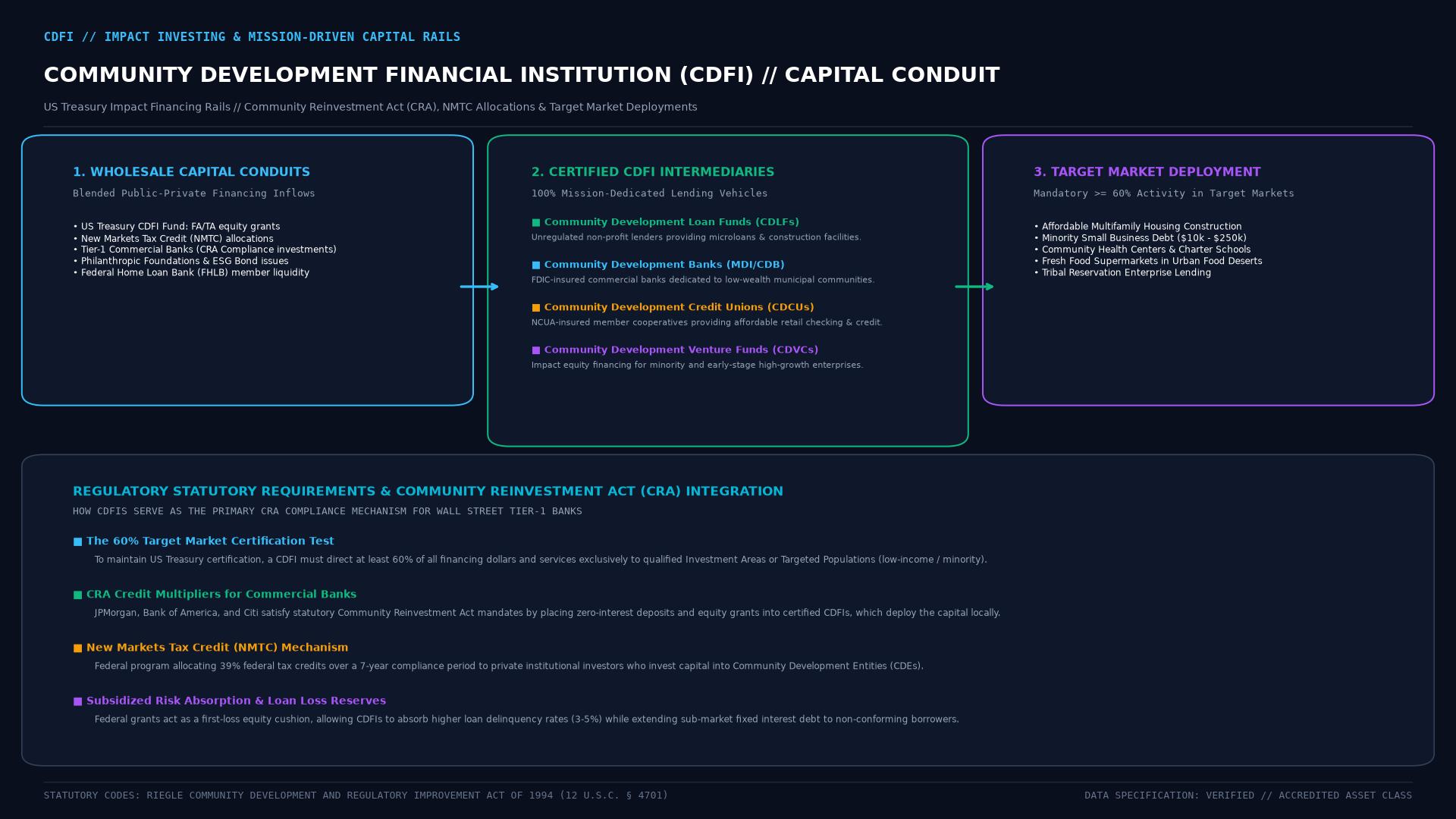 Figure: Community Development Financial Institution (CDFI) capital conduit architecture showing wholesale public-private funding conduits, CRA bank investments, and high-impact target market deployments.
The Four Institutional Categories of CDFIs
The Treasury Department certifies four distinct legal structures under the broad CDFI umbrella, each tailored to specific financial market segments:
+------------------------------------+------------------------------------+
| Institutional Category             | Capital Structure & Mission Focus  |
+------------------------------------+------------------------------------+
| Community Development Loan Funds   | Primarily non-profit revolving     |
| (CDLFs): Approximately 50% to 60%  | loan pools. Specialize in micro-   |
| of all certified CDFIs.            | enterprise debt, affordable rental |
|                                    | housing, and non-profit facilities.|
|                                    |                                    |
| Community Development Credit       | Member-owned, non-profit financial |
| Unions (CDCUs): Regulated and      | cooperatives insured by NCUSIF.    |
| insured by the NCUA.               | Provide consumer credit, PAL loans,|
|                                    | and basic deposit services.        |
|                                    |                                    |
| Community Development Banks        | For-profit commercial banks and    |
| (CDBs): Insured by the FDIC and    | thrifts with private equity backing|
| regulated by OCC/Fed/FDIC.         | focused on local business lending. |
|                                    |                                    |
| Community Development Venture      | For-profit or non-profit venture   |
| Capital Funds (CDVCs): Highly      | funds providing risk equity capital|
| specialized equity investors.      | to high-growth community firms.    |
+------------------------------------+------------------------------------+
Federal Certification Standards: 12 C.F.R. § 1805.201
To qualify for official CDFI certification from the Community Development Financial Institutions Fund (CDFI Fund), an applicant entity must satisfy seven statutory criteria:
- Primary Mission: Must have an overarching corporate mission promoting community development and economic self-sufficiency.
- Financing Entity: Must demonstrate that its predominant business activity is the provision of loans, equity investments, or guarantees.
- Target Market: Must direct at least 60% of all its financial activities (by both total loan volume and number of transactions) to qualified Investment Areas or Targeted Populations (low-income individuals or designated demographic groups).
- Development Services: Must provide structured development services alongside financing, including small business bookkeeping clinics, homebuyer counseling, or entrepreneurship workshops.
- Accountability: Must maintain formal governing or advisory boards that include verified representatives from the designated Target Market.
- Non-Governmental Entity: Must operate as an independent entity, free from direct control by federal, state, or municipal government agencies (with narrow exceptions for tribal entities).
- Comprehensive Integrity: Must maintain sound financial standing, verified regulatory compliance, and transparent underwriting manuals.
Flagship Federal Programs of the CDFI Fund
The CDFI Fund administers several major federal financing vehicles that inject liquidity into certified institutions:
1. The New Markets Tax Credit (NMTC) Program
Authorized under Internal Revenue Code (IRC) Section 45D, the NMTC attracts private corporate capital into distressed communities. The program awards tax credit allocation authority to certified Community Development Entities (CDEs). Private institutional investors (such as major commercial banks) invest equity into a CDE in exchange for a federal income tax credit equal to 39% of the qualified investment claimed over a seven-year credit period (5% per year for the first three years, and 6% per year for the remaining four years).
2. Financial Assistance (FA) and Technical Assistance (TA) Awards
The CDFI Fund distributes direct competitive federal grants through annual funding rounds:
- Financial Assistance (FA): Matching grants that require the CDFI to raise non-federal matching funds, utilized to establish loan loss reserves, build balance sheet equity, or fund new credit lines.
- Technical Assistance (TA): Capacity grants that do not require non-federal matching, utilized to upgrade management information systems, recruit specialized underwriters, or conduct market research.
3. The CDFI Bond Guarantee Program
Designed for large-scale financing, this program provides a 100% federal guarantee on long-term bonds issued by qualified CDFIs. The bonds are purchased directly by the Federal Financing Bank (FFB), providing certified lenders with low-cost, fixed-rate capital with maturities up to 30 years to finance major commercial real estate, rural hospitals, and charter school campuses.
Relationship with the Community Reinvestment Act (CRA)
Large commercial depository banks (such as JPMorgan Chase, Bank of America, and Wells Fargo) operate as the largest private capital providers to CDFIs. This relationship is driven by the Community Reinvestment Act of 1977 (CRA).
Under CRA regulations administered by the Federal Reserve, the OCC, and the FDIC, commercial banks are evaluated on their performance in meeting the credit needs of their entire communities, including low- and moderate-income (LMI) neighborhoods:
  Commercial Bank CRA Obligation
                │
                ▼
  Injects Low-Cost Wholesale Debt & Equity into Certified CDFI
                │
                ▼
  Receives Positive Qualified Investment / Lending CRA Examination Credits
                │
                ▼
  CDFI Deploys Capital to Local Micro-Borrowers (Bypassing Bank Fixed Overhead)
Because retail bank branches often cannot cost-effectively underwrite a $25,000 micro-business loan or a complex multi-layered affordable housing development, commercial banks channel capital into CDFIs. The banks earn CRA regulatory compliance credit, while the CDFI absorbs the intensive localized underwriting and servicing.
Frequently Asked Questions
Are loans from a CDFI considered charitable grants that do not need to be repaid?
No. CDFIs are professional lending institutions, not charities. Borrowers must undergo underwriting and execute binding promissory notes with agreed repayment schedules. However, CDFI loan terms are significantly more flexible than commercial bank debt, often featuring lower down payments, longer amortization terms, lower interest rates, and flexible collateral requirements.
How do CDFIs maintain low default rates while lending to distressed markets?
CDFIs maintain historically low historical loss rates (often under 2% to 3%) by pairing credit with mandatory development services. Loan officers provide intensive pre-loan financial coaching, assist borrowers with cash flow management, and conduct ongoing operational monitoring, addressing business distress long before an account enters formal default.
Can a for-profit enterprise receive financing from a CDFI?
Yes. CDFIs frequently finance for-profit small businesses, retail shops, manufacturing facilities, independent trucking operators, and family daycare centers, provided the business operates within a designated low-income census tract or creates quality jobs for low-income residents.
Ready to trade forex?
Open a free demo account with a regulated broker. Practice with virtual funds before risking real money.