CDR
A multi-faceted financial acronym representing Chinese Depository Receipts in cross-border equity, Corporate Debt Restructuring in distressed debt workouts, and Constant Default Rate in structured credit analytics.
What Does CDR Stand For in Finance?
In global finance, capital markets, and quantitative credit risk management, the acronym CDR has three distinct meanings depending on the operational context:
- Chinese Depository Receipt (Cross-Border Equity): A financial instrument issued by a Chinese depositary bank that represents underlying shares in an overseas-incorporated corporation (or offshore red-chip technology giant), allowing foreign and offshore Chinese enterprises to list and trade on domestic Chinese exchanges (Shanghai and Shenzhen).
- Corporate Debt Restructuring (Distressed Banking & Workouts): A formalized, out-of-court institutional process through which a consortium of commercial lenders negotiates with an over-indebted but commercially viable corporate borrower to reorganize repayment schedules, reduce interest margins, or convert debt into equity.
- Constant Default Rate (Structured Credit & Fixed Income): An annualized quantitative metric used by bond rating agencies, investment banks, and collateralized debt obligation (CDO) managers to measure the annualized percentage of loans within a securitized portfolio (such as an RMBS or ABS pool) that default.
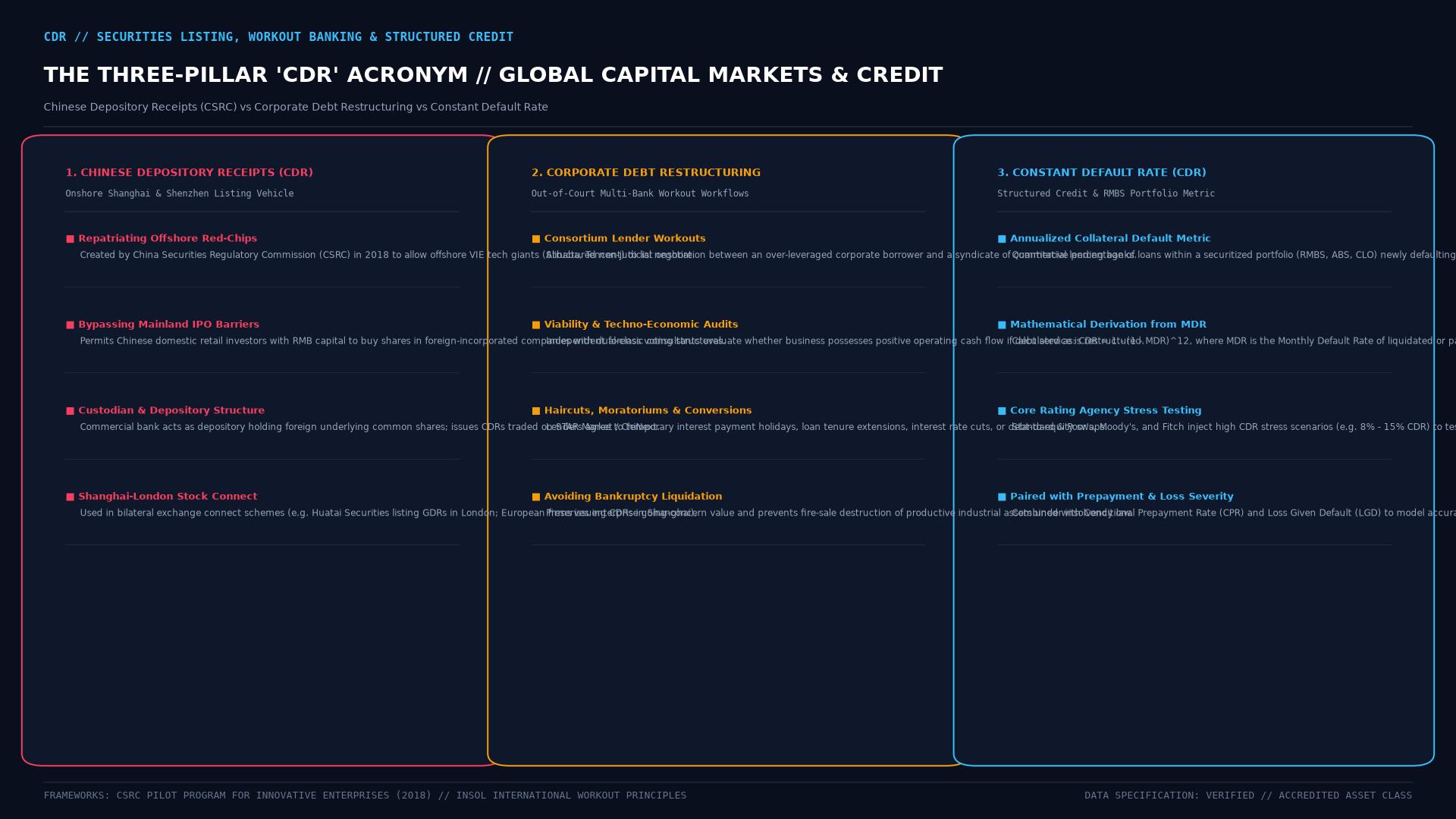 Figure: The three pillars of the CDR acronym: Chinese Depository Receipts (CDRs) for domestic tech listing, out-of-court Corporate Debt Restructuring workouts, and Constant Default Rate (CDR) portfolio metrics.
1. Chinese Depository Receipts (CDRs)
Historically, China’s most prominent technology and internet conglomerates (including Alibaba, Tencent, Baidu, and JD.com) were incorporated in offshore tax havens (such as the Cayman Islands) using Variable Interest Entity (VIE) structures and dual-class voting shares. Because Chinese domestic securities law prohibited foreign-incorporated companies with weighted voting rights from conducting domestic Initial Public Offerings (A-shares), domestic retail and institutional investors were barred from purchasing these tech leaders on onshore exchanges.
To remedy this capital dislocation, the China Securities Regulatory Commission (CSRC) designed the Chinese Depository Receipt (CDR) framework in 2018:
- Structure: Modelled after American Depositary Receipts (ADRs), an offshore corporation deposits a block of ordinary shares with a custodian bank. An onshore Chinese depositary issues electronic CDRs denominated in Chinese Yuan (CNY) listed on the Shanghai Stock Exchange (SSE) or Shenzhen Stock Exchange (SZSE).
- The Shanghai-London Stock Connect: The CDR mechanism expanded through the Shanghai-London Stock Connect program, enabling London Stock Exchange listed multinational companies to issue CDRs in Shanghai, while qualified Chinese listed companies issue Global Depository Receipts (GDRs) in London and Zurich.
2. Corporate Debt Restructuring (CDR)
In commercial banking, Corporate Debt Restructuring (CDR) is a institutional workout mechanism designed to resolve non-performing assets outside the formal court-supervised bankruptcy process (such as US Chapter 11 or UK Administration).
Consortium debt workouts follow standardized central banking frameworks (such as the historical CDR guidelines established by the Reserve Bank of India and equivalent Asian banking regulators):
+------------------------------------+------------------------------------+
| Workout Phase                      | Institutional Action & Restructuring|
+------------------------------------+------------------------------------+
| Viability Assessment:              | Independent techno-economic study  |
| Lenders evaluate whether business  | verifies that core operations have |
| can service debt under new terms.  | positive cash flow potential.      |
|                                    |                                    |
| Creditor Majority Approval:        | Typically requires consent of 75%  |
| Prevents rogue minority holdouts.  | of creditors by debt value and     |
|                                    | 60% of creditors by number.        |
|                                    |                                    |
| Restructuring Concessions:         | Implementation of interest payment |
| Structural loan contract terms.    | moratoriums, debt-to-equity swaps, |
|                                    | term extensions, and haircut caps. |
|                                    |                                    |
| Promoter Sacrifice:                | Promoters must inject fresh equity |
| Accountability safeguards.         | and pledge personal guarantees to  |
|                                    | prevent strategic moral hazard.    |
+------------------------------------+------------------------------------+
By restructuring debt through CDR, commercial banks avoid writing off massive portions of their corporate loan portfolios, while borrowers preserve ongoing operations and maintain employee payrolls without triggering public liquidations.
3. Constant Default Rate (Quantitative Structured Finance)
In fixed-income analytics and the securitization of residential mortgages (RMBS), commercial mortgages (CMBS), and auto loans (ABS), the Constant Default Rate (CDR) is a standard input for cash-flow waterfall modeling.
The CDR represents the annualized percentage of principal in an underlying asset pool that enters default during a given observation period.
Derivation from the Monthly Default Rate (MDR)
Analysts calculate defaults on a monthly cadence using the Monthly Default Rate (MDR):
$$\text{MDR}_t = \frac{\text{Unpaid Principal Balance of Newly Defaulted Loans in Month } t}{\text{Beginning Pool Principal Balance} - \text{Scheduled Principal Repayments}}$$
To convert the monthly default rate into an annualized Constant Default Rate (CDR), fixed income analysts apply a compounding formula:
$$\text{CDR} = 1.0 - (1.0 - \text{MDR})^{12}$$
$$\text{MDR} = 1.0 - (1.0 - \text{CDR})^{\frac{1}{12}}$$
  Monthly Default Rate (MDR)    Compounding Algorithm              Annual Constant Default Rate (CDR)
  ---------------------------------------------------------------------------------------------------
  0.10% per month               1 - (1 - 0.0010)^12                 1.19% Annualized CDR
  0.25% per month               1 - (1 - 0.0025)^12                 2.96% Annualized CDR
  0.50% per month               1 - (1 - 0.0050)^12                 5.84% Annualized CDR
  1.00% per month               1 - (1 - 0.0100)^12                11.36% Annualized CDR
  2.00% per month               1 - (1 - 0.0200)^12                21.53% Annualized CDR
Valuation Modeling in Securitization Tranches
Portfolio managers pricing mortgage bonds pair the CDR with two other quantitative metrics:
- Constant Prepayment Rate (CPR): Measuring voluntary early principal payoffs.
- Loss Severity (1 - Recovery Rate): The percentage of defaulted balance not recovered through property foreclosure or asset auction.
$$\text{Annual Expected Cash Loss} = \text{Pool Principal} \times \text{CDR} \times \text{Loss Severity}$$
If an analyst projects that subprime mortgage defaults will spike from a 3% CDR to a 15% CDR, the waterfall model simulates the rapid exhaustion of the junior, equity, and mezzanine tranches of the securitization structure, determining whether senior AAA-rated bonds will suffer principal impairments.
Frequently Asked Questions
What is the difference between Constant Default Rate (CDR) and Cumulative Default Rate?
The Constant Default Rate (CDR) is an annualized, annualized rate measuring the pace at which loans are defaulting during a specific interval. The Cumulative Default Rate measures the total percentage of the original loan balance that has defaulted since the securitization deal was closed up to the present observation date.
How does a company qualify to issue Chinese Depository Receipts (CDRs)?
Under CSRC regulations, an enterprise seeking to issue CDRs must operate within high-tech or strategic emerging industries (such as artificial intelligence, cloud computing, or semiconductors), possess proprietary core technologies, and maintain a minimum market valuation (typically at least 200 billion RMB, or 20 billion RMB for firms with high revenue growth).
What happens if a corporate debtor fails to meet the terms of a CDR workout agreement?
If a corporate borrower defaults on its revised obligations under an approved Corporate Debt Restructuring package (for instance, by failing to pay restructured interest or missing an operational milestone), lenders terminate the CDR agreement. The loan account is immediately downgraded to Non-Performing Asset (NPA) status, and the banking consortium initiates formal insolvency or asset seizure proceedings through commercial bankruptcy courts.
Ready to trade forex?
Open a free demo account with a regulated broker. Practice with virtual funds before risking real money.