Credit Risk
Credit risk is the probability of financial loss resulting from a borrower's or counterparty's failure to meet contractual debt obligations, encompassing debt service coupon payments and principal repayment.
What Is Credit Risk?
Credit risk (historically termed default risk) is the fundamental financial hazard that a borrower, debt issuer, or transactional counterparty will fail to satisfy their legally binding contractual debt obligations in full and on time. Credit risk permeates all debt-financed economic activity, from retail mortgages and corporate bonds to sovereign debt issuance and interbank foreign exchange clearing.
When a debtor defaults, the creditor faces immediate loss of scheduled interest coupon cash flows, partial or total loss of principal capital, and substantial legal restructuring expenses. Under modern regulatory capital frameworks (such as Basel III for global commercial banks), institutions are legally required to hold dedicated regulatory capital reserves calibrated to the precise probability of default and loss severity across their loan and trading portfolios.
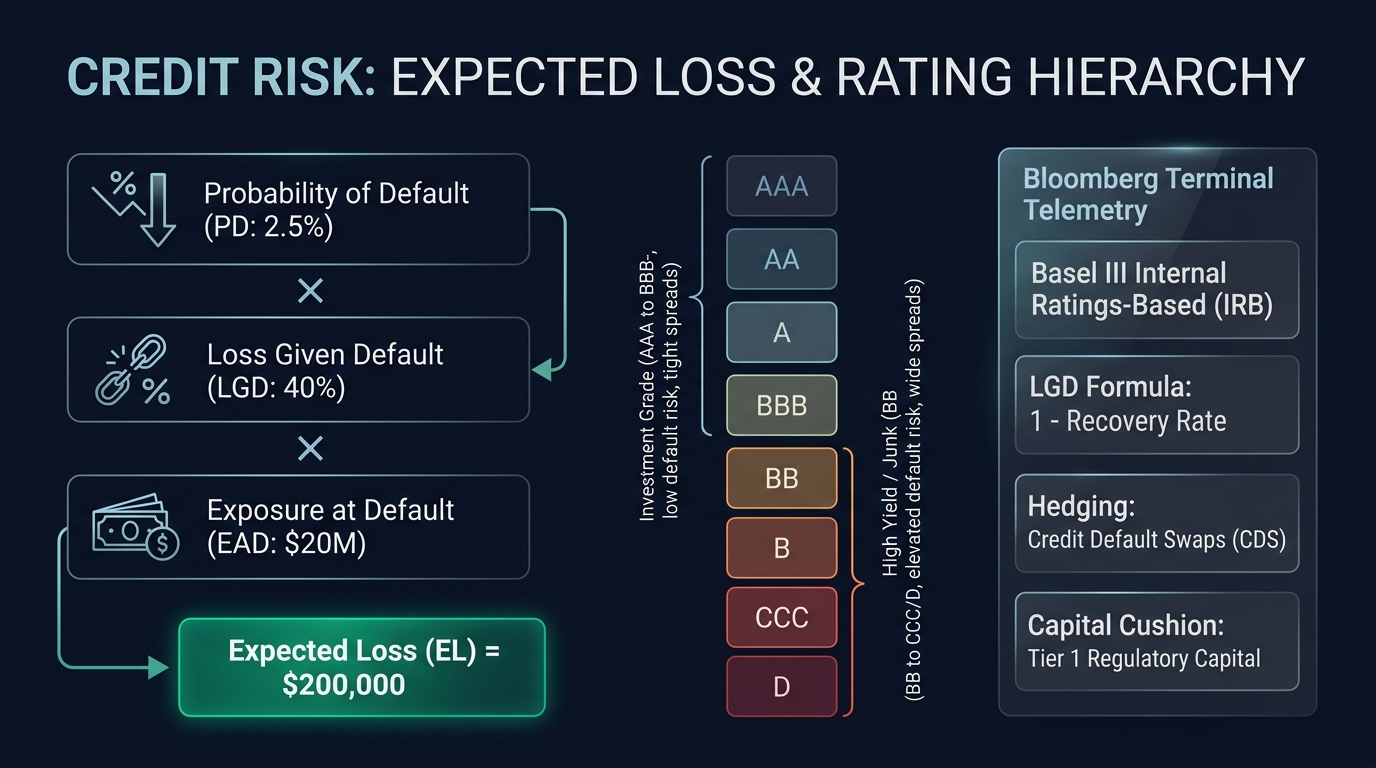
Credit Risk Analytical Components:
┌────────────────────────────────────────────────────────┐
│                   EXPECTED LOSS (EL)                   │
└──────────────────────────┬─────────────────────────────┘
                           │
      ┌────────────────────┼────────────────────┐
      ▼                    ▼                    ▼
┌──────────────┐     ┌──────────────┐     ┌──────────────┐
│  PROBABILITY │     │   LOSS GIVEN │     │   EXPOSURE   │
│  OF DEFAULT  │  ×  │    DEFAULT   │  ×  │  AT DEFAULT  │
│     (PD)     │     │    (LGD)     │     │    (EAD)     │
└──────────────┘     └──────────────┘     └──────────────┘
Key Takeaways
- The Expected Loss Equation: Banks quantify credit risk via the foundational formula: $\text{Expected Loss} = \text{PD} \times \text{LGD} \times \text{EAD}$.
- Credit Rating Hierarchy: Global rating agencies (Moody’s, S&P, Fitch) stratify credit risk into Investment Grade (AAA down to BBB-) and High Yield / Speculative Grade (“Junk” bonds rated BB+ and below).
- Credit Risk in Forex: In foreign exchange, credit risk takes the form of Settlement Risk (Herstatt risk) and Replacement Cost Risk if an OTC derivative counterparty enters bankruptcy before contract maturity.
- Credit Spread Pricing: The higher the borrower’s perceived credit risk, the wider the credit spread they must pay above risk-free sovereign benchmarks (such as U.S. Treasuries).
Mathematical Formulation: The Expected Loss (EL) Model
Under Basel Committee regulatory guidelines, financial institutions model credit risk through three quantitative parameters:
$$\text{Expected Loss (EL)} = \text{PD} \times \text{LGD} \times \text{EAD}$$
Where:
- Probability of Default (PD): The statistical likelihood ($0%$ to $100%$) that the counterparty will experience a formal credit default event within a 1-year horizon.
- Loss Given Default (LGD): The economic percentage of total exposure that will be permanently lost after all collateral liquidation, seniority claims, and legal recovery processes are completed: $$\text{LGD} = 1 - \text{Recovery Rate (R)}$$
- Exposure at Default (EAD): The gross dollar value of outstanding debt, drawn credit lines, and positive mark-to-market derivative values at the precise moment of default.
Practical Institutional Calculation:
- A regional commercial bank extends a $20,000,000 loan to a manufacturing firm.
- Internal risk models assign a $\text{PD} = 2.5%$ over the coming 12 months.
- Historical recovery for senior secured industrial assets estimates $R = 60%$, meaning $\text{LGD} = 40%$ ($1.00 - 0.60$).
- Current outstanding drawn balance: $\text{EAD} = $20,000,000$.
$$\text{Expected Loss} = 0.025 \times 0.40 \times $20,000,000 = $200,000$$
The bank must set aside $200,000 in loan loss provisions directly against its current-quarter net income.
The Credit Rating Spectrum
Credit rating agencies evaluate the creditworthiness of corporate and sovereign debt issuers, establishing standardized risk tiers:
| S&P / Fitch Rating | Moody’s Equivalent | Classification | Historical 5-Year Default Rate | Market Profile |
|---|---|---|---|---|
| AAA | Aaa | Prime Investment Grade | $< 0.05%$ | Near-zero default risk (U.S., Germany, Microsoft, J&J) |
| AA+ to AA- | Aa1 to Aa3 | High Grade | ~0.15% | Exceptionally strong financial capacity |
| A+ to A- | A1 to A3 | Upper Medium Grade | ~0.60% | Strong balance sheet; sensitive to macro downturns |
| BBB+ to BBB- | Baa1 to Baa3 | Lower Medium Grade | ~2.00% | Lowest tier of Investment Grade; vulnerable to downgrades |
| BB+ to BB- | Ba1 to Ba3 | Non-Investment Grade | ~8.50% | “Junk / Speculative”; speculative credit profile |
| B+ to B- | B1 to B3 | Highly Speculative | ~20.00% | High probability of default in economic contraction |
| CCC / D | Caa / C | Distressed / Default | > 45.00% | In active default, restructuring, or imminent bankruptcy |
The “Fallen Angel” Hazard: When an issuer drops from BBB- to BB+, it falls across the boundary into junk status. Institutional pension funds and insurers are legally prohibited from holding junk debt and must fire-sell the bonds, triggering an aggressive credit spread widening and currency sell-off.
Credit Risk in Foreign Exchange and Retail Trading
While retail traders think of forex as purely directional price speculation, credit risk underpins the entire market plumbing:
1. Counterparty Broker Risk
When you deposit $10,000 with a retail broker, you are extending unsecured credit to that brokerage firm. If the broker mismanages risk, operates an insolvent B-book dealing desk, or commingles funds without regulatory segregation, your capital can be wiped out in a bankruptcy proceeding regardless of your trading success.
2. Settlement Risk in Interbank Dealing
In spot foreign exchange, payments are bilateral and multi-currency. If Bank A transfers $100,000,000 USD to Bank B at 10:00 AM New York time, but Bank B collapses before delivering the equivalent €92,000,000 in Frankfurt at 4:00 PM, Bank A loses 100% of its principal—a credit failure known as Herstatt risk (mitigated today by Continuous Linked Settlement - CLS).
Real-World Case Study: The 2008 Lehman Brothers Credit Shock
On September 15, 2008, investment bank Lehman Brothers filed for Chapter 11 bankruptcy holding over $600 billion in debt, unleashing the worst credit crisis in modern history.
The Systemic Credit Freeze:
- Over the prior weekend, Lehman failed to secure an emergency private buyer or Federal Reserve backstop.
- Interbank Lending Paralyzed: Because global tier-one banks held hundreds of billions in bilateral OTC derivative contracts with Lehman as counterparty, nobody knew which institutions were solvent.
- The TED Spread Surge: The TED Spread (the yield spread between 3-month interbank LIBOR and risk-free 3-month U.S. Treasury bills)—the benchmark metric for systemic credit risk—blew out from a baseline of ~30 bps to an all-time record 464 basis points.
- Currency Impact: European and Asian banks faced an acute dollar shortage, sparking a massive global liquidity scramble that drove the U.S. Dollar sharply higher as institutions hoarded cash.
Frequently Asked Questions
What is the difference between credit risk and market risk?
Market risk is the danger of losses arising from movements in market prices, exchange rates, or equity valuations across open positions. Credit risk is the danger that a specific contractual debtor or counterparty fails entirely to meet their financial promises or repay borrowed principal.
How do banks mitigate credit risk?
Institutions mitigate credit risk through four primary methods: collateralization (requiring borrowers to pledge real estate or liquid securities), netting agreements (offsetting reciprocal claims via ISDA contracts), credit insurance / derivatives (purchasing Credit Default Swaps), and syndication (distributing large loans across multiple banks).
What is Credit Valuation Adjustment (CVA)?
CVA is the fair-market adjustment made to the valuation of an Over-the-Counter derivative portfolio to account for the potential future credit default of the counterparty. It discounts the unrealized paper profits of a trade based on the creditworthiness of the entity on the other side.
Ready to trade forex?
Open a free demo account with a regulated broker. Practice with virtual funds before risking real money.