CEA
A multi-faceted financial acronym denoting the Commodity Exchange Authority (historic predecessor to the CFTC under the Commodity Exchange Act) and the White House Council of Economic Advisers.
What Does CEA Stand For in Finance?
In financial market regulation, derivatives trading, and macroeconomic policymaking, the acronym CEA refers to two institutionally prominent entities:
- Commodity Exchange Authority (Derivatives History & Regulation): A historical regulatory bureau within the United States Department of Agriculture (USDA) established under the landmark Commodity Exchange Act of 1936 to police commodity futures exchanges, curb speculative manipulation, and register brokers. In 1974, Congress abolished the Authority and transferred its statutory mandate to the newly created, independent Commodity Futures Trading Commission (CFTC).
- Council of Economic Advisers (White House Macroeconomic Policy): An agency within the Executive Office of the President of the United States created by the Employment Act of 1946. Composed of academic economists, the CEA provides the US President with objective, data-driven macroeconomic analysis to guide domestic tax policy, labor legislation, international trade agreements, and fiscal stimulus packages.
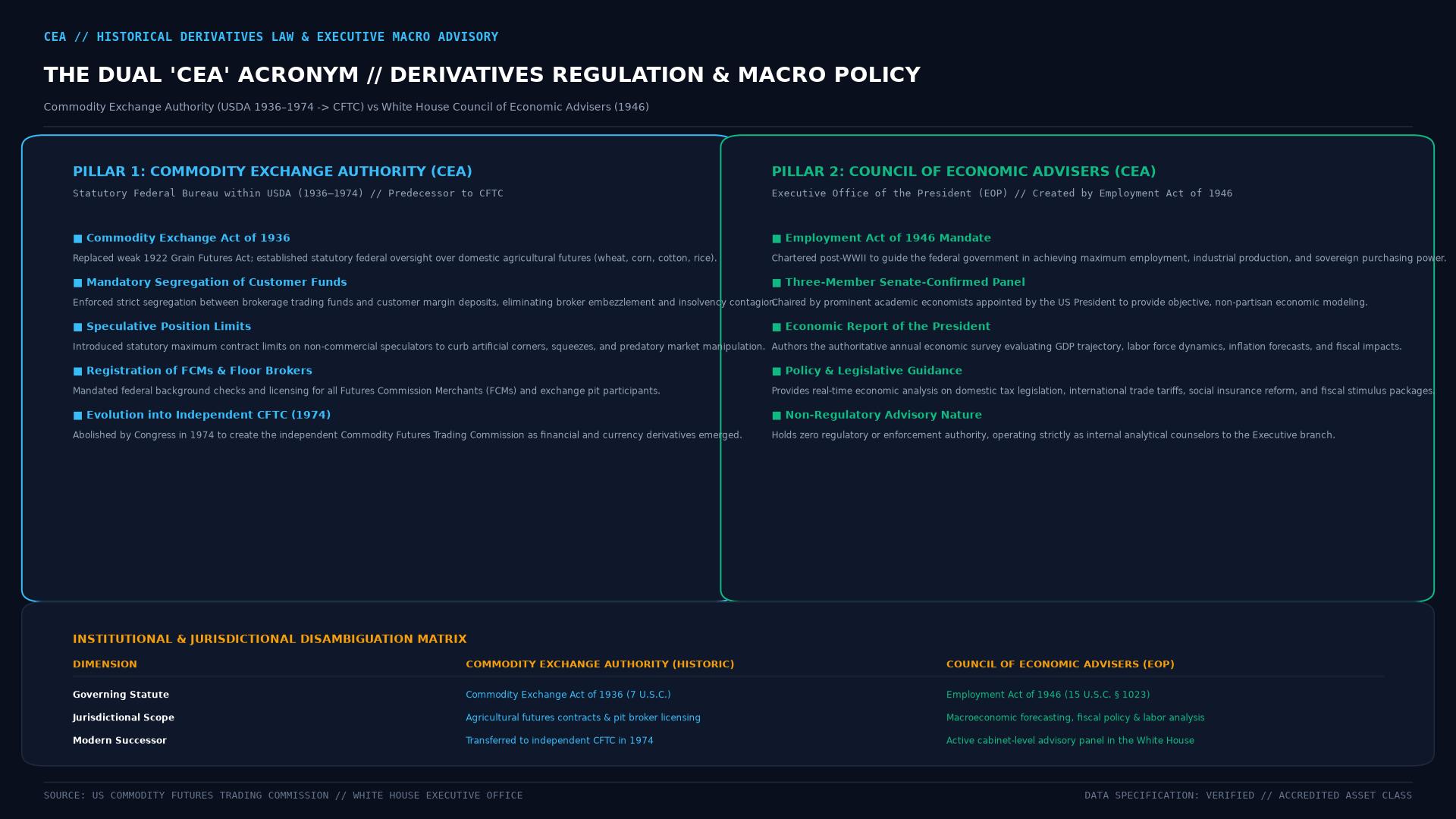 Figure: Institutional comparison of the dual ‘CEA’ acronym in American finance: The Commodity Exchange Authority (1936–1974, predecessor to the modern CFTC under the Commodity Exchange Act) versus the White House Council of Economic Advisers (established under the Employment Act of 1946).
1. The Commodity Exchange Authority and the Commodity Exchange Act
The regulatory foundation of modern global derivatives markets traces back to the agricultural crises of the 1920s and 1930s.
Legislative Origins: From the Grain Futures Act to the CEA
Following extreme volatility and market manipulation on the Chicago Board of Trade (CBOT) following World War I, Congress passed the Grain Futures Act of 1922. However, the legislation lacked adequate enforcement teeth.
In 1936, President Franklin D. Roosevelt signed the Commodity Exchange Act (CEA), codified at Title 7 of the United States Code (7 U.S.C. § 1 et seq.). The statute created the Commodity Exchange Authority within the USDA to enforce federal rules:
- Mandatory Registration: Required futures commission merchants (FCMs) and floor brokers trading designated agricultural commodities (wheat, corn, cotton, rice, soybeans) to register with the federal government.
- Segregation of Customer Funds: Enforced the segregation of customer trading deposits from brokerage operating capital, eliminating broker theft and insolvency contagion.
- Speculative Position Limits: Authorized federal regulators to impose statutory ceilings on the maximum number of speculative futures contracts an individual trader could hold, preventing speculative corners and squeezes.
+------------------------------------+------------------------------------+
| Historical Era                     | Statutory & Institutional Evolution|
+------------------------------------+------------------------------------+
| 1936–1974:                         | Commodity Exchange Authority       |
| Department of Agriculture bureau.  | regulated solely physical domestic |
|                                    | agricultural futures contracts.    |
|                                    |                                    |
| 1974 Reform:                       | Commodity Futures Trading          |
| Creation of the CFTC.              | Commission Act of 1974 created the |
|                                    | CFTC as an independent agency.     |
|                                    |                                    |
| 2000 Modernization:                | Commodity Futures Modernization    |
| The CFMA deregulatory era.         | Act of 2000 (CFMA) exempted        |
|                                    | over-the-counter swaps from CEA.   |
|                                    |                                    |
| 2010 Dodd-Frank Act:               | Title VII brought multitrillion-   |
| Sweeping post-crisis expansion.    | dollar OTC swaps, CDS, and clearing|
|                                    | houses under direct CEA authority. |
+------------------------------------+------------------------------------+
The 1974 Transition to the CFTC
By the early 1970s, derivatives trading had expanded beyond agricultural grains to encompass foreign currencies, precious metals, and financial futures. Recognizing that a sub-agency within the Department of Agriculture was unsuited to oversee global financial derivatives, Congress passed the Commodity Futures Trading Commission Act of 1974.
The legislation dissolved the Commodity Exchange Authority and transferred all statutory powers under the Commodity Exchange Act to the independent, five-member Commodity Futures Trading Commission (CFTC). The underlying statute continues to be cited in federal court as the Commodity Exchange Act (CEA).
2. The Council of Economic Advisers (White House CEA)
While the regulatory CEA governed market trading pits, the White House Council of Economic Advisers (CEA) was established by the Employment Act of 1946 in the aftermath of the Great Depression and World War II.
Institutional Mandate and Governance
Under the 1946 Act, the federal government assumed formal statutory responsibility to promote maximum employment, production, and purchasing power. The CEA was created within the Executive Office of the President to supply the Chief Executive with rigorous economic intelligence independent of cabinet departments.
The Council is led by a Chairman and two members appointed by the President and confirmed by the United States Senate, supported by a staff of senior academic economists, macroeconometricians, and post-doctoral researchers.
  White House CEA Functional Responsibilities
  ──────────────────────────────────────────────────────────────────────────
  1. The Economic Report of the President:
     Authors the comprehensive annual economic study transmitted to Congress,
     documenting macro growth trends, productivity, and fiscal baselines.

  2. Policy Impact Modeling:
     Simulates real-world effects of proposed tariffs, corporate tax rate
     changes, minimum wage adjustments, and energy subsidies.

  3. Interagency Coordination:
     Collaborates with the National Economic Council (NEC), Office of
     Management and Budget (OMB), and Department of the Treasury.

  4. Neutral Macro Forecasting:
     Prepares unbiased GDP, inflation, and unemployment assumptions used to
     construct the official annual Federal Budget proposal.
Contrast: CEA vs. National Economic Council (NEC)
Within the White House, financial commentators often confuse the Council of Economic Advisers with the National Economic Council (NEC):
- The CEA is an academic advisory body. It does not manage political negotiations or draft legislative compromises; its role is pure empirical economic research and quantitative forecasting.
- The NEC (created in 1993) is a political policy-coordination body. Headed by the Assistant to the President for Economic Policy, the NEC coordinates cabinet secretaries, negotiates with Congressional leaders, and builds coalitions to pass economic legislation.
Comparative Matrix of the Two CEAs
  Feature               Commodity Exchange Authority (USDA)           Council of Economic Advisers (White House)
  ---------------------------------------------------------------------------------------------------------------
  Primary Function      Financial derivatives market enforcement      Macroeconomic research and policy advisory
  Governing Statute     Commodity Exchange Act of 1936                Employment Act of 1946
  Jurisdiction          Futures exchanges, floor brokers, FCMs        Executive branch economic initiatives
  Modern Status         Evolved into the CFTC in 1974                 Active cabinet-level agency
  Enforcement Powers    Fines, suspensions, trading bans, court orders Zero enforcement power; advisory only
Frequently Asked Questions
Is the Commodity Exchange Act (CEA) still in force today?
Yes. Although the Commodity Exchange Authority was replaced by the CFTC in 1974, the underlying statute, the Commodity Exchange Act, remains the foundational federal law governing futures, options, and over-the-counter swaps markets in the United States. Federal prosecutors and CFTC enforcement attorneys routinely file charges citing violations of sections of the CEA (such as anti-manipulation provisions under Section 6(c) or fraud rules under Section 4b).
Does the Council of Economic Advisers set interest rates?
No. The CEA has zero authority over interest rates. Monetary policy and short-term interest rate decisions in the United States are determined exclusively by the independent Federal Open Market Committee (FOMC) of the Federal Reserve System. The CEA monitors Fed decisions and advises the President on how monetary conditions affect the broader economy.
Why was swaps trading brought under the Commodity Exchange Act in 2010?
Prior to 2010, the Commodity Futures Modernization Act of 2000 exempted most over-the-counter derivatives (such as credit default swaps and interest rate swaps) from regulation under the CEA. Following the 2008 financial crisis, Title VII of the Dodd-Frank Act amended the CEA to mandate that standardized OTC swaps must clear through central clearing houses and execute on Swap Execution Facilities (SEFs), granting the CFTC comprehensive supervisory authority over swap markets.
Ready to trade forex?
Open a free demo account with a regulated broker. Practice with virtual funds before risking real money.