CECU
A specialized financial acronym referring to Corporate Educators Credit Union, Corporate Credit Unions under NCUA Part 704, and community educational credit unions.
What Does CECU Stand For in Finance?
In cooperative banking, financial institution regulation, and credit union operations, the acronym CECU primarily refers to Corporate Educators Credit Union (or Community Educators Credit Union), identifying specialized credit unions chartered to serve teachers, university professors, school administrators, and public education professionals.
In regulatory and wholesale banking contexts, the acronym also connects to the institutional architecture of Corporate Credit Unions (governed under Title 12, Part 704 of the Code of Federal Regulations), which operate as the wholesale “banker’s banks” providing payment settlement, short-term liquidity, and investment services to retail “natural-person” credit unions across the United States.
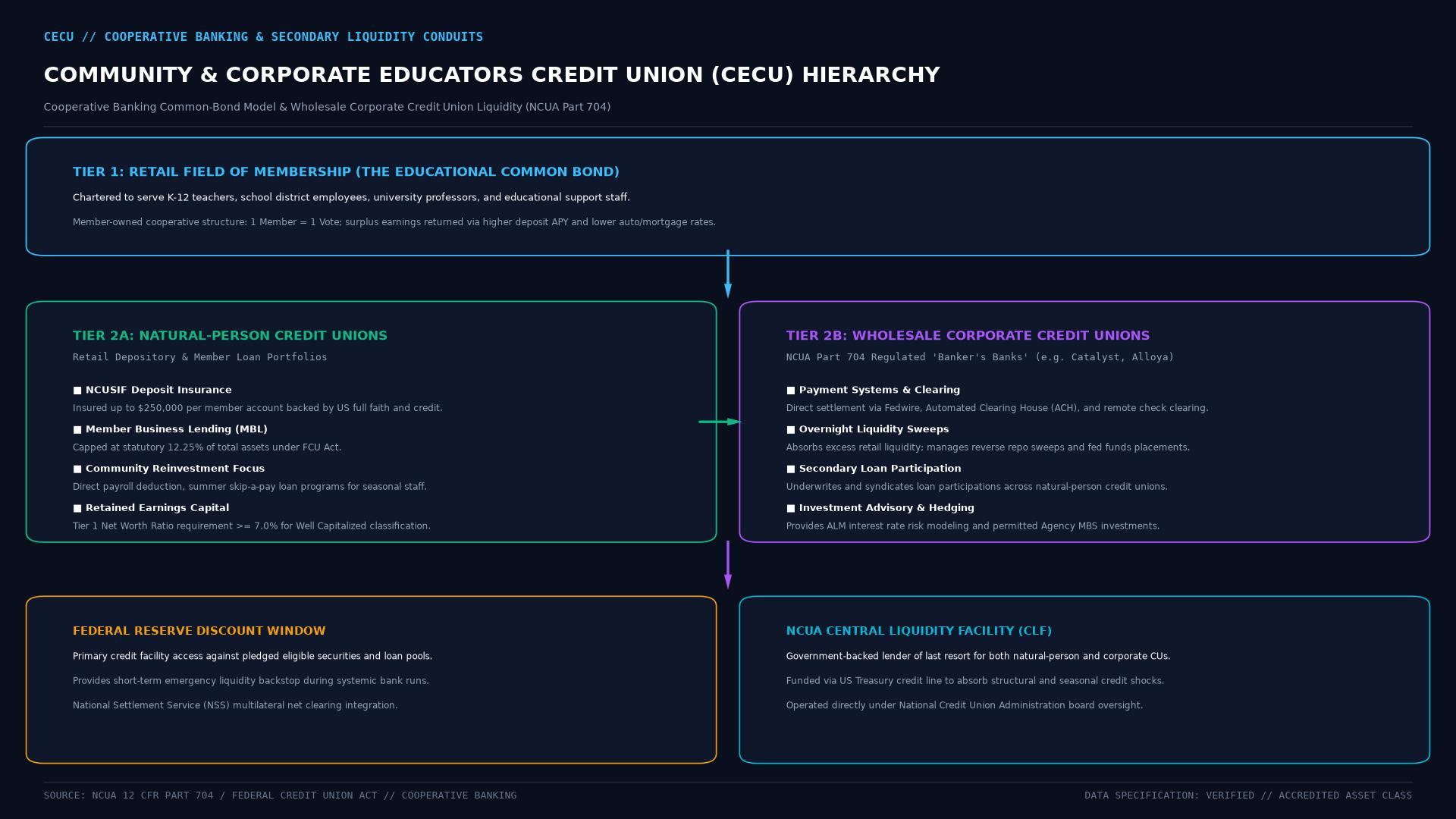 Figure: Institutional hierarchy of educator credit unions and the cooperative banking ecosystem, illustrating the educational common-bond member tier, natural-person credit union operations, the wholesale corporate credit union layer under NCUA Part 704, and emergency liquidity facilities via the Federal Reserve and the NCUA Central Liquidity Facility (CLF).
1. Educator Credit Unions: The Common Bond Principle
Under the Federal Credit Union Act of 1934 (12 U.S.C. § 1759), a credit union must be organized around a defined field of membership known as a common bond. Historically, common bonds were strictly enforced across three categories:
- Occupational Common Bond: Employees of the identical employer or school district.
- Associational Common Bond: Members of a specific labor union, religious body, or professional association.
- Community Common Bond: Residents of a well-defined local geographical neighborhood or rural county.
The Educational Mandate
Educator credit unions (such as Corporate Educators Credit Union, Community Educators Credit Union, or Educational Employees Credit Union) were founded during the mid-20th century by public school teachers. During this era, commercial banks frequently denied personal credit lines to female teachers without a husband signature or viewed seasonal summer teaching breaks as credit risks.
By pooling personal savings, teachers established self-funded cooperative credit institutions:
- Summer Paycheck Smoothing: Automated savings programs that set aside portions of ten-month academic salaries to distribute level paychecks across the two unpaid summer months.
- Classroom Supply Micro-Loans: Low-interest or zero-interest micro-loans allowing educators to purchase instructional supplies without incurring credit card debt.
- Public Service Student Loan Forgiveness (PSLF) Coaching: Free financial counseling assisting education professionals with federal loan forgiveness certification.
Following the Credit Union Membership Access Act of 1998 (CUMAA), many educator credit unions expanded their charters from single-district occupational bonds to broader community charters, serving all residents, students, and businesses across their regional educational districts.
2. Corporate Credit Unions (NCUA Part 704 Governance)
While educator credit unions serve retail human members (termed “natural persons”), they rely on an underlying institutional wholesale layer known as Corporate Credit Unions:
+------------------------------------+------------------------------------+
| Wholesale Corporate Service        | Operational Function for Retail CUs|
+------------------------------------+------------------------------------+
| Payment Systems & Settlement:      | Acts as the clearing gateway for   |
| Clearing millions of transactions. | ACH transfers, mobile check        |
|                                    | capture, and wire transfers.       |
|                                    |                                    |
| Liquidity Pooling & Overnight Sweeps| Absorbs surplus cash deposits from |
| Interbank liquidity management.    | retail credit unions and provides  |
|                                    | secured borrowing lines of credit. |
|                                    |                                    |
| Asset-Liability Management (ALM):  | Delivers quantitative balance      |
| Advisory & risk analytics.         | sheet stress tests, duration models|
|                                    | and fixed-income safekeeping.      |
+------------------------------------+------------------------------------+
The 2010 Corporate System Crisis and Regulatory Reform
Between 2004 and 2007, several of the largest corporate credit unions in the country (most notably U.S. Central Corporate Federal Credit Union and Western Corporate Federal Credit Union / WesCorp) pursued aggressive yield strategies. They invested hundreds of billions of dollars of member credit union reserves into private-label, subprime mortgage-backed securities (MBS) and collateralized debt obligations (CDOs).
When the US housing market collapsed in 2008, these wholesale portfolios suffered catastrophic credit losses:
- In March 2009, the National Credit Union Administration (NCUA) placed U.S. Central and WesCorp into federal conservatorship.
- The NCUA established the Corporate System Resolution Program (CSRP), issuing tens of billions of dollars in government-guaranteed NCUA Guaranteed Notes (NGNs) to isolate distressed legacy assets.
- Retail credit unions nationwide were assessed billions of dollars in statutory stabilization premiums over multiple years to replenish the National Credit Union Share Insurance Fund (NCUSIF).
  Key Post-Crisis Regulatory Reforms Under 12 C.F.R. Part 704
  ──────────────────────────────────────────────────────────────────────────
  1. Ban on Private-Label Securitization:
     Corporate credit unions are prohibited from purchasing private-label MBS,
     subprime ABS, or complex subordinated debt tranches.

  2. Strict Tier 1 Capital Mandates:
     Institutions must maintain robust Retained Earnings ratios (Tier 1 Risk-
     Based Capital of at least 4.0% to 5.0%) without counting member deposits.

  3. Single-Obligor Exposure Caps:
     Exposure to any single commercial issuer is capped at modest percentages
     of capital, eliminating asset concentration risks.

  4. Decoupling of Advisory Services:
     Strict structural separation between investment product sales and balance
     sheet advisory services to eliminate conflicts of interest.
Following these reforms, the surviving corporate credit union sector (including institutions like Catalyst Corporate FCU, Corporate One FCU, and Alloya Corporate FCU) operates with conservative investment portfolios concentrated in US Treasuries, agency debentures, and cash deposits at the Federal Reserve.
Comparative Institutional Matrix
  Metric                Community Educators Credit Union (CECU)       Corporate Credit Union Tier
  ---------------------------------------------------------------------------------------------------------------
  Client Base           Retail individuals (teachers, school staff)    Institutional retail credit unions
  Regulatory Framework  12 C.F.R. Part 701 (Natural-Person Rules)     12 C.F.R. Part 704 (Corporate CU Rules)
  Core Lending Focus    Auto loans, mortgages, consumer lines          Lines of credit, liquidity advances
  Insurance Coverage    NCUSIF Retail Insurance ($250,000 per member)  Corporate Capital / Uninsured wholesale
  Primary Clearing Link Routes transactions via Corporate CU           Direct link to Fedwire & Automated Clearing
Frequently Asked Questions
Who owns an educator credit union?
An educator credit union is owned democratically by its members. Every member who maintains a minimum deposit in their share savings account (typically $5 to $25) owns one equal cooperative share. Regardless of whether an individual holds $50 or $500,000 on deposit, each member has one vote in annual board of directors elections.
Can someone who is not a teacher join an educator credit union?
In many cases, yes. While these institutions were originally chartered exclusively for school district employees, many have adopted community charters or expanded fields of membership. Today, membership is frequently open to immediate family members of teachers, students, alumni of local school systems, or anyone who lives, works, or worships within designated geographic boundaries.
What is the NCUA Central Liquidity Facility (CLF)?
The Central Liquidity Facility (CLF) is a mixed-ownership government corporation established by Congress within the NCUA in 1978. It operates as the lender of last resort for the credit union system, providing emergency liquidity advances to member credit unions during systemic liquidity disruptions, functioning identically to the Federal Reserve Discount Window.
Ready to trade forex?
Open a free demo account with a regulated broker. Practice with virtual funds before risking real money.