Liquidity
Liquidity in forex refers to how easily and quickly a currency pair can be bought or sold in large quantities without causing a significant change in its price. High liquidity means trades execute rapidly at the quoted price with minimal spread. Low liquidity means wider spreads, slower execution, and greater price impact when large orders enter the market.
The Most Liquid Financial Market on Earth
The global forex market processes over $7.5 trillion in daily volume (Bank for International Settlements, 2022 Triennial Survey). This makes it the most liquid financial market in the world — more liquid than global stock markets, bond markets, and commodity markets combined. This liquidity has direct, practical consequences for traders: in major currency pairs, you can buy or sell $10 million without meaningfully moving the market.
That said, liquidity is not evenly distributed. It varies by pair, by session, by time of day, and by market conditions. Understanding where and when liquidity is deep or shallow is fundamental knowledge for anyone trading forex professionally.
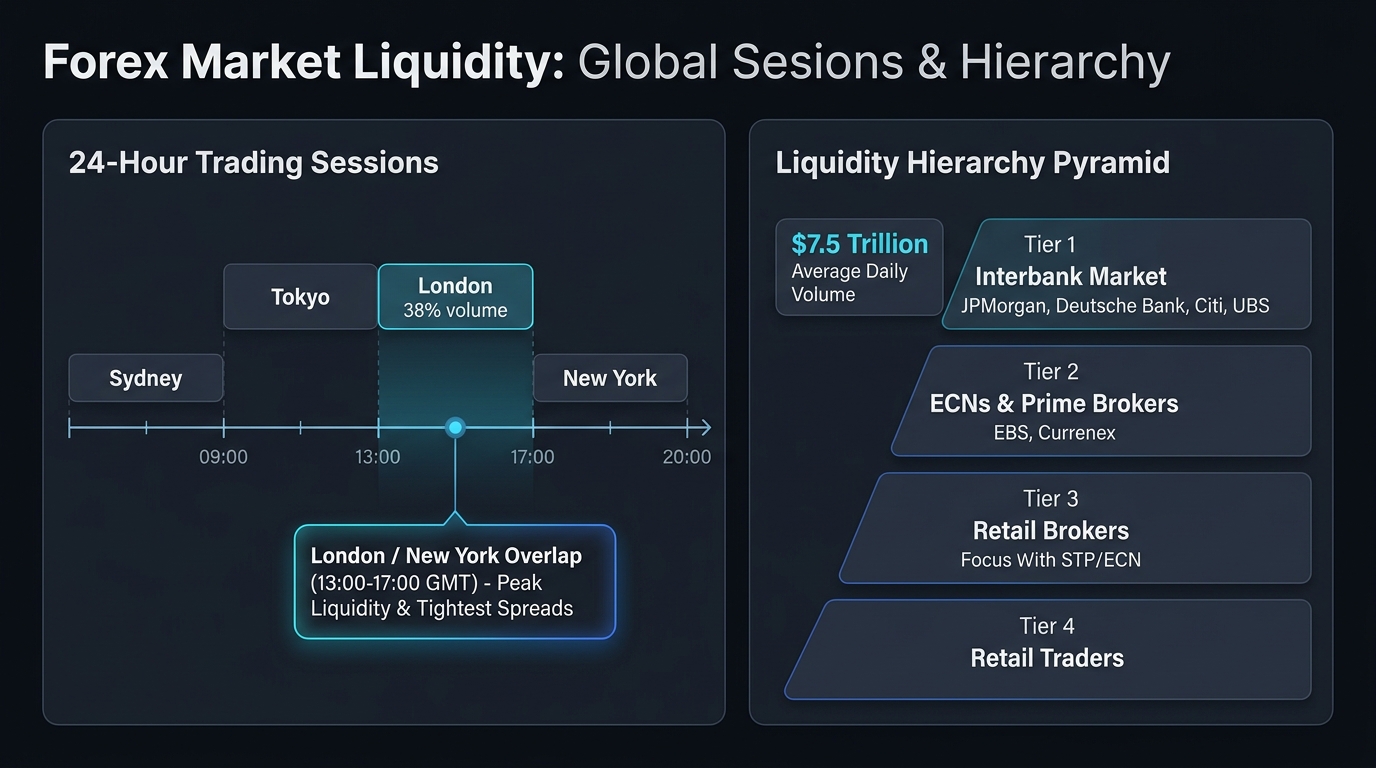
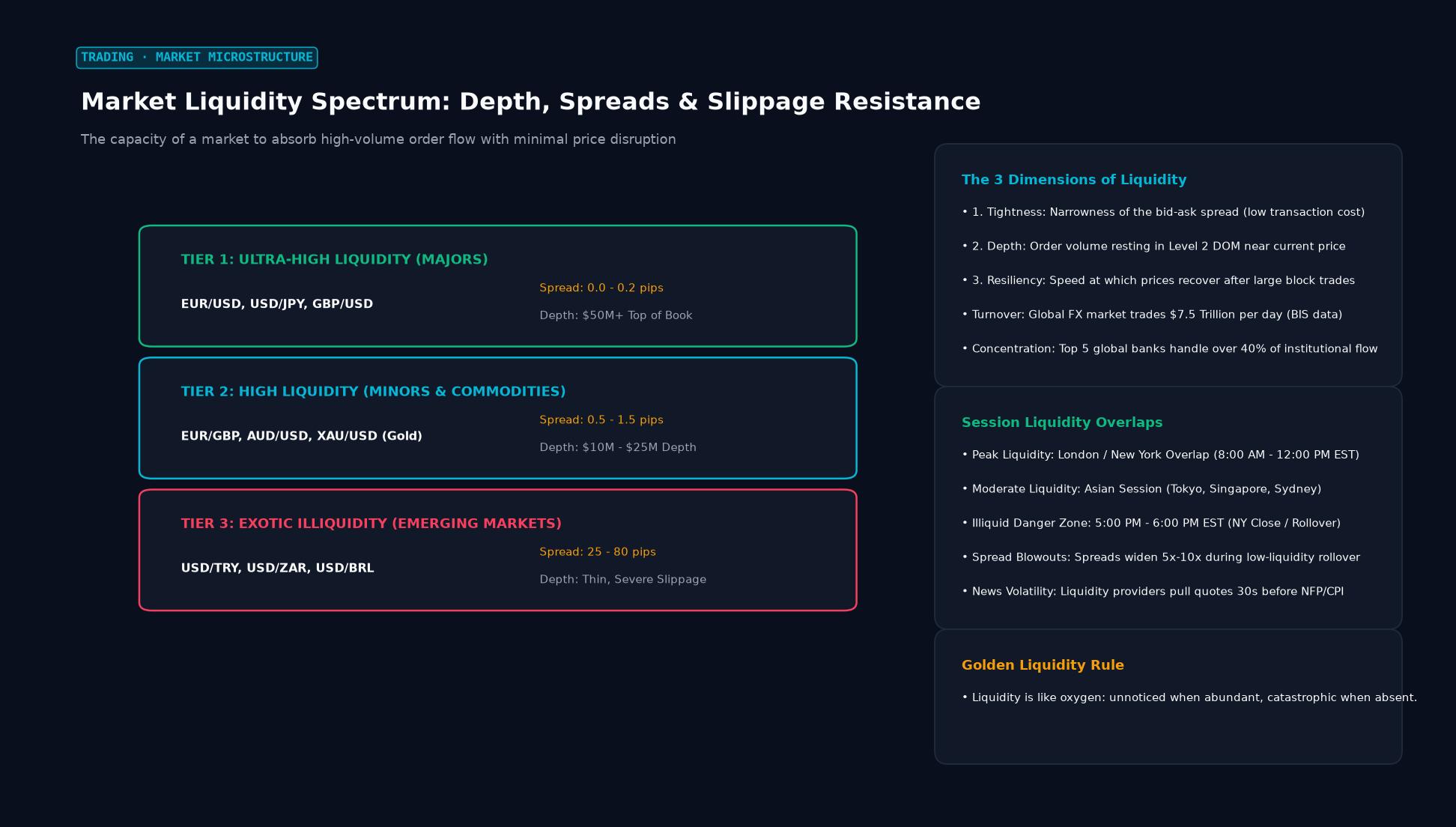 Figure: The capacity of a market to absorb high-volume order flow with minimal price disruption
What Creates Liquidity
Liquidity in forex comes from the overlapping activity of multiple participant types:
Commercial banks: The primary source. Banks handle corporate FX transactions, manage their own currency positions, and provide quotes to other market participants. The top 5 banks (JPMorgan, Deutsche Bank, Citi, HSBC, UBS) account for a significant fraction of global interbank FX volume.
Central banks: Mostly peripheral liquidity providers — they don’t trade for profit — but their intervention activity can temporarily flood the market with large order flow.
Hedge funds and institutional investors: Major secondary liquidity sources. Their large orders can absorb or add to market depth.
Retail brokers and market makers: Aggregate retail order flow and hedge it in the interbank market, effectively channeling retail demand into the overall liquidity pool.
High-frequency trading (HFT) firms: Provide substantial short-term liquidity by posting aggressive bid-ask quotes and reacting to market imbalances in microseconds.
Liquidity Across Sessions
The forex market’s 24-hour structure means liquidity varies through the day:
Sydney session (22:00–07:00 GMT): Lowest volume globally. AUD/NZD pairs most active. Major pairs (EUR/USD, GBP/USD) are relatively quiet — spreads widen, price can be choppy without clear direction.
Tokyo session (00:00–09:00 GMT): Moderate liquidity for Asian currencies (JPY, AUD, NZD). Still quiet for European pairs.
London session (08:00–17:00 GMT): Major liquidity event. London handles the largest share of global FX volume (~38% of daily activity). Major pairs come alive; spreads tighten to their lowest levels of the day.
New York session (13:00–22:00 GMT): Second largest volume hub. USD pairs most active. Peak liquidity during the London-New York overlap.
Overlap (13:00–17:00 GMT): The most liquid 4-hour window of the trading week. EUR/USD, GBP/USD spreads at absolute minimums. Market moves are cleanest and most reliable technical setups tend to form here.
Liquidity in Different Currency Pairs
Major pairs benefit from the deepest liquidity:
- EUR/USD: The most liquid pair (~28% of all FX volume). Spreads of 0.1 pips or less on top ECN accounts during peak hours
- USD/JPY, GBP/USD, USD/CHF, AUD/USD, USD/CAD: High liquidity, competitive spreads
Crosses (no USD): Moderate liquidity. EUR/GBP, EUR/JPY, GBP/JPY are actively traded but with wider spreads than majors.
Exotics: Low liquidity. USD/TRY, USD/ZAR can have spreads of 30-100+ pips. A $1 million order in USD/ZAR visibly moves the price in a way that the same order in EUR/USD would not.
How Liquidity Affects Your Trading
Tight spreads: High liquidity = cheaper transaction costs. EUR/USD at 0.1 pip spread vs. USD/TRY at 50 pips — the cost difference per trade is enormous at scale.
Execution quality: In liquid markets, market orders fill at or very near the quoted price. In thin markets, slippage is common because there aren’t enough counterparties at each price level.
Technical reliability: Technical analysis works better in liquid markets where patterns reflect genuine collective decision-making by thousands of participants. In thin markets, a single large order can distort chart patterns without representing true market sentiment.
Flash crashes: Periods of sudden, extreme illiquidity — often caused by algorithmic trading feedback loops or major news gaps — can produce violent, temporary price distortions. The January 2019 flash crash in AUD/JPY produced an 800-pip move in under 10 minutes before rapid recovery. Low liquidity amplified what should have been a moderate move.
Key Takeaways
- Forex is the world’s most liquid financial market at $7.5 trillion daily volume
- Liquidity varies by pair, session, and market conditions — highest during London-New York overlap
- High liquidity = tighter spreads, better execution, lower slippage, more reliable technical setups
- Exotic pairs can have 10-100x wider spreads than major pairs due to thinner liquidity
- Flash crashes are extreme illiquidity events — rapid, temporary dislocations amplified by algorithmic activity
FAQ
Does high liquidity mean prices are always fair? Generally yes — in liquid markets, prices quickly reflect all available information because many participants compete to transact at the best prices. But even in highly liquid markets, short-term dislocations occur. Liquidity ≠ efficiency, especially during the immediate aftermath of major news surprises.
Can retail traders affect forex market liquidity? Individual retail trades have no perceptible impact on a $7.5 trillion/day market. Even aggregated retail flow represents a small fraction of total volume. This is a feature, not a bug — retail traders can enter and exit without moving the market against themselves, which is not the case in small-cap stock markets.
Ready to trade forex?
Open a free demo account with a regulated broker. Practice with virtual funds before risking real money.