CHF
The ISO 4217 currency code for the Swiss Franc, the official legal tender of Switzerland and Liechtenstein, renowned globally as a premier safe-haven reserve currency.
What is the CHF (Swiss Franc)?
CHF is the ISO 4217 three-letter currency code for the Swiss Franc, the official national currency and legal tender of the Swiss Confederation and the Principality of Liechtenstein (under the 1980 customs and currency union treaty). Deriving its Latin abbreviation from Confoederatio Helvetica Franc, the currency is represented by the symbols Fr. or SFr. and subdivided into 100 centimes (Rappen in German, centimes in French, centesimi in Italian, and raps in Romansh).
The Swiss National Bank (SNB / Schweizerische Nationalbank), established under the National Bank Act of 1905 with headquarters in Bern and Zurich, exercises sole authority to issue Swiss banknotes and execute national monetary policy.
In global foreign exchange trading, the Swiss Franc is a member of the elite G10 currency group. Traded heavily against the US Dollar (USD/CHF, colloquially known among interbank traders as the “Swissie”) and the Euro (EUR/CHF), the Franc occupies a unique position as the preeminent international safe-haven currency. Backed by centuries of geopolitical neutrality, sound fiscal accounts, persistent current account surpluses, and high political stability, the CHF functions as a global financial refuge during periods of systemic economic crisis, war, and geopolitical turmoil.
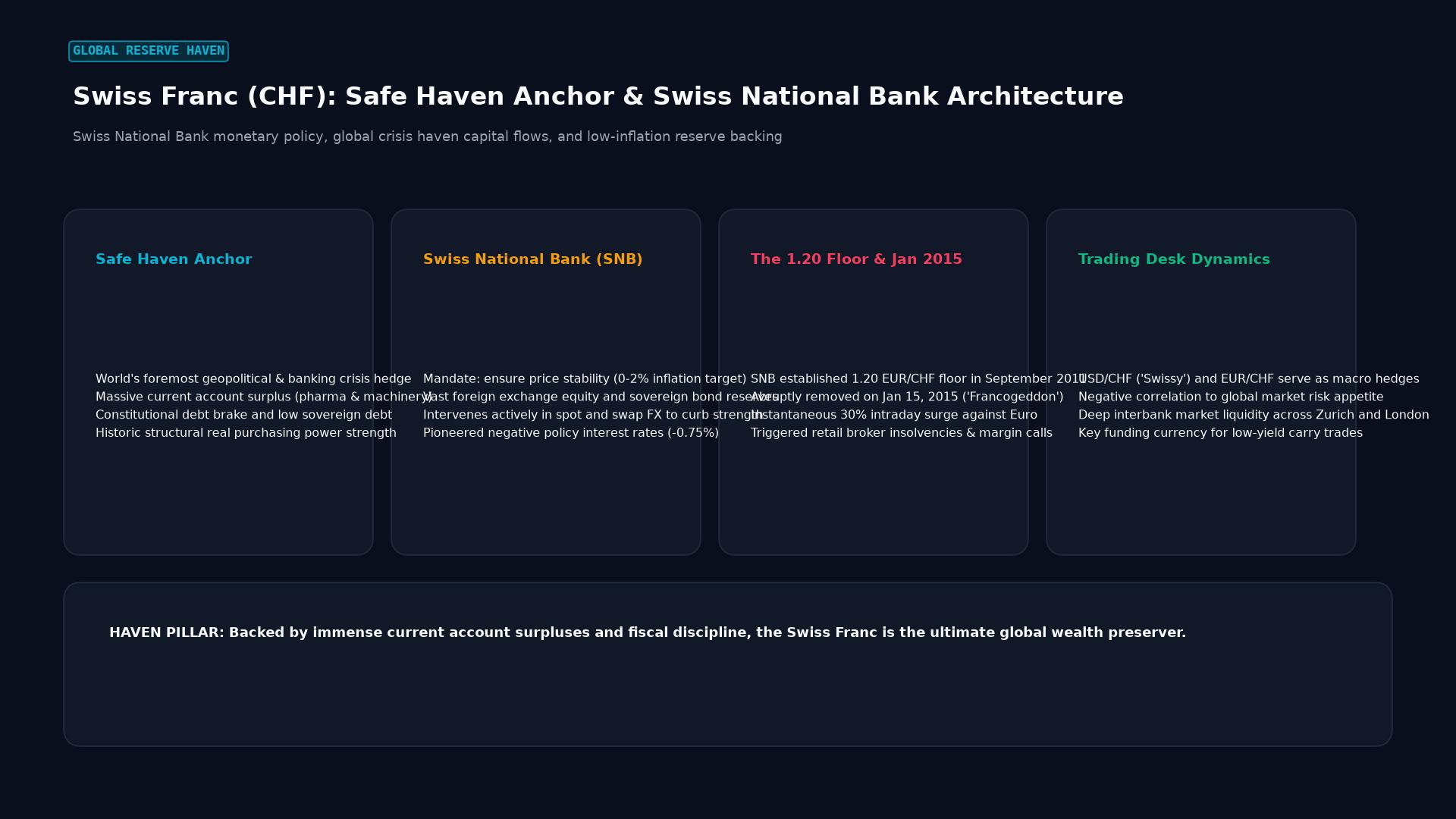 Figure: Swiss National Bank monetary policy, global crisis haven capital flows, and low-inflation reserve backing

Macroeconomic Foundations of Safe-Haven Status
The global status of the Swiss Franc as a reserve currency and safe haven is underpinned by deep macroeconomic structural pillars:
- Constitutional Neutrality and Rule of Law: Switzerland long-standing foreign policy neutrality shields it from direct involvement in foreign wars and international military sanctions.
- Structural Current Account Surpluses: Driven by high-value pharmaceutical exports (Novartis, Roche), specialized precision engineering, luxury horology, and global commodities trading houses (in Geneva and Zug), Switzerland exports far more goods and services than it imports, generating persistent organic foreign currency inflows.
- The Debt Brake (Schuldenbremse): Enshrined in Article 126 of the Swiss Federal Constitution following a 2001 national referendum, the constitutional debt brake requires the federal government to balance its budget over the business cycle, keeping Swiss sovereign debt-to-GDP among the lowest in the OECD (typically below 30%).
- Historical Gold Backing: Until a constitutional amendment in 1999, Swiss Franc banknotes were legally required to be 40% backed by physical gold reserves, establishing a cultural and institutional reputation for sound money that persists today.
The Swiss National Bank (SNB) Monetary Policy Framework
Unlike central banks with dual statutory mandates (such as the US Federal Reserve’s target of maximum employment alongside price stability), the Swiss National Bank primary constitutional mandate is to ensure price stability while taking due account of economic development.
The SNB defines price stability as a year-on-year increase in the Swiss Consumer Price Index (CPI) of between 0% and 2.0%.
+------------------------------------+------------------------------------+
| Historical SNB Policy Regime       | Operational Characteristics        |
+------------------------------------+------------------------------------+
| 2011–2015:                         | Enforced an absolute floor of      |
| The EUR/CHF 1.20 Minimum Exchange  | 1.2000 on the EUR/CHF pair through |
| Rate Floor.                        | unlimited foreign currency sales.  |
|                                    |                                    |
| 2015–2022:                         | Imposed a -0.75% deposit rate      |
| The Negative Interest Rate Era.    | on commercial bank sight balances  |
|                                    | to deter foreign capital parking.  |
|                                    |                                    |
| 2022–Present:                      | Swift return to positive policy    |
| Post-Inflation Normalization.      | rates; active two-way FX sales to  |
|                                    | prevent imported energy inflation. |
+------------------------------------+------------------------------------+
The 2015 “Franc Shock” (Frankenschock)
The defining event in modern foreign exchange history occurred on the morning of January 15, 2015.
Between September 2011 and January 2015, the SNB defended a minimum exchange rate floor of 1.2000 Francs per Euro. As the European Central Bank (ECB) prepared to launch an expansive quantitative easing (QE) bond-buying program that would flood Europe with trillions of new Euros, the SNB recognized that maintaining the 1.20 peg was mathematically impossible without printing infinite quantities of Swiss Francs and suffering catastrophic balance sheet losses.
At 09:30 CET on January 15, 2015, the SNB issued an unannounced press release terminating the 1.20 floor with immediate effect and lowering its deposit rate to -0.75%:
  Chronology of the 2015 Franc Shock
  ──────────────────────────────────────────────────────────────────────────
  09:30 CET: SNB abruptly cancels EUR/CHF 1.2000 floor.
  09:31 CET: Electronic liquidity evaporates from interbank broker feeds.
  09:35 CET: EUR/CHF collapses from 1.2000 to an intraday low of 0.8500 (-30%).
  09:45 CET: Retail FX brokerages suffer massive negative client balances;
             Alpari UK and Boston Prime declare corporate insolvencies.
  Close:     Major global investment banks (including Citigroup, Deutsche Bank,
             and Barclays) report combined trading losses exceeding $1 billion.
The Frankenschock demonstrated the systemic risks inherent in artificial central bank exchange rate pegs and reshaped risk management protocols across the global retail and institutional brokerage sector.
The SNB Balance Sheet and Foreign Asset Accumulation
To counteract excessive currency appreciation, the SNB printed hundreds of billions of Francs to purchase foreign government bonds and international equities:
$$\text{SNB Assets} = \text{Foreign Exchange Reserves (EUR, USD, JPY)} + \text{Gold Bullion} + \text{Swiss Franc Debt}$$
As a result of these interventions, the SNB balance sheet expanded past 1,000,000,000,000 (one trillion) Swiss Francs, exceeding 120% of the entire gross domestic product of Switzerland.
The SNB became one of the largest institutional equity shareholders in the world, holding tens of billions of dollars in US blue-chip equities (including Apple, Microsoft, Amazon, and Alphabet) within its foreign exchange reserve portfolio. Consequently, the SNB experiences immense annual profit and loss volatility, reporting record annual profits when global equity markets surge and multibillion-dollar accounting losses when tech shares decline or the Franc appreciates.
Frequently Asked Questions
Why does a strong Swiss Franc present an economic problem for Switzerland?
While a strong currency reduces the domestic cost of imported oil, consumer goods, and raw materials, it makes Swiss manufactured exports and domestic tourism significantly more expensive on global markets. When the CHF appreciates rapidly against the Euro, Swiss machine tool builders, pharmaceutical exporters, and Alpine ski resorts lose price competitiveness against European competitors, compressing corporate earnings and threatening domestic employment.
What is the Swiss Average Rate Overnight (SARON)?
SARON is the reference interest rate for the Swiss Franc wholesale money market, succeeding Swiss Franc LIBOR in 2021. Administered by SIX Swiss Exchange in partnership with the SNB, SARON is a volume-weighted transaction rate reflecting actual overnight collateralized interbank repurchase (repo) transactions, providing the benchmark for retail mortgages and corporate debt in Switzerland.
How does the Swiss Franc behave in carry trade strategies?
Because Swiss inflation has historically remained significantly lower than global averages, the SNB maintains lower policy interest rates than other central banks. Consequently, during periods of calm market sentiment and low volatility, hedge funds use the CHF as a funding currency for carry trades, borrowing Francs at low interest rates to invest in high-yielding currencies (such as the Mexican Peso, Brazilian Real, or US Dollar). When global financial panic strikes, traders rapidly unwind these positions, buying back Francs to repay their loans and triggering sharp spikes in CHF valuation.
Ready to trade forex?
Open a free demo account with a regulated broker. Practice with virtual funds before risking real money.