EUR
EUR is the ISO 4217 currency code for the Euro, the official single currency of 20 European Union member states and the world's second-largest reserve and trading currency.
The Euro (ISO code: EUR, symbol: €) is the official single currency of the Eurozone, a monetary union comprising 20 member states of the European Union representing over 350 million citizens. Issued and regulated by the European Central Bank (ECB) in Frankfurt am Main in conjunction with the national central banks of the Eurosystem, the Euro is the second most heavily traded currency on earth and the second-largest global reserve currency after the United States Dollar. In foreign exchange markets, the EUR/USD currency pair (colloquially known as “Fiber”) forms the bedrock of global currency trading, accounting for the highest daily trading volume and tightest bid-ask liquidity in modern finance.
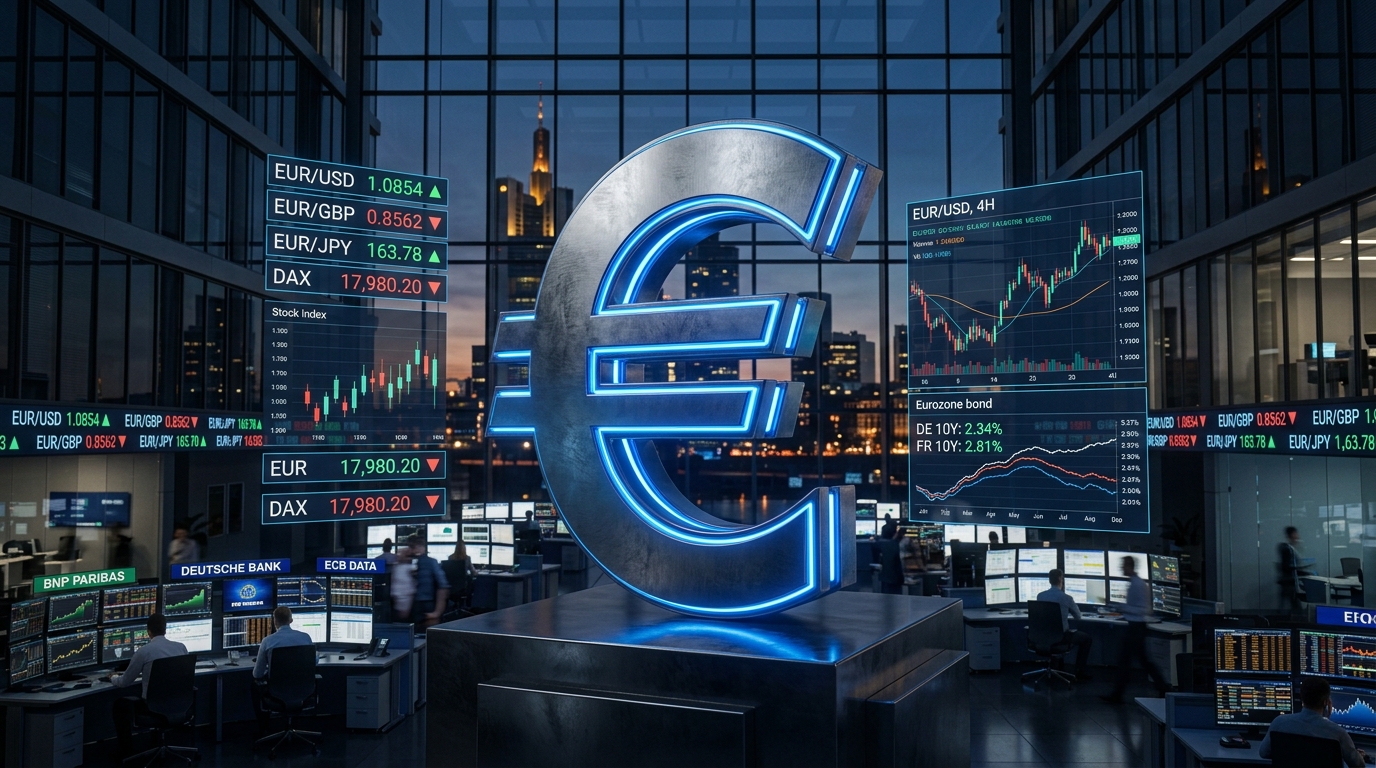
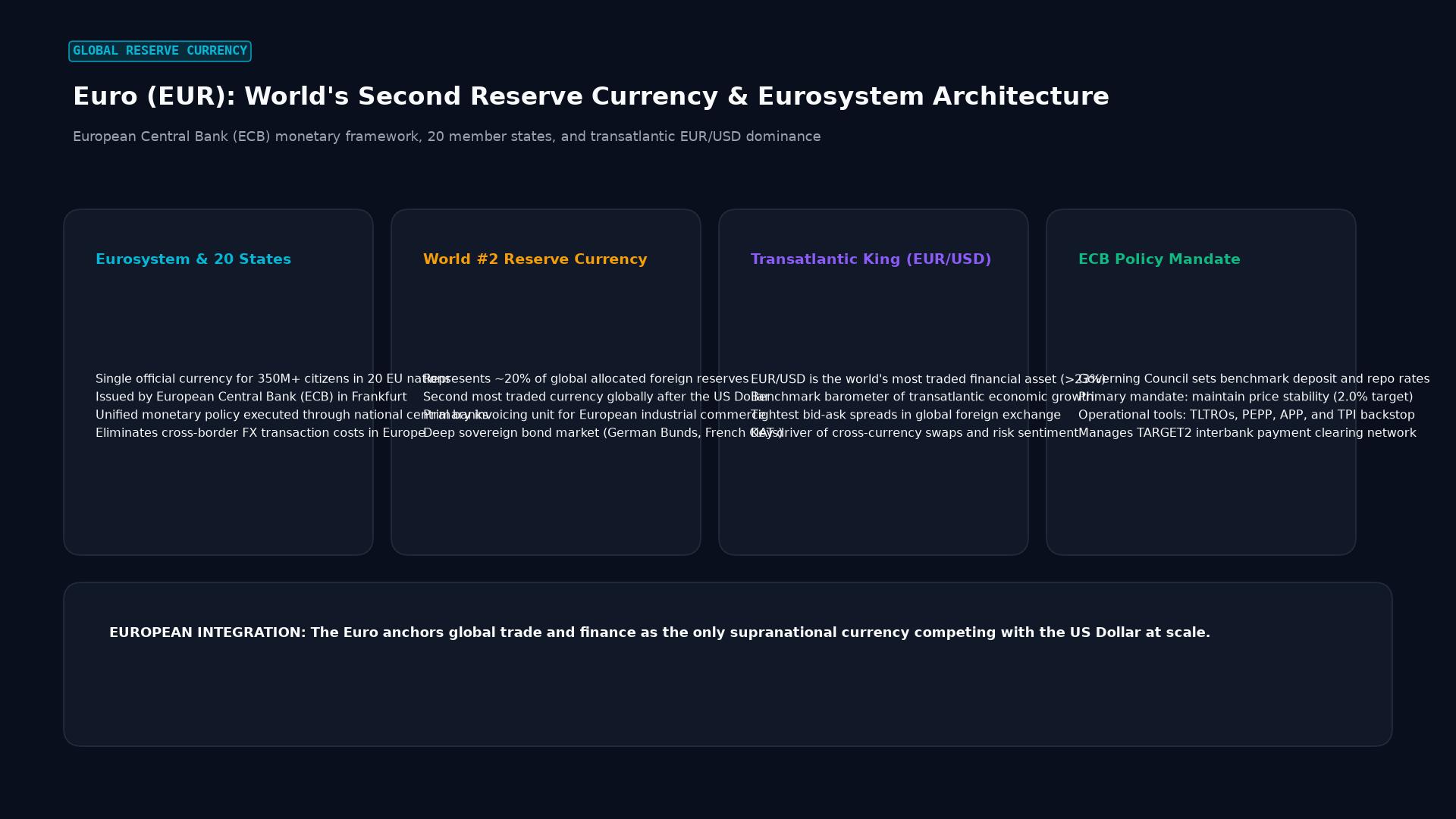 Figure: European Central Bank (ECB) monetary framework, 20 member states, and transatlantic EUR/USD dominance
Historical Inception and Monetary Integration
The conceptual origins of the Euro lie in the post-war European integration movement, designed to prevent devastating continental conflict by intertwining European economies. Early experiments with currency coordination included the European Currency Snake in 1972 and the European Monetary System (EMS) established in 1979, which utilized the European Currency Unit (ECU) as an artificial basket accounting unit.
The legal foundation for the single currency was codified in the Treaty on European Union (the Maastricht Treaty), signed in February 1992. The treaty established strict economic convergence criteria that candidate nations were required to satisfy prior to adoption:
- Price Stability: Inflation rate not exceeding that of the three best-performing member states by more than 1.5 percentage points.
- Fiscal Discipline: Government budget deficit below 3 percent of gross domestic product (GDP), and gross sovereign debt below 60 percent of GDP (or declining toward that threshold at a satisfactory pace).
- Exchange Rate Stability: Participation in the European Exchange Rate Mechanism (ERM II) for at least two years without severe tensions or devaluations.
- Long-Term Interest Rate Convergence: Nominal long-term government bond yields not exceeding those of the three best price-stability performers by more than 2 percentage points.
On January 1, 1999, the Euro was formally launched as an electronic accounting currency across eleven founding nations: Austria, Belgium, Finland, France, Germany, Ireland, Italy, Luxembourg, Netherlands, Portugal, and Spain. National currencies (such as the German Deutsche Mark, French Franc, and Italian Lira) became legacy sub-units of the Euro at irrevocably fixed conversion rates.
On January 1, 2002, physical Euro banknotes and coins entered public circulation in history’s largest monetary changeover. The Eurozone subsequently expanded to include Greece (2001), Slovenia (2007), Cyprus and Malta (2008), Slovakia (2009), Estonia (2011), Latvia (2014), Lithuania (2015), and Croatia (2023).
Institutional Governance: The ECB and the Eurosystem
Monetary authority in the Eurozone is exercised by the Eurosystem, consisting of the European Central Bank and the 20 National Central Banks (NCBs) of member states that have adopted the single currency.
The primary decision-making body is the ECB Governing Council, which meets every six weeks in Frankfurt to assess macroeconomic conditions and adjust benchmark monetary policy. The ECB’s primary statutory mandate, established under Article 127 of the Treaty on the Functioning of the European Union, is price stability. The ECB defines price stability as maintaining a symmetric 2 percent Harmonised Index of Consumer Prices (HICP) inflation rate over the medium term.
The ECB steers financial conditions across the Eurozone through three key policy interest rates:
- Deposit Facility Rate (DFR): The rate commercial banks receive for parking overnight deposits with the central bank. In modern operations, the DFR serves as the primary policy anchor for short-term interbank money market rates (such as the euro short-term rate, €STR).
- Main Refinancing Operations (MRO) Rate: The interest rate commercial banks pay when borrowing one-week liquidity from the Eurosystem against eligible collateral in regular auctions.
- Marginal Lending Facility (MLF) Rate: The overnight ceiling rate charged to banks requiring emergency liquidity from the central bank.
$$\text{Interest Rate Corridor} = [\text{DFR}, ; \text{MRO}, ; \text{MLF}]$$
Architectural Challenges: Sovereign Fragmentation and TARGET2
Unlike the United States, where a unified federal treasury backs the US Dollar with unified federal taxation, the Eurozone represents an asymmetric currency union: a single, centralized monetary policy operated alongside 20 decentralized, sovereign fiscal policies.
This structural asymmetry became acutely apparent during the European Sovereign Debt Crisis of 2010-2012. Lacking an independent currency to devalue, peripheral economies (Greece, Ireland, Portugal, Spain, and Italy) faced surging sovereign bond yields as private investors questioned their debt sustainability. The crisis was contained in July 2012 when ECB President Mario Draghi uttered his historic declaration that the ECB was prepared to do “whatever it takes” to preserve the Euro, backed by the creation of Outright Monetary Transactions (OMT).
         INTRA-EUROZONE LIQUIDITY & TARGET2 DYNAMICS
         ===========================================

       CORE CREDITOR REGION                   PERIPHERAL REGION
       (e.g., Germany / Bundesbank)           (e.g., Italy / Banca d'Italia)
     +------------------------------+       +------------------------------+
     | VAST TARGET2 CLAIMS          |       | TARGET2 LIABILITIES          |
     | Surplus capital flows inward |       | Net capital outflows toward  |
     | from peripheral banking hubs |       | safe-haven core bond markets |
     +------------------------------+       +------------------------------+
                    \                               /
                     \                             /
                      v                           v
     +-------------------------------------------------------------+
     |                 TRANS-EUROPEAN SETTLEMENT (T2)              |
     |                                                             |
     |   * Real-time gross settlement clearing for high-value euro |
     |   * Central bank balance sheet equalization mechanism       |
     |   * Transmission Protection Instrument (TPI) activation     |
     |     prevents unjustified peripheral bond spread blowouts    |
     +-------------------------------------------------------------+
To prevent sovereign spread widening from disrupting the transmission of monetary policy across borders, the ECB introduced the Transmission Protection Instrument (TPI) in 2022. The TPI permits the ECB to purchase sovereign securities issued by specific member states experiencing unjustified market turbulence, provided the nation complies with European Union fiscal and macroeconomic surveillance rules.
Another vital technical component of the single currency is TARGET (Trans-European Automated Real-time Gross Settlement Express Transfer System). TARGET2 balances reflect cross-border capital flows between national central banks within the Eurosystem. Capital flight from peripheral banks toward core financial centers (such as Germany or Luxembourg) manifests as expanding TARGET2 claims on the balance sheet of the Deutsche Bundesbank and matching liabilities at peripheral central banks.
The Euro in the Global FX Market
The Euro occupies a dominant role in international trade and foreign exchange:
- Share of Global FX Turnover: The Bank for International Settlements (BIS) Triennial Survey confirms that the Euro is involved in roughly 31 to 32 percent of all global foreign exchange transactions.
- Global Reserve Currency: The Euro accounts for approximately 20 percent of allocated foreign exchange reserves held by global central banks, solidifying its place as the primary global diversification alternative to the US Dollar.
- EUR/USD Trading Dynamics: The EUR/USD pair trades 24 hours a day with ultra-tight spreads, responding immediately to interest rate differentials between the Federal Reserve and the ECB, macroeconomic releases (US Non-Farm Payrolls, Eurozone HICP, German Ifo business climate), and global equity risk sentiment.
- Key Cross Rates: Major crosses include EUR/GBP (reflecting trade between continental Europe and the UK post-Brexit), EUR/JPY (a popular funding and carry vehicle during divergent interest rate cycles), and EUR/CHF (historically subject to interventions by the Swiss National Bank).
| Euro Currency Pair | Market Moniker | Liquidity Profile & Key Characteristics |
|---|---|---|
| EUR/USD | “Fiber” | World’s most liquid financial pair; ultra-tight spreads; macro benchmark |
| EUR/GBP | “Chunnel” | Driven by UK-EU trade policy, Bank of England vs ECB policy spreads |
| EUR/JPY | Euro-Yen | High sensitivity to global equity sentiment, risk-on/risk-off carry unwinds |
| EUR/CHF | Euro-Swiss | Safe-haven capital rotation; heavily watched by Swiss National Bank |
Frequently Asked Questions
Why is the EUR/USD currency pair nicknamed “Fiber” in foreign exchange markets?
While the British Pound is nicknamed “Cable” due to the transatlantic telegraph cable laid in 1858, the Euro emerged in the era of high-speed modern telecommunications. Traders christened EUR/USD “Fiber” in reference to the intercontinental fiber-optic cables that transmit high-frequency electronic foreign exchange transactions across the Atlantic.
What is the difference between the European Union and the Eurozone?
The European Union (EU) is an economic and political union comprising 27 European member states. The Eurozone refers specifically to the subset of 20 EU member states that have fulfilled Maastricht convergence criteria and replaced their national currencies with the Euro. EU members outside the Eurozone include Denmark (which holds a formal opt-out), Sweden, Poland, Czechia, Hungary, Romania, and Bulgaria.
How does the ECB manage inflation across countries with different economic growth rates?
The ECB conducts monetary policy based on Eurozone-wide aggregate economic data rather than conditions in individual countries. It sets a single set of policy interest rates aimed at keeping the aggregate Harmonised Index of Consumer Prices (HICP) inflation at 2 percent. Individual member countries must use national fiscal policy, taxation, and structural labor market reforms to manage local growth variations and localized price pressures.
Ready to trade forex?
Open a free demo account with a regulated broker. Practice with virtual funds before risking real money.