COP
The ISO 4217 currency code for the Colombian Peso, the official legal tender of the Republic of Colombia, regulated by the Banco de la República.
What is the COP (Colombian Peso)?
COP is the three-letter international currency code assigned under ISO 4217 to the Colombian Peso, the national currency and legal tender of the Republic of Colombia. Represented domestically by the dollar sign ($) or Col$ and nominally subdivided into 100 centavos (although centavos were eliminated from circulation due to historical inflation), the currency is issued, managed, and regulated by the Banco de la República, Colombia autonomous central bank founded in 1923 following the recommendations of the Kemmerer Mission.
In global emerging market foreign exchange trading, the Colombian Peso is classified as a liquid Latin American commodity currency. Because Colombia merchandise export earnings are heavily weighted toward hydrocarbon energy products (specifically crude petroleum and thermal coal) alongside agricultural commodities like specialty Arabica coffee and cut flowers, the valuation of the COP against the United States Dollar (USD/COP) exhibits a high structural correlation with global crude oil prices and international risk sentiment.
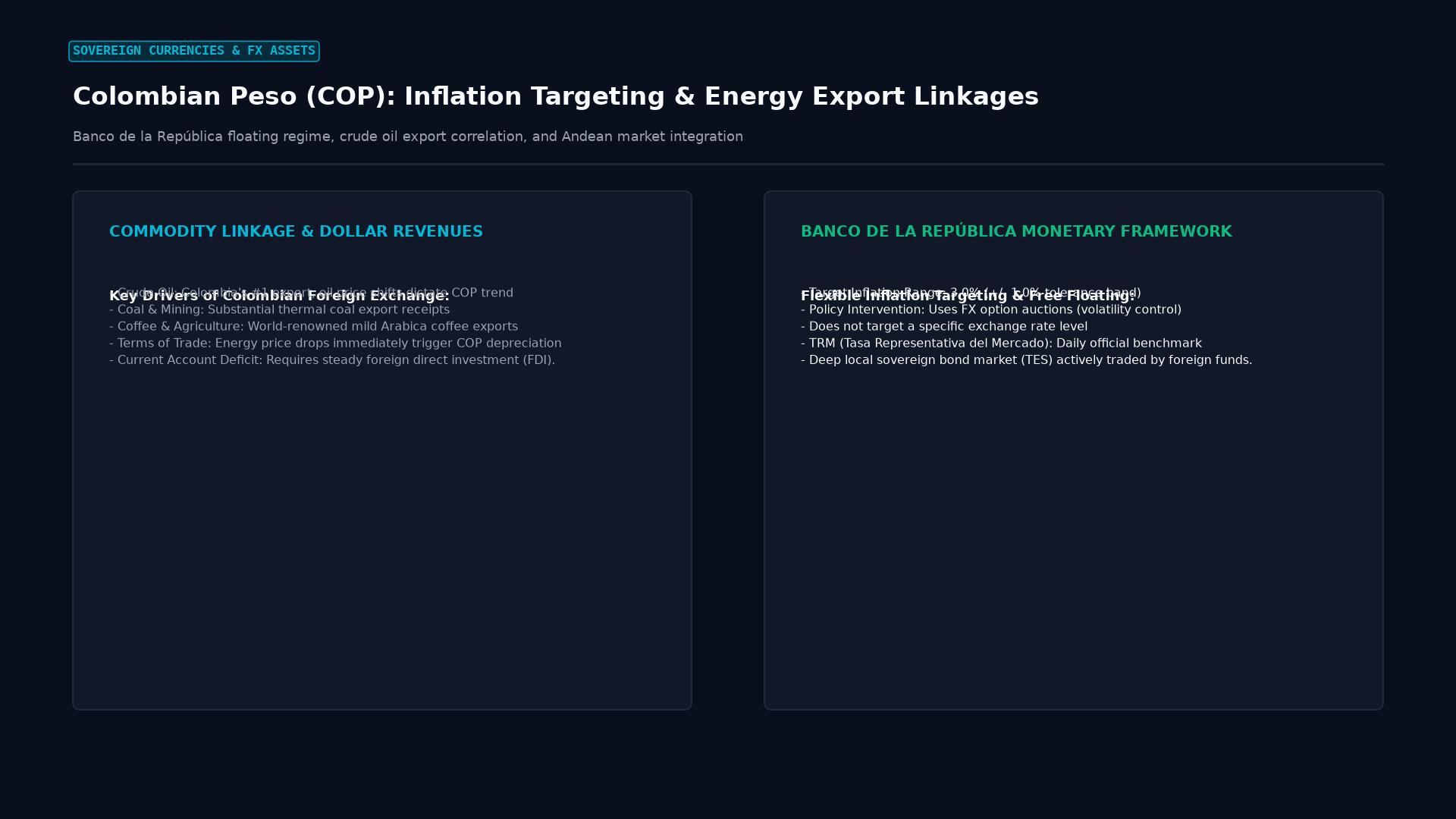 Figure: Andean commodity currency: Banco de la República flexible inflation targeting, crude oil terms-of-trade sensitivity, and TRM benchmark rate formation.
The Commodity Engine: Crude Oil and Terms of Trade
The external valuation of the Colombian Peso is closely linked to national terms of trade. Over the past three decades, hydrocarbons transformed the Colombian export profile:
+------------------------------------+------------------------------------+
| Primary Export Category            | Share of Total Merchandise Exports |
+------------------------------------+------------------------------------+
| Crude Petroleum & Derivatives:     | Approximately 30% to 40% of gross  |
| State-controlled Ecopetrol & private| foreign currency export earnings.  |
| multinational oil concessions.     |                                    |
|                                    |                                    |
| Thermal Coal:                      | Approximately 12% to 18% of total  |
| Cerrejón and Cesar mining basins.  | exports, sensitive to energy cycles|
|                                    |                                    |
| Agricultural Exports:              | Approximately 10% to 14% of exports|
| Premium washed Arabica coffee and  | providing consistent baseline FX.  |
| floriculture exports.              |                                    |
|                                    |                                    |
| Non-Traditional Exports:           | Industrial chemicals, textiles,    |
| Manufacturing and plastics.        | and processed food products.       |
+------------------------------------+------------------------------------+
The Oil-Peso Beta
Because crude oil accounts for such a massive portion of foreign currency receipts and federal fiscal royalties, the USD/COP pair displays a strong inverse relationship with global Brent crude benchmarks:
- Rising Oil Prices: When Brent crude rallies, dollar inflows to the treasury and state oil producer Ecopetrol expand. The supply of US Dollars inside the domestic interbank market surges, driving down USD/COP (strengthening the Colombian Peso).
- Collapsing Oil Prices: When world crude prices experience severe supply gluts or global demand contractions (such as in 2014–2016 or early 2020), export revenues evaporate. The fiscal deficit widens, and the Colombian Peso undergoes steep nominal depreciation against the USD.
Monetary Policy Framework: Inflation Targeting and TRM
Banco de la República operates a fully flexible floating exchange rate regime anchored by an Inflation Targeting Framework:
- Price Stability Target: The central bank targets an annual inflation rate of 3.0% with a tolerance band of $\pm 1.0%$ (2.0% to 4.0%).
- Policy Transmission: The seven-member Board of Directors (Junta Directiva) adjusts the benchmark overnight intervention lending rate to cool domestic demand or stimulate economic activity.
The Representative Market Exchange Rate (TRM)
In Colombian commerce, the benchmark reference exchange rate is known as the Tasa Representativa del Mercado (TRM).
- The TRM is calculated and certified daily by the Financial Superintendence of Colombia (Superintendencia Financiera de Colombia / SFC).
- It represents the precise volume-weighted average exchange rate of all spot buy and sell transactions executed between authorized financial intermediaries on the electronic Set-FX trading platform during that business day.
- The TRM serves as the legal reference rate for public tax calculations, customs declarations, corporate balance sheet valuations, and commercial contract settlements across the nation.
BanRep Foreign Exchange Intervention Mechanisms
Although Banco de la República permits the Peso to float freely to absorb external terms-of-trade shocks, it retains rule-based, transparent intervention tools to prevent extreme volatility:
  Central Bank Intervention Tool       Operational Mechanism & Purpose
  ──────────────────────────────────────────────────────────────────────────
  Volatility Options (Call / Put):     Auctions options to commercial banks when
                                       the spot rate deviates by more than a set
                                       percentage (e.g., 5%) from its 20-day
                                       moving average, dampening panic.

  Reserve Accumulation Options:        Purchases US Dollars to replenish gross
                                       foreign exchange reserves during periods
                                       of strong commodity export windfalls.

  Direct Interbank Spot Purchases:     Exceptional bilateral operations executed
                                       rarely to resolve acute market failure.

  Non-Deliverable Forwards (NDFs):     Offers FX swap contracts to provide dollar
                                       liquidity without draining physical reserves.
Foreign Capital and the Sovereign TES Bond Market
A major driver of short-term and medium-term COP exchange rate swings is foreign institutional participation in Colombia local-currency sovereign bond market, known as TES (Títulos de Tesorería).
Issued by the Ministry of Finance and Public Credit (Ministerio de Hacienda y Crédito Público), TES bonds are fixed-income securities denominated in Colombian Pesos:
- Global Index Inclusion: When international index providers (such as JPMorgan GBI-EM Global Diversified Index) increased Colombia weighting in local-currency benchmark indices, global mutual funds and pension funds were forced to purchase billions of dollars worth of TES.
- Capital Carry Flows: International hedge funds execute carry trade strategies, borrowing US Dollars or Japanese Yen at low interest rates, selling those hard currencies for Colombian Pesos on the interbank Set-FX market, and investing the proceeds into high-yielding 5-year and 10-year TES bonds.
- Reversal Risk: When global risk aversion strikes or political uncertainty rises, foreign asset managers sell their TES bonds, convert the resulting COP balances back into USD, and repatriate their capital, triggering sharp depreciations in the Colombian Peso.
Frequently Asked Questions
Can an international trader trade the COP directly on standard spot forex platforms?
In retail foreign exchange, direct deliverable spot trading in the COP is rare due to local clearing requirements and capital registration rules under the central bank Foreign Exchange Statute (Circular Reglamentaria Externa DCIN-83). However, institutional investors, hedge funds, and multinational corporations trade the pair actively via USD/COP Non-Deliverable Forwards (NDFs) cleared in New York and London, settling net price profits and losses in US Dollars.
What is the “Mil Pesos” (New Peso) redenomination project in Colombia?
For decades, the Colombian Congress and Banco de la República debated a currency redenomination proposal to drop three zeroes from the Colombian Peso (e.g., converting 1,000 old Pesos into 1 new Peso). The reform aimed to simplify corporate accounting, reduce cash transaction printing costs, and standardize the currency unit. However, high administrative costs, public education hurdles, and recurring political debates have repeatedly delayed formal legislative implementation.
How does the National Federation of Coffee Growers (FNC) interact with the COP exchange rate?
The National Federation of Coffee Growers of Colombia (Federación Nacional de Cafeteros) manages the National Coffee Fund (Fondo Nacional del Café). The FNC calculates a daily internal reference purchase price paid in COP to hundreds of thousands of independent smallholder coffee farmers. This price is derived mathematically from the New York ICE Arabica Coffee “C” futures price, the quality premium for Colombian washed coffee, and the prevailing TRM exchange rate. A depreciating Peso increases the domestic income of rural coffee farmers, whereas a strong Peso compresses rural agricultural profits.
Ready to trade forex?
Open a free demo account with a regulated broker. Practice with virtual funds before risking real money.