Discounting of Bill
A short-term trade finance arrangement where a commercial bank advances immediate funds to a seller against an accepted bill of exchange or trade invoice prior to maturity, deducting a pre-agreed discount fee.
What is Discounting of a Bill?
Discounting of a bill (commonly termed bill discounting or trade bill purchase) is a specialized short-term trade finance mechanism whereby a commercial bank or financial institution purchases an accepted, legally binding bill of exchange or commercial trade draft from a seller before its contractual maturity date. The bank pays the seller immediate cash proceeds equal to the face value of the bill minus a pre-agreed financial charge known as the discount fee.
In domestic commercial trade and international cross-border supply chains, buyers routinely demand 30-day, 60-day, 90-day, or 120-day credit terms before paying for delivered merchandise. For an exporter or manufacturer, waiting months for customer payment ties up working capital and restricts operational liquidity. By discounting the accepted trade bill with a bank, the seller converts an illiquid trade receivable into immediate working capital cash, while the discounting bank collects the full face amount directly from the buyer when the bill reaches maturity.
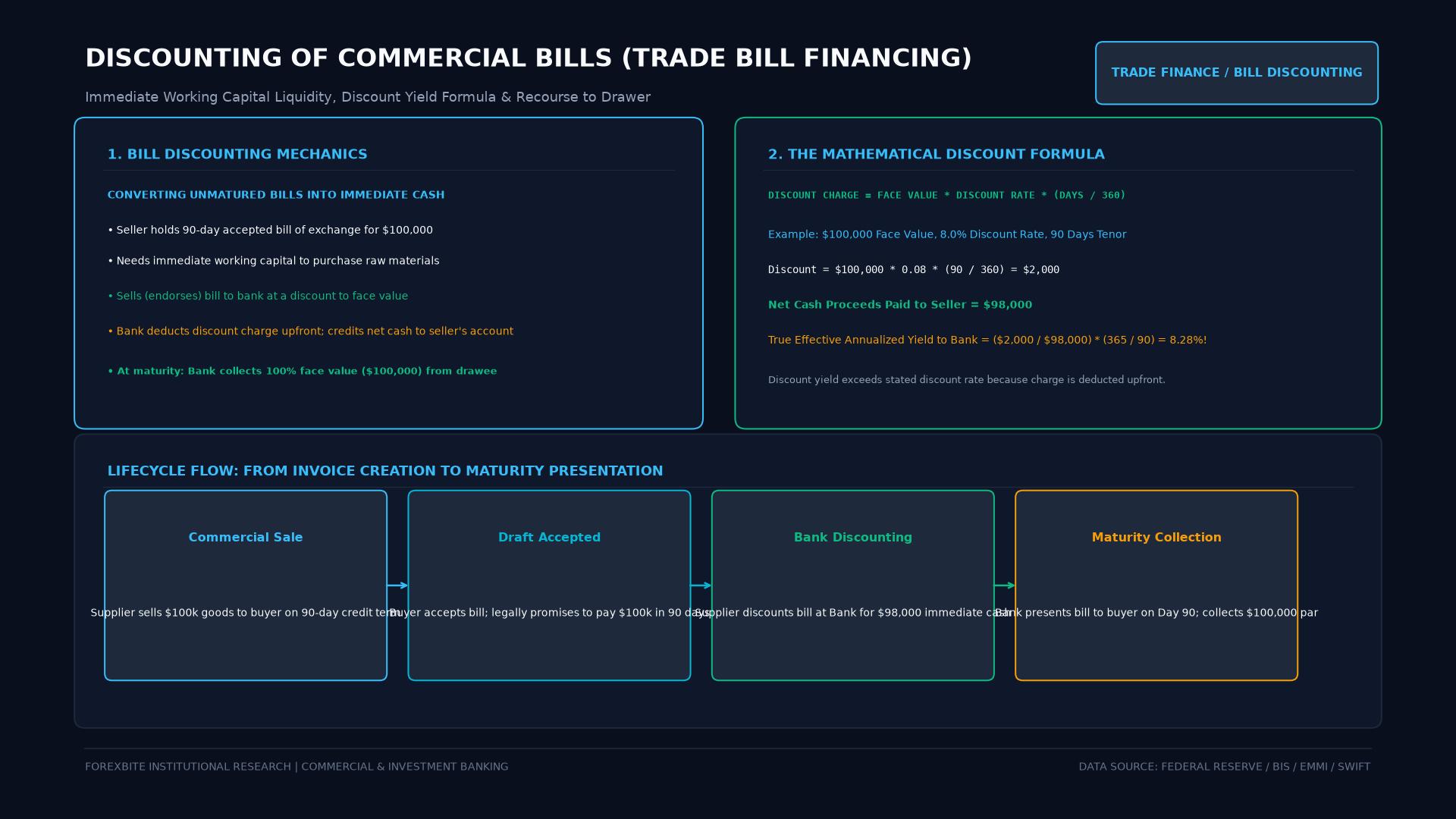 Figure: Working capital discounting pipeline: bill generation, bank acceptance, upfront discount interest deduction, and full face value collection at maturity.
Legal Architecture: The Three Parties to the Bill
Bill discounting operates under statutory negotiable instruments legislation, such as Article 3 of the Uniform Commercial Code (UCC) in the United States, the UK Bills of Exchange Act of 1882, and the Indian Negotiable Instruments Act of 1881.
The transaction involves three distinct legal parties:
+------------------------------------+------------------------------------+
| Transaction Role                   | Legal Definition & Obligation      |
+------------------------------------+------------------------------------+
| 1. The Drawer (Seller / Creditor): | The manufacturer or merchant who   |
| Originator of the instrument.      | sells the merchandise and draws the|
|                                    | formal bill ordering payment.      |
|                                    |                                    |
| 2. The Drawee (Buyer / Debtor):    | The purchasing entity upon whom the|
| Primary obligor of the debt.       | bill is drawn. Upon signing the    |
|                                    | bill as "Accepted", the drawee     |
|                                    | assumes unconditional liability.   |
|                                    |                                    |
| 3. The Payee / Discounter:         | The commercial bank or discount    |
| The financing entity.              | house that purchases the bill,     |
|                                    | advances net funds, and holds legal|
|                                    | title as a Holder in Due Course.   |
+------------------------------------+------------------------------------+
Mathematical Computation of Bill Discounting
The discount fee charged by the financing bank is calculated using standard money market discount yield conventions:
$$\text{Discount Fee} = \frac{\text{Face Value of Bill} \times \text{Annual Discount Rate} \times \text{Days to Maturity}}{365 \text{ (or 360)}}$$
$$\text{Net Cash Proceeds Paid to Drawer} = \text{Face Value of Bill} - \text{Discount Fee}$$
Practical Industrial Demonstration
A precision tooling manufacturer sells $500,000 worth of industrial machinery to a corporate buyer on a 90-day trade bill.
- The buyer signs and accepts the bill of exchange.
- The seller presents the accepted bill to their commercial bank for immediate discounting.
- The bank approved commercial discount rate is 8.0% per annum (utilizing a standard 365-day year).
The bank calculates the discount fee: $$\text{Discount Fee} = \frac{$500,000 \times 0.08 \times 90}{365} = \frac{$3,600,000}{365} = $9,863.01$$
The bank credits the manufacturer account immediately: $$\text{Net Proceeds Delivered} = $500,000 - $9,863.01 = $490,136.99$$
When the 90 days elapse, the bank presents the promissory bill to the buyer, collecting the full $500,000 par face value. The $9,863.01 differential represents the bank net interest earnings.
Structural Classifications: Recourse vs. Non-Recourse (Forfaiting)
Bill discounting agreements are structured under two distinct credit risk frameworks:
+------------------------------------+------------------------------------+
| Discounting With Recourse          | Discounting Without Recourse       |
+------------------------------------+------------------------------------+
| Credit Default Risk:               | Credit Default Risk:               |
| Retained primarily by the seller.  | Transferred 100% to the bank.      |
|                                    |                                    |
| Failure to Pay at Maturity:        | Failure to Pay at Maturity:        |
| If the drawee (buyer) defaults or  | The discounting bank absorbs the   |
| enters bankruptcy, the bank debits | full financial loss, with zero     |
| the seller account for the full sum| legal right to claim repayment from|
| under legal drawer endorsements.   | the original seller.               |
|                                    |                                    |
| Financing Cost & Pricing:          | Financing Cost & Pricing:          |
| Lower discount rate, reflecting    | Higher discount rate (risk premium)|
| minimal credit risk for the bank.  | Common in international forfaiting |
| Standard in domestic commerce.     | backed by bank avals or letters of |
|                                    | credit from emerging market banks. |
+------------------------------------+------------------------------------+
Bill Discounting vs. Factoring vs. Bank Overdraft
Corporate treasurers select between several working capital tools depending on cost, collateral, and administrative burden:
  Feature               Bill Discounting              Invoice Factoring             Bank Overdraft (OD)
  ──────────────────────────────────────────────────────────────────────────
  Underlying Asset      Formal, accepted negotiable   Entire accounts receivable    General working capital
                        instrument (Bill of Exchange) sales ledger assignment       line of credit

  Transaction Nature    Individual, transaction-      Comprehensive ongoing debt    Revolving credit facility
                        specific financing            management service            secured by assets

  Collections Role      Bank collects only at single  Factor frequently manages     Borrower deposits daily
                        maturity presentation         customer collections directly receipts to service debt

  Legal Standing        Governed by rigid Negotiable  Governed by general contract  Governed by master credit
                        Instruments statutory law     and commercial assignment law agreement covenants
Banker’s Acceptances and Central Bank Rediscounting
In wholesale money markets and international trade, bills of exchange gave rise to Banker’s Acceptances (BAs).
When a bill of exchange is drawn on and accepted by an investment-grade commercial bank (frequently under an irrevocable commercial Letter of Credit / LC), the credit backing of the bill transitions from a commercial corporation to the bank itself:
- Money Market Liquidity: Because the payment obligation is guaranteed by a major commercial bank, discounted BAs become negotiable money market instruments traded actively by institutional money market funds and corporate treasurers.
- Central Bank Rediscounting: Historically, central banks operated a Rediscount Window. If a commercial bank experienced liquidity squeezes, it could present its portfolio of discounted high-grade trade bills to the central bank, which “rediscounted” the paper at the official policy rate, injecting liquid central bank reserves into the banking system.
Frequently Asked Questions
What happens if the drawee (buyer) refuses to pay the bill when it matures?
When a discounted bill is dishonored by non-payment at maturity, the holder (the discounting bank) must execute a formal legal protest. The bank engages a licensed Notary Public to present the bill and record a formal certificate of dishonor (Protest for Non-Payment). Under negotiable instruments law, this certificate provides incontestable legal proof of default in commercial court, enabling the bank to enforce immediate repayment against the drawer (under recourse contracts) or seize the drawee pledged assets.
Does bill discounting require physical paper documents today?
While historical trade finance relied on signed paper parchment, modern commerce utilizes Electronic Bills of Exchange (e-Bills) and digital trade finance platforms (such as TradeXchange or electronic bills of lading under UNCITRAL Model Law on Electronic Transferable Records / MLETR). Digital cryptographic signatures and verified electronic endorsements have replaced physical wax stamps and ink signatures.
Why do banks prefer discounting bills of exchange over issuing unsecured loans?
Banks prefer bill discounting because a bill of exchange represents a self-liquidating, legally standardized debt instrument. Under negotiable instruments law, a holder in due course possesses senior legal rights against all prior endorsers, making judicial recovery in the event of default significantly faster and cheaper than litigating a disputed breach of an ordinary commercial loan contract.
Ready to trade forex?
Open a free demo account with a regulated broker. Practice with virtual funds before risking real money.