Factoring
Factoring is a financial transaction in which a business sells its outstanding accounts receivable (unpaid customer invoices) to a specialized third-party financial institution called a factor at a discount in exchange for immediate cash, transferring credit risk and collection responsibility to the factor.
What Is Factoring?
Factoring (also designated as accounts receivable financing or invoice discounting) is a structured commercial finance transaction in which a business (the assignor or client) sells its portfolio of outstanding unpaid customer invoices to a specialized financial institution (the factor) at a negotiated discount price in exchange for immediate cash liquidity — typically within 24 to 48 hours of invoice submission.
The factor then assumes the legal ownership of the purchased receivables and the operational responsibility for collecting payment from the business’s customers (account debtors) at their scheduled payment due dates. If customers fail to pay, the factor typically absorbs the credit loss under non-recourse factoring, or seeks recovery from the original business under recourse factoring.
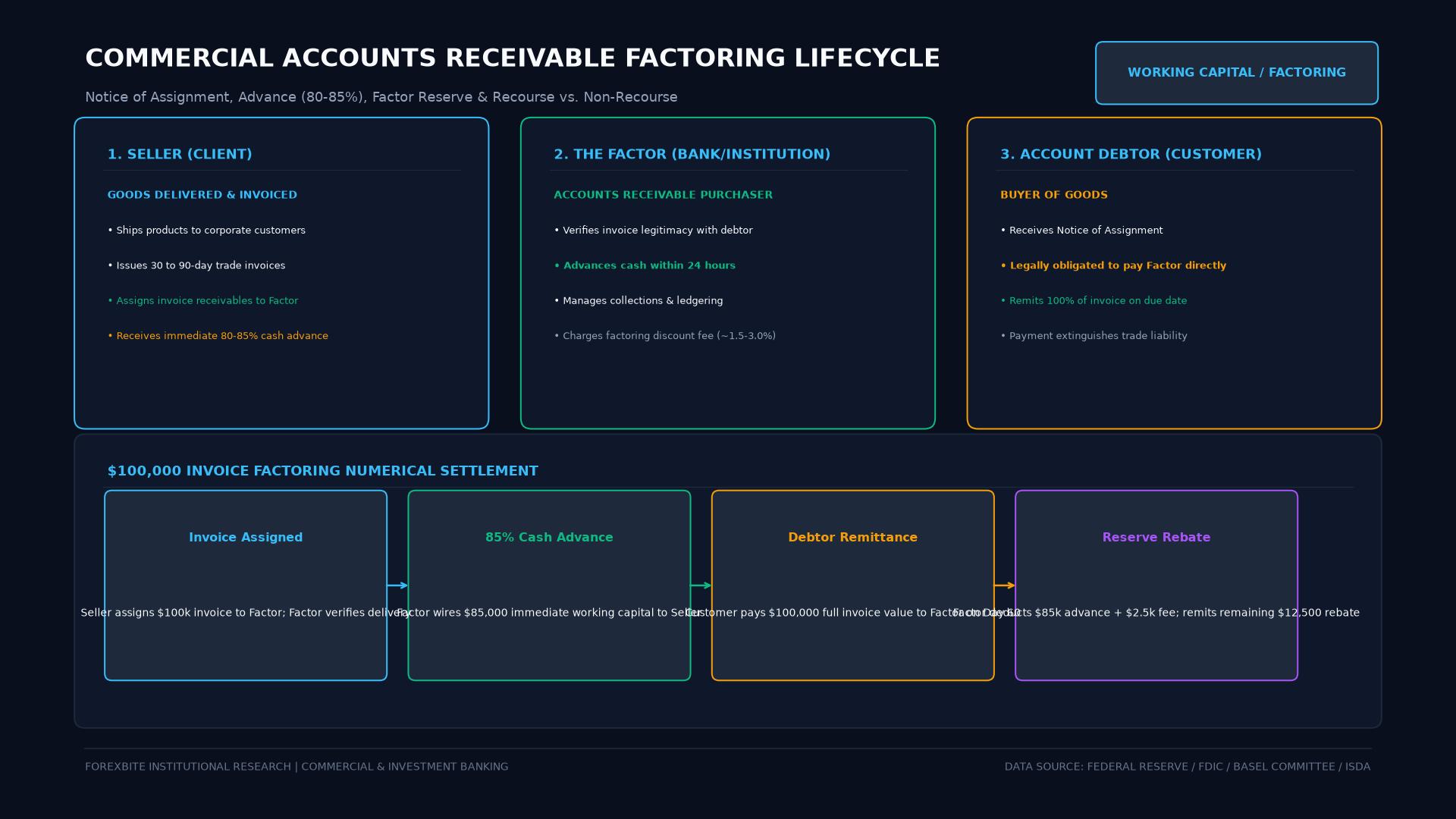 Figure: Commercial factoring lifecycle: invoice assignment, factor advance, debtor collection, and credit default loss allocation under recourse agreements.
Technical Mechanics & Pricing Formulations
1. Factoring Cost Structure
The total cost of a factoring arrangement consists of:
$$\text{Total Factoring Cost} = \text{Discount Fee %} \times \text{Invoice Face Value} + \text{Administrative Fees}$$
$$\text{Effective Annual Interest Rate} = \frac{\text{Discount Fee}}{\text{Advance Received}} \times \frac{365}{\text{Invoice Terms (Days)}}$$
For a 2% factoring fee on a 60-day invoice with a 90% advance rate:
$$\text{EAR} = \frac{0.02}{0.90} \times \frac{365}{60} \approx 13.5%$$
The effective annual cost of factoring (13.5%) must be weighed against the business’s alternative financing options (e.g., a revolving line of credit at SOFR + 3.0%).
2. Non-Recourse vs. Recourse Factoring
- Non-Recourse Factoring: The factor bears all credit default risk if customers become insolvent. Discount fees are higher (2.5% to 5.0%) to compensate.
- Recourse Factoring: If a customer fails to pay, the business must buy back the unpaid invoice. Discount fees are lower (1.0% to 2.5%) as the factor retains limited credit risk.
Comparative Matrix: Trade Finance Products
| Product | Speed of Cash | Credit Risk Transfer | Typical Cost (APR) | Best For |
|---|---|---|---|---|
| Non-Recourse Factoring | 24–48 hours | Full (to Factor) | 13–24% APR equivalent | SMEs with weak credit controls |
| Recourse Factoring | 24–48 hours | Partial (stays with Client) | 8–16% APR equivalent | SMEs with strong buyer quality |
| Invoice Discounting | 24–72 hours | Stays with Client | 6–12% APR | Larger businesses (confidential) |
| Bank Line of Credit | 1–5 days (after setup) | Stays with Client | SOFR + 2–4% | Stable, bank-creditworthy firms |
| Supply Chain Finance | Varies | None (Buyer-led) | 1–3% APR | Large corporate buyer programs |
Real-World Case Study: Amazon Small Seller Factoring Crisis (2020–2021)
The strategic utility of factoring for high-growth e-commerce businesses was demonstrated during Amazon’s payment acceleration programs.
The SME Factoring Surge During E-Commerce Boom:
1. The Problem: Amazon paid third-party marketplace sellers net-14 to net-30 days after confirmed product sales. Small sellers with thin working capital desperately needed cash to reorder inventory before Amazon's 30-day payment cleared.
2. The Factoring Solution: Amazon launched its "Merchant Cash Advance" program, effectively functioning as an embedded factoring arrangement — purchasing future marketplace receivables at a discount to provide immediate inventory capital.
3. Independent Factors: Simultaneously, fintech factoring platforms (including BlueVine, Fundbox, and Payoneer) emerged to purchase Amazon seller receivables directly, advancing 85% to 92% of outstanding sales balances within 24 hours.
4. The Scale: By 2021, the global accounts receivable factoring market had expanded to over $3.5 trillion in annual factored invoice volumes, driven primarily by global supply chain disruptions creating massive working capital shortfalls across SME manufacturers.
Frequently Asked Questions (FAQ)
What is the difference between factoring and invoice discounting?
In factoring, the factor publicly purchases the invoices, notifies the business’s customers to redirect payments to the factor, and takes over accounts receivable collections. The arrangement is generally known to the customers. In invoice discounting, the business retains ownership and control of its invoice collection process. The lender provides cash against the invoices as collateral but remains invisible to customers, who continue paying the original business directly. Invoice discounting is preferred by larger companies that wish to maintain confidential, uninterrupted customer relationships.
Can a company factor receivables if it has poor credit?
Unlike traditional bank lending (which evaluates the borrower’s creditworthiness), factoring companies primarily evaluate the credit quality of the business’s customers (the account debtors) rather than the business itself. A startup with poor or no credit history can often factor high-quality receivables from creditworthy Fortune 500 customers. This makes factoring uniquely accessible to young, fast-growing businesses that cannot yet qualify for traditional bank credit facilities.
What does a “factor’s lien” protect?
A factor’s lien is a statutory legal security interest that grants the factoring company the right to retain physical possession of or claim against the client’s accounts receivable assets until the factor has been fully compensated for all outstanding advances and fees. Under the Uniform Commercial Code (UCC) Article 9 in the United States, factors perfect their security interest by filing a UCC-1 Financing Statement in the appropriate state filing office, establishing legal priority over other potential creditors.
Ready to trade forex?
Open a free demo account with a regulated broker. Practice with virtual funds before risking real money.