FAD Multiple
The FAD multiple (Funds Available for Distribution multiple) is a real estate valuation metric calculated by dividing a Real Estate Investment Trust's (REIT) share price by its FAD per share, representing the price investors pay per dollar of cash flow available for dividend distributions.
What Is the FAD Multiple?
In real estate investment analysis and equity research, the FAD multiple (Funds Available for Distribution multiple, often used interchangeably with CAD multiple or Cash Available for Distribution) is a specialized price-to-cash-flow multiple used to value Real Estate Investment Trusts (REITs).
Standard GAAP accounting metrics like Net Income and Price-to-Earnings (P/E) ratios are deeply misleading when applied to commercial real estate. Under GAAP, buildings and structures must be depreciated over time, creating massive non-cash depreciation charges that artificially depress GAAP net income—even while well-maintained physical properties appreciate in market value. The FAD multiple solves this distortion by comparing share price directly against the actual discretionary cash remaining after funding property maintenance and capital expenditures.
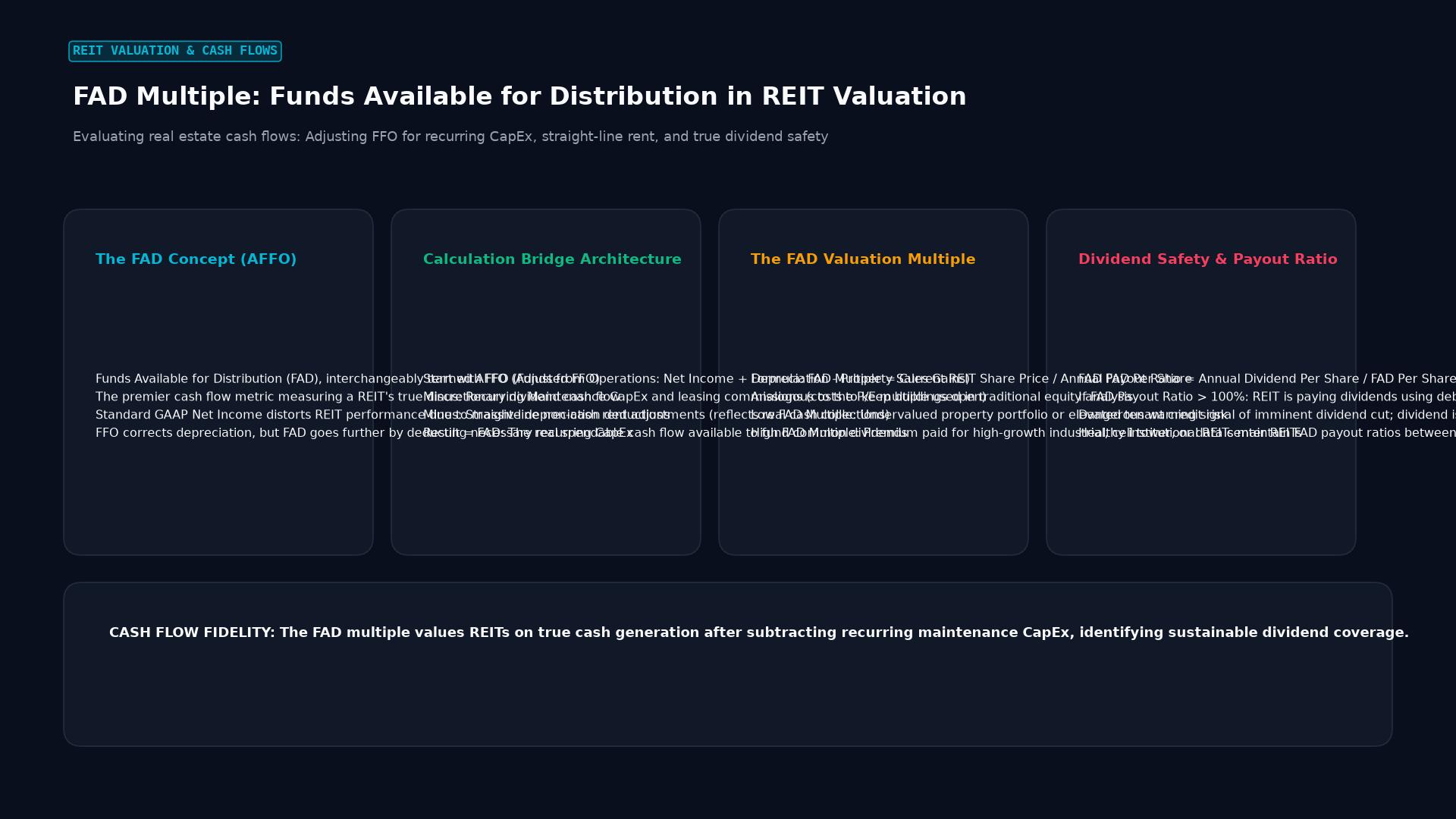 Figure: Evaluating real estate cash flows: Adjusting FFO for recurring CapEx, straight-line rent, and true dividend safety
Technical Mechanics & Calculation Formulas
The FAD multiple is calculated by dividing the REIT’s current market share price by its annual FAD per diluted share:
$$\text{FAD Multiple} = \frac{\text{Current Market Share Price}}{\text{FAD per Diluted Share}}$$
Alternatively, at the firm-wide level:
$$\text{FAD Multiple} = \frac{\text{Total Equity Market Capitalization}}{\text{Total Funds Available for Distribution}}$$
Deriving FAD (Funds Available for Distribution)
To calculate the denominator, analysts begin with NAREIT Funds From Operations (FFO) and adjust for real cash outflows required to sustain the real estate portfolio:
$$\text{FAD} = \text{FFO} - \text{Routine Maintenance CapEx} - \text{Leasing Commissions} - \text{Tenant Improvements} \pm \text{Non-Cash Rent Adjustments}$$
Where:
- Routine Maintenance CapEx: Capital spent to maintain buildings in their current state (e.g., roof replacements, HVAC overhauls), as opposed to growth/development CapEx.
- Tenant Improvements (TI): Capital invested to customize space for incoming corporate tenants.
- Non-Cash Rent Adjustments: Eliminating non-cash straight-line rent accounting to reflect actual contractual cash rent collected during the period.
Comparative Matrix: REIT Valuation Multiples
| Valuation Metric | Formula | Depreciates Physical Assets? | Accounts for Ongoing CapEx? | Primary Valuation Role |
|---|---|---|---|---|
| FAD Multiple | Price / FAD | No (non-cash depreciation added back) | Yes (deducts maintenance & tenant costs) | Gold standard for evaluating dividend safety and payout sustainability |
| FFO Multiple | Price / FFO | No (depreciation added back) | No (ignores routine property CapEx) | Quick benchmark across the broad REIT sector |
| P/AFFO Multiple | Price / AFFO | No (depreciation added back) | Yes (practically identical to FAD) | Industry-standard alternative term to FAD multiple |
| P/E Ratio | Price / EPS | Yes (heavily depressed by GAAP depreciation) | No | Unreliable for real estate; drastically overstates true valuation |
Real-World Case Study: Dividend Coverage in a Commercial Office REIT
In 2023, an institutional real estate fund evaluated an office REIT trading at $45 per share with an annual dividend payout of $3.20 per share (a seemingly attractive 7.1% dividend yield):
- The Flawed FFO Picture: The REIT reported annual FFO of $4.80 per share, resulting in an FFO multiple of $9.38\text{x}$ and an apparent FFO dividend payout ratio of $66.7%$ ($$3.20 / $4.80$), signaling ample dividend safety to naive retail investors.
- The FAD Reality Check: A deep dive into cash maintenance revealed heavy recurring capital requirements to retain commercial tenants:
- FFO per share: $4.80
- Maintenance CapEx per share: -$1.10
- Tenant improvements & leasing concessions: -$1.20
- Non-cash straight-line rent adjustments: -$0.30
- True FAD per share: $2.20
- FAD Multiple & True Payout:
- True FAD Multiple: $\frac{$45}{$2.20} = \mathbf{20.45\text{x}}$ (far more expensive than the 9.38x FFO multiple suggested).
- FAD Payout Ratio: $\frac{$3.20}{$2.20} = \mathbf{145.5%}$.
- Outcome: Because the REIT was paying out 145% of its true cash flow available for distribution, it was funding dividends through debt issuance. Six months later, management cut the dividend by 50%, sending the stock down 35%. Investors utilizing the FAD multiple avoided the dividend trap entirely.
Frequently Asked Questions (FAQ)
What is the practical difference between FAD and AFFO?
In real estate equity research, FAD (Funds Available for Distribution) and AFFO (Adjusted Funds From Operations) are virtually identical concepts measuring discretionary cash flow after maintenance CapEx. However, because neither metric is formally standardized by GAAP or NAREIT, individual REIT management teams may define them with slight proprietary nuances. Analysts should always inspect 10-K footnotes to verify exact line-item adjustments.
What is considered a healthy FAD payout ratio for a REIT?
A sustainable FAD payout ratio typically sits between 70% and 85%. A ratio consistently above 90% leaves little margin of safety for unexpected tenant vacancies, interest rate hikes, or necessary building repairs, creating imminent risk of a dividend reduction.
Why do market multiples for FAD vary across property sectors?
FAD multiples reflect the capital intensity of different real estate asset classes. Industrial warehouses, self-storage facilities, and cell towers require very low ongoing maintenance CapEx, allowing FFO and FAD to trade at tighter, premium multiples ($20\text{x}-28\text{x}$). In contrast, commercial office buildings and full-service hotels demand substantial ongoing tenant improvements and renovations, resulting in lower historical multiples ($10\text{x}-15\text{x}$).
Ready to trade forex?
Open a free demo account with a regulated broker. Practice with virtual funds before risking real money.