Valuation
Valuation is the analytical process of determining the economic intrinsic worth of an asset, company, security, or national currency using quantitative mathematical models, discounted future cash flows, and relative market multiples.
What Is Valuation?
Valuation is the quantitative discipline in corporate finance, investment banking, and asset management that seeks to establish the theoretical intrinsic value of a financial asset. Whether evaluating common equity, commercial real estate, sovereign debt, or foreign exchange, valuation provides the empirical foundation for capital allocation, merger and acquisition (M&A) pricing, risk management, and fundamental investing.
Market prices fluctuate continuously based on order-flow imbalances, liquidity conditions, and emotional sentiment (fear and greed). Valuation acts as an objective, model-driven compass: when an asset’s market price trades substantially below its calculated intrinsic valuation, value investors identify a margin of safety; when it trades far above, analysts warn of speculative bubbles.
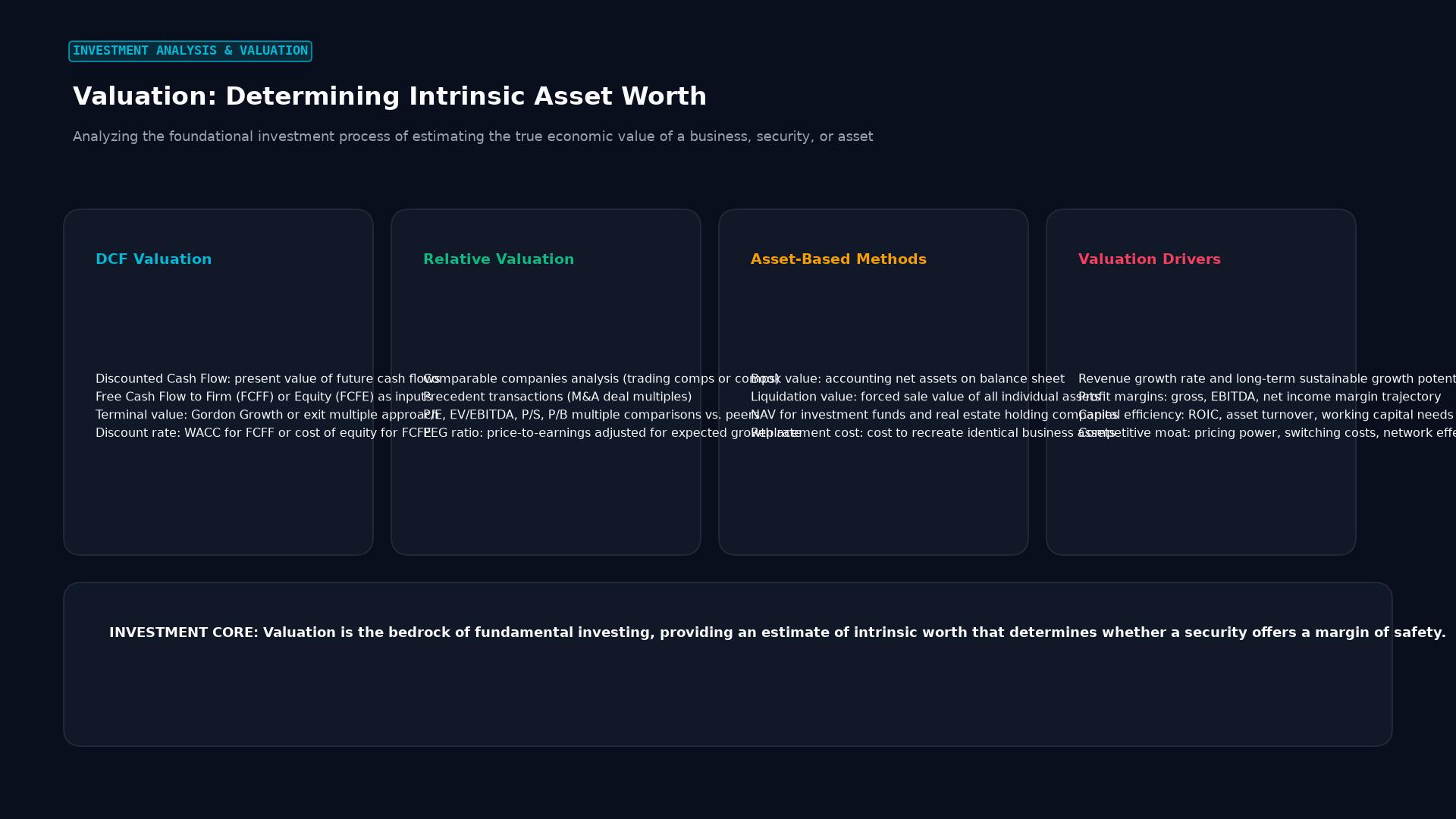 Figure: Analyzing the foundational investment process of estimating the true economic value of a business, security, or asset
Mathematical Formulation: The Discounted Cash Flow (DCF) Framework
The institutional cornerstone of fundamental valuation is the Discounted Cash Flow (DCF) model, which states that the value of any financial asset is equal to the present value of all future cash flows it generates, discounted at an appropriate risk-adjusted rate.
1. Enterprise Value DCF Formula
Enterprise Value ($EV$) is derived by discounting projected Free Cash Flows to Firm ($\text{FCFF}$) over discrete forecast period $T$, plus a Terminal Value ($\text{TV}$):
$$EV = \sum_{t=1}^{T} \frac{\text{FCFF}_t}{(1 + \text{WACC})^t} + \frac{\text{Terminal Value}_T}{(1 + \text{WACC})^T}$$
2. The Gordon Growth Terminal Value Model
Assuming cash flows stabilize into perpetuity at constant growth rate $g$:
$$\text{Terminal Value}T = \frac{\text{FCFF}{T+1}}{\text{WACC} - g} = \frac{\text{FCFF}_T \times (1 + g)}{\text{WACC} - g}$$
Where:
- $\text{WACC}$: Weighted Average Cost of Capital.
- $g$: Long-term sustainable growth rate (theoretically bounded by long-term nominal GDP growth, typically $2%–3%$).
3. Weighted Average Cost of Capital (WACC)
WACC reflects the blended hurdle rate demanded by debt and equity capital providers:
$$\text{WACC} = \left( \frac{E}{V} \right) R_e + \left( \frac{D}{V} \right) R_d (1 - T_c)$$
Where $E$ is equity market cap, $D$ is total debt, $V = E + D$, $R_e$ is the cost of equity (derived via the Capital Asset Pricing Model, $\text{CAPM}: R_e = R_f + \beta [E(R_m) - R_f]$), $R_d$ is the cost of debt, and $T_c$ is the corporate marginal tax rate.
Valuation Methodologies Across Asset Classes
Valuation frameworks must adapt to the unique cash flow characteristics of each financial asset class:
| Asset Class | Primary Valuation Models | Key Inputs & Assumptions | Invalidation Trigger |
|---|---|---|---|
| Public Equities | DCF, EV/EBITDA, P/E multiples | Revenue CAGR, operating margins, WACC, terminal growth | Secular disruption, accounting fraud, margin compression |
| Fixed Income / Bonds | Discounted Cash Flows (YTM) | Coupon payments, recovery rate, benchmark sovereign yield curve | Sovereign default, credit rating downgrade, inflation shock |
| Real Estate | Capitalization Rate ($\text{Cap Rate} = \frac{\text{NOI}}{\text{Value}}$) | Net Operating Income (NOI), occupancy rates, tenant credit | Structural vacancy increases, commercial mortgage rate hikes |
| Currencies (FX) | PPP, BEER, Real Effective Exchange Rates (REER) | Inflation differentials, terms of trade, net foreign assets | Permanent productivity collapse, unconstrained money printing |
Currency Valuation vs. Corporate Valuation
Unlike corporate equities, currencies do not generate independent balance sheet revenues or pay dividends. Consequently, foreign exchange valuation relies on equilibrium exchange rate frameworks:
Corporate Valuation:     Value = Present Value of Operating Cash Flows
Currency Valuation:      Value = Relative International Purchasing Power (PPP)
                         + Real Interest Rate Parity + Sovereign External Balance
When a currency’s exchange rate deviates significantly from its macroeconomic equilibrium (e.g., Real Effective Exchange Rate diverges by $>20%$), algorithmic macro funds position for medium-term mean reversion.
Real-World Institutional Case Study: The WeWork Valuation Implosion (2019)
The hazards of unanchored relative valuation were epitomized in 2019 during the failed initial public offering (IPO) of The We Company (WeWork).
In early 2019, SoftBank’s Vision Fund led a private funding round that valued WeWork at a staggering $$47\text{ billion}$. SoftBank and early venture investors justified this astronomical valuation by categorizing WeWork as a high-growth tech platform deserving software-as-a-service (SaaS) forward revenue multiples of $20\times$ to $30\times$.
[January 2019: Venture Capital Narrative]
Positioned as "Tech Platform" -> 20x Revenue Multiple -> $47 Billion Valuation

[August 2019: Public S-1 Filing Scrutiny]
Institutional Wall Street analysts dissected the financial disclosures:
* WeWork was NOT a tech company; it was a commercial real estate sublease arbitrageur
* Long-term lease liabilities: $47 Billion | Short-term tenant commitments: $4 Billion
* Burning $2.00 of cash for every $1.00 of revenue generated
                    |
                    v
[September - October 2019: The Intrinsic Reality Check]
Valuation slashed: $47B -> $20B -> $10B -> Under $8B
IPO canceled; CEO ousted; SoftBank forced to inject emergency rescue financing
                    |
                    v
Result: WeWork filed for Chapter 11 bankruptcy in November 2023, equity wiped out to $0
The WeWork collapse provided a historic demonstration that narrative-driven market multiples cannot permanently mask negative unit economics. When fundamental intrinsic valuation models (DCF and liquidity runway analysis) were applied, the illusion of value evaporated.
Frequently Asked Questions
What is the difference between intrinsic value and market price?
Market price is the instantaneous clearing price at which an asset is actively transacting in the open market, determined by current supply and demand. Intrinsic value is the theoretical, objective worth of that asset based on the discounted value of its underlying fundamental cash flows and assets. When market price diverges from intrinsic value, investment opportunities arise.
Why is DCF valuation highly sensitive to the discount rate?
Because the discount rate (WACC) appears in the denominator of every cash flow term, a fractional change in WACC compounds exponentially across multi-year and terminal horizons. In growth companies whose cash flows lie far in the future, increasing WACC by just $1.00%$ ($100$ basis points) can slash calculated enterprise value by $20%$ to $35%$.
How can a trader determine if a currency is fairly valued?
Traders examine the Real Effective Exchange Rate (REER) against its 5-year or 10-year rolling average. If the current REER trades more than two standard deviations below its historical mean while the nation maintains a strong current account balance and rising productivity, the currency is quantitatively undervalued and positioned for cyclical appreciation.
Ready to trade forex?
Open a free demo account with a regulated broker. Practice with virtual funds before risking real money.