Financial Statement
A financial statement is a formal, standardized record of the financial activities, position, and cash performance of an economic entity, prepared under US GAAP or IFRS accounting frameworks.
A financial statement is a formal, legally binding record summarizing the financial activities, operational results, and economic condition of a corporation, financial institution, or public entity. Prepared in accordance with standardized accounting frameworks, primarily United States Generally Accepted Accounting Principles (US GAAP) overseen by the Financial Accounting Standards Board (FASB) or International Financial Reporting Standards (IFRS) issued by the International Accounting Standards Board (IASB), financial statements provide investors, creditors, regulators, and corporate executives with objective data to evaluate solvency, liquidity, profitability, and enterprise value.
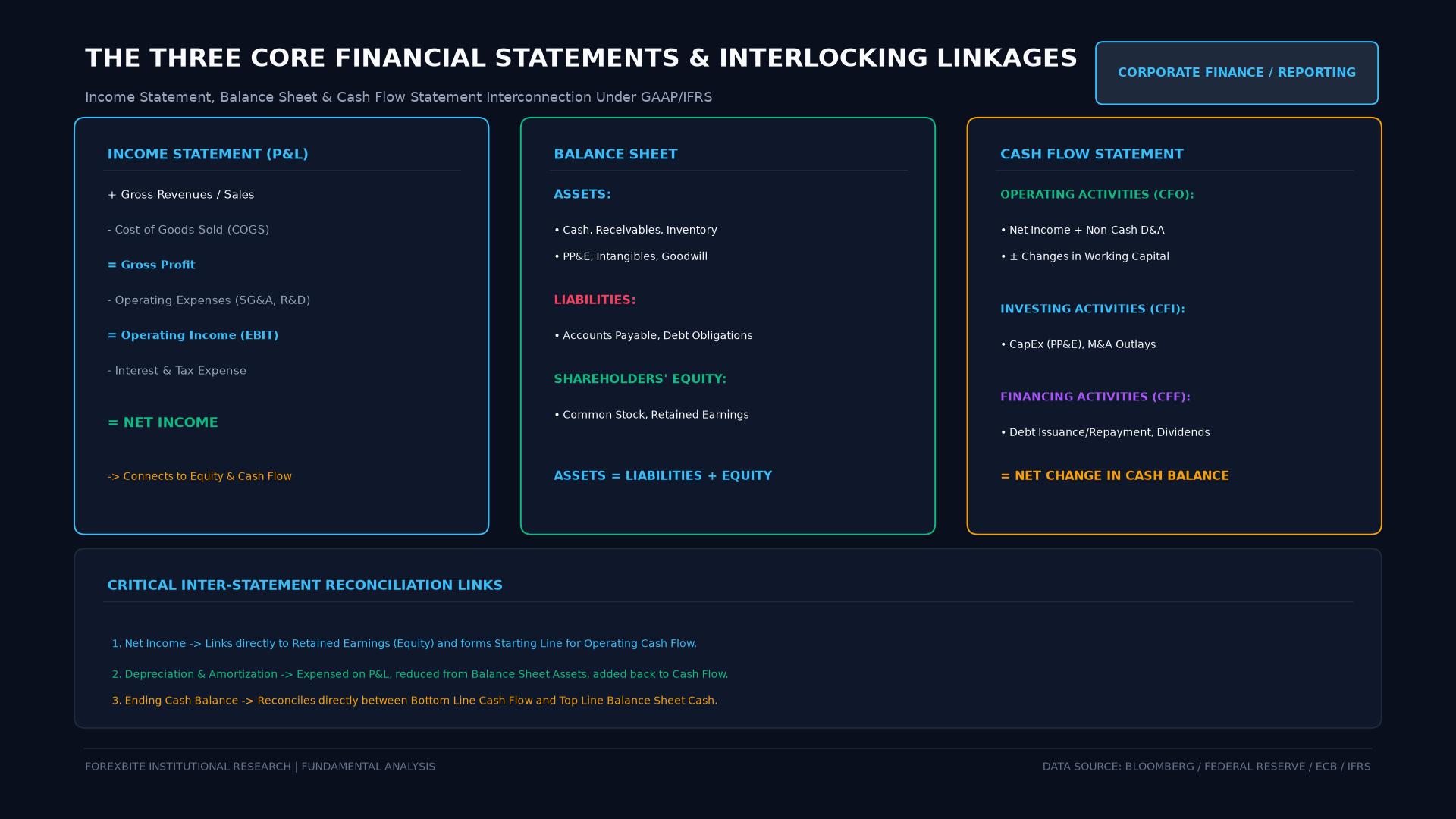 Figure: The interconnected financial statement triad (Income Statement, Balance Sheet, and Statement of Cash Flows), detailing fundamental accounting equations, net income flow to equity, and working capital reconciliation.
The Four Primary Financial Statements
Comprehensive financial reporting consists of four foundational statements that function as an integrated accounting ecosystem:
1. The Balance Sheet (Statement of Financial Position)
The balance sheet provides a point-in-time snapshot of what a company owns (assets), what it owes to external counterparties (liabilities), and the residual interest attributable to shareholders (equity). It adheres to the fundamental accounting equation:
$$\text{Assets} = \text{Liabilities} + \text{Shareholders’ Equity}$$
Assets and liabilities are segmented into current (convertible to cash or due within twelve months) and non-current (long-term property, plant, equipment, goodwill, and multi-year bond obligations). Working capital ($\text{Current Assets} - \text{Current Liabilities}$) provides an immediate indicator of short-term operational solvency.
2. The Income Statement (Statement of Comprehensive Income)
The income statement measures financial performance over a defined period (a fiscal quarter or year). It records the generation of revenue and deducts the direct costs of goods sold (COGS) to arrive at gross profit. Operating expenses (selling, general, administrative, and research and development) are subtracted to calculate Operating Income (Earnings Before Interest and Taxes, or EBIT). After accounting for financing interest expenses and corporate income taxes, the statement concludes with Net Income and Earnings Per Share (EPS), both basic and diluted.
3. The Statement of Cash Flows
While the income statement operates on the accrual basis of accounting (recognizing revenues when earned and expenses when incurred, regardless of cash movement), the statement of cash flows tracks the physical inflow and outflow of cash. Mandated under ASC 230 and IAS 7, the statement divides cash movements into three distinct categories:
- Operating Activities (CFO): Core day-to-day business cash generation, reconciling net income by adding back non-cash expenses (depreciation, amortization, stock-based compensation) and adjusting for changes in working capital accounts (receivables, payables, inventory).
- Investing Activities (CFI): Capital deployment into physical and financial productive capacity, prominently including capital expenditures (CapEx) for property and equipment, acquisition purchases, and investments in marketable securities.
- Financing Activities (CFF): Transactions with debt and equity capital providers, including proceeds from bank borrowings, bond issuances, share buybacks, and dividend disbursements.
$$\text{Free Cash Flow to Firm (FCFF)} = \text{CFO} + \text{Interest Expense} \times (1 - \text{Tax Rate}) - \text{CapEx}$$
4. The Statement of Shareholders’ Equity
This statement reconciles changes in the equity section of the balance sheet over the fiscal period. It details movements in common stock par value, additional paid-in capital (APIC), treasury share repurchases, foreign currency translation adjustments housed within Accumulated Other Comprehensive Income (AOCI), and the accumulation of retained earnings:
$$\text{Ending Retained Earnings} = \text{Beginning Retained Earnings} + \text{Net Income} - \text{Dividends Declared}$$
The Mechanical Interlocking of Statements
A critical principle of fundamental financial analysis is that no single statement can be evaluated in isolation. The three major statements form an interlocking circuit:
- Net Income Link: The bottom-line Net Income from the income statement flows directly into the cash flow statement as the starting line of Operating Cash Flow, while simultaneously expanding Retained Earnings in the equity section of the balance sheet.
- CapEx and PP&E Link: Capital expenditures recorded in the Investing section of the cash flow statement increase Property, Plant, and Equipment (PP&E) on the asset side of the balance sheet. In subsequent periods, this asset is depreciated, creating an expense on the income statement that is added back on the cash flow statement.
- Debt and Interest Link: New borrowings appear as cash inflows in Financing Cash Flow and increase long-term liabilities on the balance sheet, generating future periodic interest expenses on the income statement.
- Cash Balance Reconciliation: The final net change in cash on the cash flow statement, when added to the beginning cash balance, equals the exact cash and cash equivalents figure reported on the ending balance sheet.
| Financial Statement | Primary Question Answered | Accounting Basis | Time Horizon |
|---|---|---|---|
| Balance Sheet | What is the net worth and liquidity structure of the firm? | Accrual | Specific Date (Snapshot) |
| Income Statement | Did the company generate operating profit from operations? | Accrual | Cumulative Period (Quarter/Year) |
| Cash Flow Statement | Did the business produce actual cash liquidity? | Cash | Cumulative Period (Quarter/Year) |
| Equity Statement | How did shareholder ownership and retained value change? | Mixed | Cumulative Period (Quarter/Year) |
Disclosures, Footnotes, and Regulatory Filings
For public corporations listed on major stock exchanges, the numerical tables are accompanied by extensive Notes to the Financial Statements and Management’s Discussion and Analysis (MD&A). Regulators mandate that footnotes disclose:
- Revenue Recognition Polices (ASC 606 / IFRS 15): The specific milestones required to book sales across multi-year contracts or subscription models.
- Lease Accounting (ASC 842 / IFRS 16): Recognition of right-of-use operating assets and associated lease liabilities on the balance sheet.
- Legal Contingencies and Debt Covenants: Details regarding pending litigation, potential regulatory fines, environmental liabilities, and interest-coverage debt covenants.
In the United States, public companies submit standardized regulatory filings to the Securities and Exchange Commission (SEC) via the EDGAR system:
- Form 10-K: The comprehensive annual report, including full financial statements audited by an independent certified public accounting firm.
- Form 10-Q: Unaudited quarterly reports filed for the first three fiscal quarters of the year.
- Form 8-K: Current reports filed within four business days of significant corporate events, such as executive resignations, major acquisitions, or bankruptcy filings.
Quality of Earnings and Red Flags in Financial Analysis
Forensic equity analysts and credit rating agencies evaluate financial statements to assess the “quality of earnings.” Discrepancies between accrual profits and cash realities frequently serve as early warning signs of corporate distress:
- Divergence Between Net Income and Operating Cash Flow: If net income rises consistently while operating cash flow stagnates or turns negative, the company may be aggressively pulling forward revenue or building uncollectible accounts receivable.
- Sudden Inventory Accumulation: A sharp rise in Days Sales of Inventory (DSI) relative to sales growth indicates unsold goods piling up in warehouses, presaging future write-downs and gross margin compression.
- Off-Balance-Sheet Commitments: Variable interest entities (VIEs) and unfunded pension obligations that disguise true financial leverage.
Frequently Asked Questions
What is the difference between US GAAP and IFRS in financial statement preparation?
While both systems share the objective of transparent reporting, US GAAP is rules-based with extensive prescriptive industry guidelines, whereas IFRS is principles-based. Key technical differences include the treatment of inventory (GAAP allows LIFO, while IFRS strictly prohibits LIFO) and the reversal of asset impairments (permitted under IFRS under certain conditions, but strictly forbidden under US GAAP).
Why is the Statement of Cash Flows often considered more reliable than the Income Statement?
The income statement relies on accrual accounting rules, subjective management estimates (such as useful asset lives, bad debt allowances, and revenue milestone completions), and non-cash allocations. The statement of cash flows tracks verified cash movements into and out of corporate bank accounts, making it far more difficult for management to manipulate through accounting adjustments.
What is an unqualified audit opinion on a financial statement?
An unqualified opinion (often termed a “clean opinion”) is the highest endorsement an independent external auditor can issue. It confirms that the auditor has inspected the financial records and concluded that the financial statements represent the company’s financial position fairly, in all material respects, in accordance with applicable accounting standards.
Ready to trade forex?
Open a free demo account with a regulated broker. Practice with virtual funds before risking real money.