Balance Sheet
A balance sheet is a financial statement that shows a company's (or country's) assets, liabilities, and equity at a specific point in time. In forex context, a central bank's balance sheet — which grows through quantitative easing and shrinks through quantitative tightening — directly affects monetary conditions and currency supply, making it a closely watched indicator for institutional forex traders.
Balance Sheets in Forex: Why Central Bank Balance Sheets Matter
For most forex traders, corporate balance sheets are background material — company financials inform stock prices but rarely move currency pairs directly. Central bank balance sheets are another matter entirely.
When the Federal Reserve or European Central Bank expands its balance sheet — purchasing government bonds and adding them as assets while issuing newly created bank reserves as liabilities — they are directly increasing the money supply. More money in the financial system, all else equal, is inflationary and tends to weaken the currency. When they shrink the balance sheet (quantitative tightening), the opposite occurs.
The Fed’s balance sheet ballooned from approximately $900 billion in 2008 to over $8.9 trillion by 2022 as a result of three rounds of QE and pandemic-era emergency purchases. This massive expansion was one structural contributor to the inflationary environment of 2021-2022.
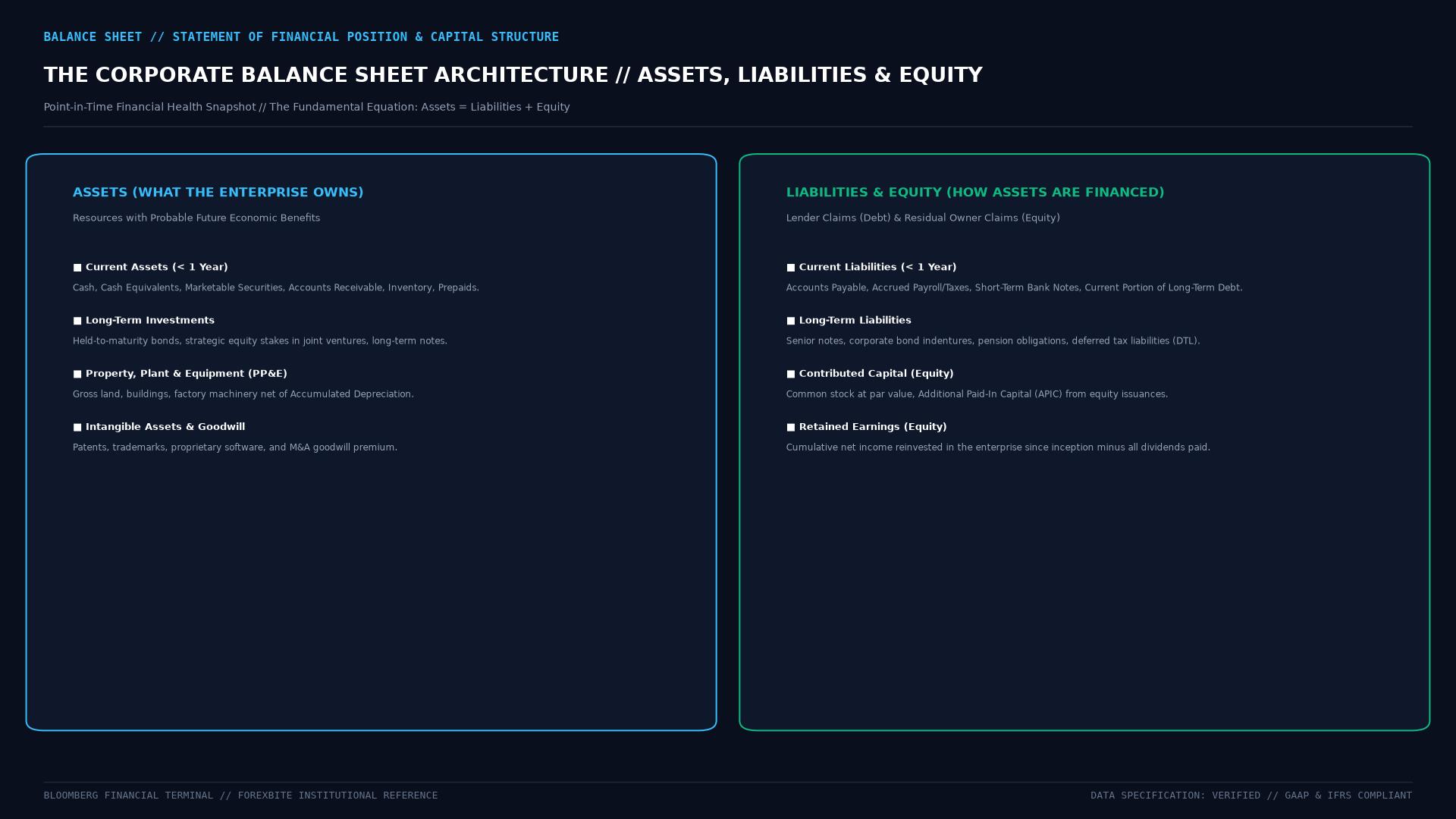 Figure: The institutional Balance Sheet architecture under US GAAP and IFRS, detailing current and non-current assets balanced against liabilities and shareholders’ equity ($Assets = Liabilities + Equity$).
Central Bank Balance Sheet Structure
Assets (what the central bank owns):
- Government bonds (sovereign debt purchased through QE)
- Mortgage-backed securities (in the Fed’s case)
- Foreign exchange reserves
- Gold reserves
- Emergency lending facilities
Liabilities (what the central bank owes):
- Currency in circulation (physical banknotes are a liability — the central bank “owes” value for every bill)
- Bank reserves (deposits commercial banks hold at the central bank)
- Reverse repurchase agreements
Equity:
- Central bank capital (retained earnings)
The accounting is technically sophisticated, but the key insight for traders is straightforward: when the asset side grows faster than it otherwise would (QE), the currency supply increases. When it shrinks (QT), the supply contracts.
Reading Fed Balance Sheet Data
The Federal Reserve publishes its balance sheet weekly (every Thursday, for the prior Wednesday). The data is available at federalreserve.gov. Traders track:
Total assets: The headline number. A rising total indicates ongoing accommodation or emergency lending. A falling total indicates QT is reducing the balance sheet.
Reserves: The level of commercial bank reserves held at the Fed. Very high reserve levels generally support financial stability but can also indicate excess liquidity driving inflation.
The QT pace: During the 2022-2023 tightening cycle, the Fed was reducing its balance sheet at a pace of $95 billion per month (via allowing maturing bonds to roll off). This pace directly affected the pace of tightening beyond just the rate hikes.
Corporate Balance Sheets and Currency Exposure
While central bank balance sheets are the primary forex-relevant balance sheet type, major corporate balance sheets also contain information relevant to currency analysis:
Currency hedging disclosures: Large multinationals disclose their foreign currency exposure and hedging strategies in annual reports. Understanding the aggregate hedging positions of a sector can explain unusual currency flow patterns.
Foreign-denominated debt: Companies that borrowed in foreign currencies (e.g., emerging market companies with dollar-denominated debt) create structural demand for that foreign currency when repayment or refinancing is needed.
Asset repatriation: When US corporations bring overseas earnings back to the United States (as during the 2017-2018 tax reform period), they sell foreign currencies and buy dollars — creating temporary but sometimes significant USD demand.
Key Takeaways
- Central bank balance sheets are the most forex-relevant application of balance sheet analysis
- QE expands the balance sheet (more money supply, typically currency-weakening)
- QT shrinks it (less money supply, typically currency-supportive)
- Fed publishes weekly balance sheet data — traders watch total assets and pace of QT
- Corporate balance sheets matter for understanding FX hedging flows and repatriation effects
FAQ
How does a central bank balance sheet differ from a commercial bank’s? Commercial banks’ balance sheets matter for credit risk and economic growth (lending capacity), but don’t directly affect money creation in the same way. Central banks are unique because their liabilities (bank reserves and currency) are the base of the entire monetary system. When the central bank expands its balance sheet, it creates new base money from nothing — commercial banks cannot do this.
Is a larger central bank balance sheet always bad for a currency? Not necessarily in the short run. When QE is deployed during financial crises, it can actually stabilize the currency by preventing deflationary collapses. The long-run risk is inflation — if balance sheet expansion significantly outpaces growth in real economic output, inflation eventually follows. The currency consequences depend on how QE affects relative inflation rates and interest rate expectations compared to other countries.
Ready to trade forex?
Open a free demo account with a regulated broker. Practice with virtual funds before risking real money.