GAO
The Government Accountability Office (GAO) is the non-partisan, supreme audit institution of the United States federal government, providing legislative oversight, financial audits, and program evaluations for Congress.
The Government Accountability Office (GAO) is an independent, non-partisan legislative branch agency that operates as the supreme audit institution of the United States federal government. Colloquially termed the “Congressional Watchdog,” the GAO is tasked with examining how federal taxpayer funds are received, managed, and disbursed. Headed by the Comptroller General of the United States, who serves a 15-year non-renewable statutory term to ensure institutional independence, the agency conducts rigorous financial audits, program evaluations, legal analyses, and policy investigations. In financial markets, the GAO plays an essential regulatory role by auditing the consolidated financial statements of the US Government, reviewing emergency Federal Reserve liquidity facilities, and assessing systemic risk oversight across financial regulators.
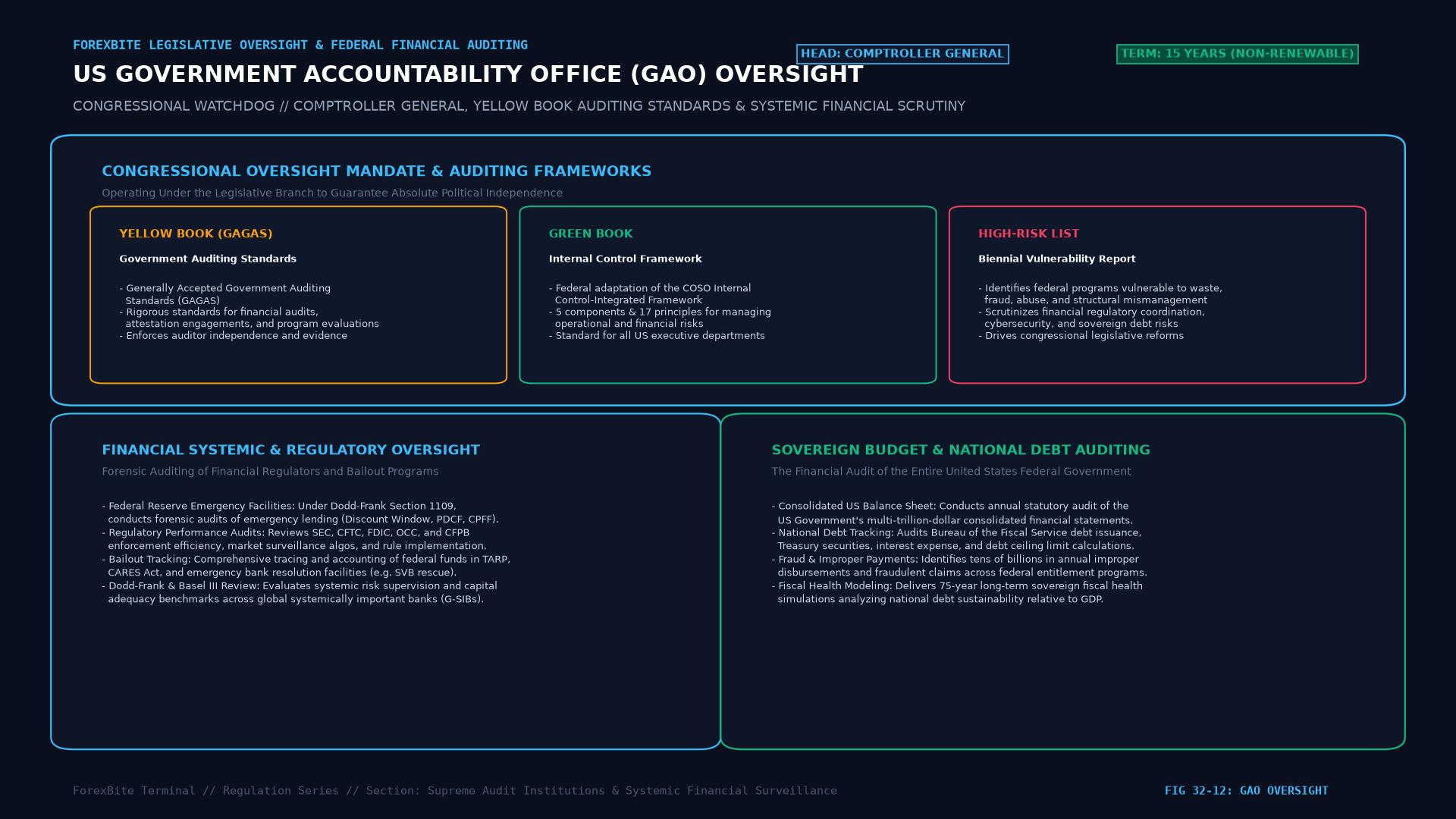 Figure: The statutory architecture of the Government Accountability Office (GAO) under the Comptroller General, spanning GAGAS Yellow Book audits, Green Book internal controls, and financial systemic oversight.
Legislative History and Statutory Evolution
The GAO was established by the Budget and Accounting Act of 1921 under its original name, the General Accounting Office. The 1921 Act marked a turning point in American public finance:
- Prior to 1921, individual executive departments submitted disconnected budget requests directly to Congress, with financial accounting decentralized across the Department of the Treasury.
- The 1921 Act created the Bureau of the Budget (now the Office of Management and Budget, or OMB) within the Executive Branch to formulate the President’s budget.
- Concurrently, Congress established the General Accounting Office as an independent agency located outside the executive branch, reporting directly to Congress to perform post-expenditure audits and settlement of public accounts.
In 2004, President George W. Bush signed into law the GAO Human Capital Reform Act, which formally renamed the agency the Government Accountability Office. The name change reflected the agency’s evolution from a clerical accounting bureau into a sophisticated multidisciplinary policy evaluation organization employing economists, forensic accountants, legal scholars, IT specialists, and public policy analysts.
Professional Standards: The Yellow Book and Green Book
The GAO establishes the benchmark standards for public-sector auditing across the United States:
1. Generally Accepted Government Auditing Standards (The Yellow Book)
Formally known as GAGAS, the Yellow Book defines the ethical, operational, and reporting standards required for auditors of government entities, federal contractors, and non-profit recipients of federal grant awards. The Yellow Book outlines core requirements for auditor independence, professional judgment, competence, and quality control.
2. Standards for Internal Control in the Federal Government (The Green Book)
The Green Book adapts the Committee of Sponsoring Organizations of the Treadway Commission (COSO) internal control framework for the federal environment. It provides federal agency leadership with operational guidelines to establish, monitor, and assess internal controls to prevent fraud, financial waste, and administrative abuse.
$$\text{GAO Financial Audit Scope} = \text{Internal Control Integrity} + \text{GAGAS Compliance} + \text{Substantive Testing}$$
The Biennial High-Risk List
Since 1990, the GAO has published a biennial report known as the High-Risk List at the start of each new congressional session. The report identifies federal programs, operations, and agencies that are exceptionally vulnerable to fraud, waste, abuse, and mismanagement, or that require fundamental transformation to address structural weaknesses.
Prominent financial and macroeconomic areas consistently scrutinized on the High-Risk List include:
- Federal Fiscal Health: The unsustainable long-term trajectory of the US federal debt relative to gross domestic product.
- Financial Regulatory Fragmentation: Overlapping jurisdictions and regulatory gaps between the Securities and Exchange Commission (SEC), the Commodity Futures Trading Commission (CFTC), the Federal Reserve Board, the Office of the Comptroller of the Currency (OCC), and the Federal Deposit Insurance Corporation (FDIC).
- Federal Student Loan Portfolio: High credit default rates and escalating taxpayer liabilities within the Department of Education’s direct lending portfolio.
- National Flood Insurance Program (NFIP): Chronic insolvency in the Federal Emergency Management Agency (FEMA) flood insurance program, which requires recurring congressional debt forgiveness.
| Oversight Domain | Key Audit Output | Primary Financial Market Transmission |
|---|---|---|
| Federal Balance Sheet | Consolidated US Financial Audit | Informs credit rating agencies (Moody’s, S&P, Fitch) on sovereign risk |
| Federal Reserve Oversight | Emergency Lending Audits | Details emergency discount window, repo facilities, and CPFF operations |
| Troubled Asset Relief (TARP) | Capital Purchase Program Audits | Traced taxpayer equity injection recoupments in Wall Street banks post-2008 |
| National Debt Ceiling | Debt Limit Timing Models | Informs Treasury cash management and institutional money market fund strategies |
Financial Market Oversight and Federal Reserve Audits
The relationship between the GAO and the Federal Reserve is defined by statutory boundaries designed to balance public accountability with central bank independence:
1. The Federal Banking Agency Audit Act of 1978
For decades, the Federal Reserve operated outside standard congressional audit purview. The 1978 Act granted the GAO authority to audit the regulatory, administrative, and supervisory operations of the Federal Reserve Board and Federal Reserve Banks. However, to preserve monetary policy autonomy, the statute explicitly prohibited the GAO from auditing:
- Deliberations, decisions, or actions on monetary policy matters, including discount window interest rate adjustments.
- Open market operations (OMO) conducted by the Federal Reserve Bank of New York.
- Foreign exchange transactions or swap agreements with foreign central banks.
2. The Dodd-Frank Wall Street Reform and Consumer Protection Act (2010)
Following the 2008 Global Financial Crisis, Section 1109 of the Dodd-Frank Act mandated that the GAO execute a one-time comprehensive forensic audit of all emergency liquidity programs established by the Federal Reserve under Section 13(3) of the Federal Reserve Act.
The resulting landmark GAO report, published in July 2011, provided unprecedented transparency into crisis lending. The audit revealed that between December 2007 and July 2010, the Federal Reserve provided more than 16 trillion dollars in cumulative emergency short-term financing across facilities such as the Primary Dealer Credit Facility (PDCF), the Term Asset-Backed Securities Loan Facility (TALF), and foreign central bank currency liquidity swap lines.
3. Auditing the Federal Balance Sheet
Every year, in coordination with the Treasury Office of Inspector General, the GAO attempts to audit the Consolidated Financial Statements of the United States Government. While major agencies (such as the Social Security Administration and the Department of Health and Human Services) receive clean audit opinions, the GAO has historically been unable to issue an audit opinion on the overall consolidated government statements, primarily due to serious financial management and inventory tracking deficiencies at the Department of Defense.
Frequently Asked Questions
Is the Government Accountability Office part of the Executive Branch?
No. The GAO is an independent legislative branch agency that reports directly to the United States Congress. This structure guarantees that GAO audits and investigations remain free from executive political interference by the White House or presidential cabinet departments.
Can the GAO subpoena documents if a government agency refuses to cooperate?
Yes. Under 31 U.S.C. § 716, the Comptroller General possesses statutory subpoena authority to compel the production of records, communications, and data from non-federal entities, federal contractors, and private commercial firms that receive federal funds. If an executive agency refuses access, the GAO can file suit in the United States District Court to enforce compliance.
How does the GAO track the US Debt Ceiling?
When the US federal government approaches the statutory debt limit enacted by Congress, the Department of the Treasury must deploy “extraordinary measures” (such as suspending investments in federal employee retirement funds) to avoid sovereign default. The GAO produces independent analyses modeling how long extraordinary measures will last and documenting the secondary financial costs incurred by taxpayers due to heightened Treasury bill yield volatility during debt-ceiling impasses.
Ready to trade forex?
Open a free demo account with a regulated broker. Practice with virtual funds before risking real money.