General mortgage
A general mortgage is a single security instrument that pledges multiple parcels of real estate or all mortgageable properties of an enterprise as unified collateral for a debt obligation.
A general mortgage, interchangeably referred to in real estate and commercial corporate finance as a blanket mortgage or blanket debenture, is a comprehensive debt security instrument that pledges two or more separate parcels of real property, or an enterprise’s entire inventory of physical real assets, as unified collateral for a single credit facility. Widely utilized by residential tract subdivision developers, commercial real estate investment trusts (REITs), utility operators, and industrial conglomerates, a general mortgage enables borrowers to consolidate borrowing power, minimize closing fees across multiple transactions, and secure lower interest rates through cross-collateralization.
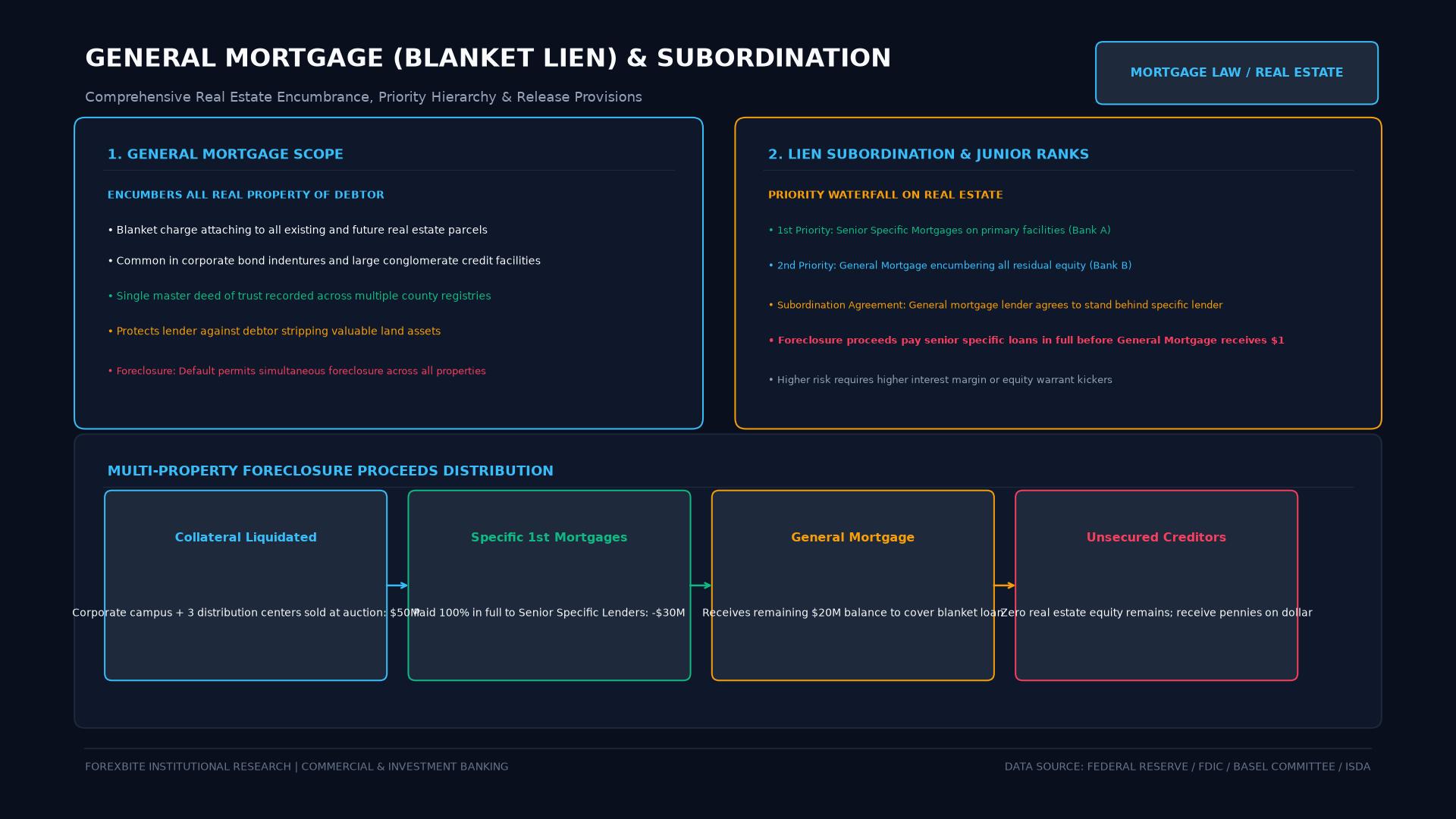 Figure: Comprehensive corporate mortgage structure: blanket pledge encompassing multiple commercial real estate properties under a single subordinated lien.
Structural Real Estate Mechanics and the Partial Release Clause
In commercial real estate land development, a builder acquires a large tract of agricultural land with the intention of grading roads, installing municipal utilities, and subdividing the property into fifty individual residential home lots.
If the developer financed each lot under an independent mortgage, the administrative overhead, recording fees, separate title insurance policies, and legal documentation would be financially prohibitive. By executing a general mortgage, the developer finances the entire master acreage under a single loan agreement.
However, a standard mortgage presents a fatal legal obstacle: an encumbered property cannot be sold with clear, marketable title until the underlying debt is satisfied in full. If a homebuyer wishes to purchase Lot 14, they cannot take clear title if the bank holds a mortgage over the entire subdivision.
To resolve this issue, every properly drafted general mortgage contains an essential statutory covenant known as the Partial Release Clause (or Partial Reconveyance Provision):
- The clause establishes a contractual formula stipulating how much debt principal the developer must pay down to release the lender’s lien on an individual subdivided lot.
- Lenders typically demand a release price equal to 110 percent to 125 percent of the lot’s proportional loan allocation. This premium ensures that the remaining collateral cushion grows stronger as individual lots are sold, protecting the lender against the risk that the developer sells the premier lots first and defaults on the less desirable remaining inventory.
$$\text{Required Paydown per Lot} = \left( \frac{\text{Master Loan Amount}}{\text{Total Developed Lots}} \right) \times \text{Release Multiplier (e.g., 1.15)}$$
Once the borrower wires the agreed release payment to the escrow agent, the lender signs and records a Deed of Partial Release, extinguishing the general mortgage lien solely from that specific lot while leaving the master lien intact across the rest of the property portfolio.
Corporate General Mortgage Bonds
In corporate bond markets and public utility finance, a general mortgage bond occupies a distinct niche within the capital structure. Historically popularized by American transcontinental railroads and electrical power utilities in the late nineteenth and twentieth centuries, general mortgage bonds encumber all or substantially all of a company’s fixed physical operating infrastructure.
       CORPORATE CAPITAL STRUCTURE HIERARCHY
       =====================================

   [ SENIOR FIRST MORTGAGE BONDS ] (Closed-End Liens on Specific Plants)
                 |
                 v
   [ GENERAL MORTGAGE BONDS ]      (Blanket Lien Across All Assets)
                 |
                 v
   [ UNSECURED DEBENTURES ]        (General Corporate Credit)
                 |
                 v
   [ SUBORDINATED DEBT ]           (Junior Ranking)
                 |
                 v
   [ EQUITY CAPITAL ]              (Common and Preferred Shares)
Key contractual provisions of corporate general mortgage bonds include:
1. Subordination and Divisional Liens
Corporate general mortgages are often junior to prior existing liens. For example, a power utility might have specific first mortgages securing individual hydroelectric generating facilities. When the utility issues a general mortgage bond, the new bond acts as a second mortgage on those specific facilities, but a first mortgage on newly constructed transmission grids. Over time, as underlying first mortgage bonds mature and are retired, the general mortgage bond automatically steps up into senior first-lien priority across the entire enterprise.
2. The After-Acquired Property Clause
Most corporate general mortgages contain an after-acquired property clause. This covenant stipulates that any real estate, transmission rights-of-way, power substations, or industrial manufacturing facilities acquired by the corporation in the future immediately and automatically become subject to the blanket lien of the existing bondholders, providing expanding asset protection as the company grows.
3. Cross-Collateralization and Cross-Default Provisions
General mortgages enforce complete cross-collateralization. The lender is not restricted to recovering losses from a single underperforming asset. If a commercial borrower owns five hotel properties under a blanket facility and Hotel C suffers from a catastrophic occupancy drop, the lender can foreclose on the entire five-hotel portfolio if the borrower defaults on total debt service payments.
| Feature | Standard Specific Mortgage | General (Blanket) Mortgage |
|---|---|---|
| Number of Properties | Exactly one defined physical parcel | Two or more parcels, or enterprise-wide assets |
| Release Mechanism | Full reconveyance upon 100% loan payoff | Staged partial release clauses per parcel |
| Cross-Collateralization | None; debt tied strictly to single property | Complete; all assets secure the entire debt |
| Primary Borrower | Individual homeowner or single-asset LLC | Tract developers, commercial REITs, utilities |
| Closing Transaction Costs | Standard single title and escrow fee | Lower aggregate closing costs across multiple sites |
Advantages and Systemic Risks for Borrowers and Lenders
The deployment of a general mortgage introduces profound operational efficiencies, along with concentrated default risks:
Core Advantages
- Greater Borrowing Capacity: By pooling multiple properties into a single borrowing base, borrowers can achieve higher overall loan-to-value (LTV) ratios than if weaker individual properties were assessed independently.
- Administrative Streamlining: A single monthly debt service payment, unified reporting covenants, and synchronized maturity schedules reduce corporate treasury overhead.
- Lower Financing Rates: Lenders offer tighter interest rate spreads on blanket facilities because cross-collateralization significantly reduces lender loss given default (LGD).
Structural Risks
- Contagion Risk Across Properties: In a severe economic downturn, a cash-flow shortfall at a single property can trigger an acceleration of the entire master loan, putting solvent, highly profitable properties at risk of liquidation.
- Title Complexity: The presence of a blanket lien across multiple jurisdictions requires coordinated title searches across county recording offices, complicating land sales if partial releases are not processed meticulously.
Frequently Asked Questions
What happens if a developer fails to negotiate a partial release clause in a general mortgage?
Without an explicit partial release clause, the developer faces a catastrophic operational trap: they cannot legally sell an individual home or subdivided lot to an end-buyer because the bank holds an unreleased blanket lien over the entire tract. The only way to clear title would be to pay off the entire master loan in full, which is impossible for most builders until dozens of homes have been sold.
Can an individual real estate investor use a blanket mortgage for rental properties?
Yes. Real estate investors who accumulate portfolios of single-family rental homes or small multi-family buildings frequently utilize commercial blanket mortgages to refinance their equity out of multiple properties simultaneously, consolidating separate high-interest mortgages into a single institutional loan with lower interest rates.
How does a general mortgage differ from an all-assets debenture?
A general mortgage specifically encumbers real estate property (land, buildings, fixed industrial structures) and must be formally recorded in the local land registry or county recorder’s office for each property. An all-assets debenture (or UCC blanket floating lien in the United States) encumbers personal property, receivables, inventory, and equipment, which is perfected by filing a UCC-1 Financing Statement with the Secretary of State.
Ready to trade forex?
Open a free demo account with a regulated broker. Practice with virtual funds before risking real money.