After-acquired collateral
After-acquired collateral refers to any tangible or intangible property obtained by a debtor following the signing of a security agreement that becomes automatically pledged to secure an existing loan.
What Is After-Acquired Collateral?
After-acquired collateral comprises any assets, inventory, machinery, receivables, or intellectual property obtained by a borrower after executing a formal credit facility and security agreement. While an “after-acquired clause” describes the legal covenant granting the creditor future rights, “after-acquired collateral” identifies the physical or financial property that flows into the encumbered collateral pool.
In modern commercial banking, after-acquired collateral is the cornerstone of asset-based lending (ABL) and corporate working capital revolvers. In fast-paced commercial industries, raw materials are converted into finished inventory, shipped to customers, and converted into accounts receivable on a daily basis. Without after-acquired collateral mechanics, a lender’s secured position would evaporate the moment the debtor sells its initial inventory stock.
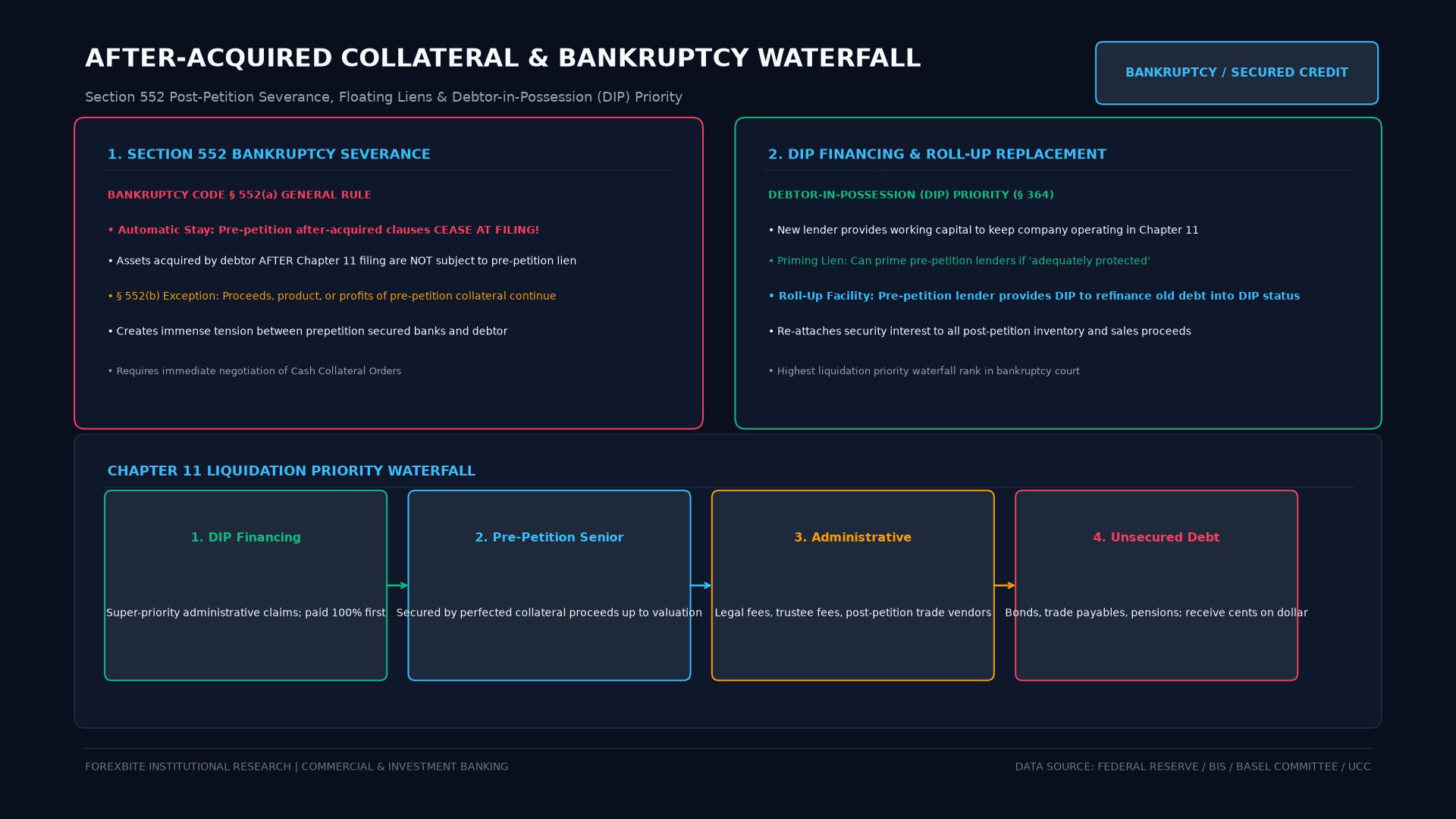 Figure: Legal perfection and priority waterfall: blanket floating liens versus Purchase Money Security Interest (PMSI) super-priority exceptions.
Asset Classes Commonly Subject to After-Acquired Liens
Commercial lenders classify after-acquired collateral into several distinct asset categories, each carrying unique monitoring protocols and advance rates:
| Collateral Category | Typical Advance Rate | Monitoring & Audit Mechanism |
|---|---|---|
| Eligible Accounts Receivable | 80% to 85% of face value | Monthly aging schedules, bad-debt reserve checks, lockbox audits |
| Finished Goods Inventory | 50% to 65% of Net Orderly Liquidating Value (NOLV) | Semi-annual third-party appraisal, warehouse inspections |
| Raw Materials Inventory | 20% to 40% of landed cost | Commodity price indexation, scrap factor audits |
| Machinery & Equipment | 50% to 75% of orderly liquidation value | Desktop appraisals, maintenance record tracking, serial number logs |
| Intellectual Property | Conservative / 0% advance | Trademark renewals, patent office filings, software copyright logs |
Work-in-process (WIP) inventory is almost universally excluded from borrowing base calculations because partially completed assemblies possess negligible liquidation value if the manufacturing facility halts operations.
Global Legal Implementations: US vs. Commonwealth Systems
The legal characterization of after-acquired collateral differs significantly between the American statutory framework and English common-law jurisdictions:
1. United States: The UCC Article 9 Floating Lien
Under Article 9 of the Uniform Commercial Code, the lender’s lien attaches to after-acquired collateral the precise moment the debtor acquires “rights in the collateral.” The lien maintains a continuous senior perfected status dating back to the original UCC-1 financing statement filing. The lien floats over the changing mass of collateral without requiring any formal intervention or declaration of default.
2. United Kingdom and Commonwealth: The Floating Charge
In English, Canadian, and Australian commercial law, after-acquired collateral is traditionally secured via a floating charge. The floating charge hovers over the company’s fluctuating pool of assets, allowing the borrower to dispose of assets in the ordinary course of business without lender interference.
Unlike the US floating lien, the English floating charge does not attach as a fixed property right until a specific trigger event occurs, such as a loan default or appointment of an administrator. At that point, the floating charge crystallizes into a fixed charge, legally freezing the borrower’s control over the assets.
Floating Lien (US) vs. Floating Charge (Commonwealth):
┌──────────────────────────────┬──────────────────────────────┐
│       UCC Article 9 (US)     │   Floating Charge (UK/Common)│
├──────────────────────────────┼──────────────────────────────┤
│ • Attaches instantly as      │ • Hovers over assets without │
│   assets are acquired        │   immediate fixed attachment │
│ • Continuous perfected       │ • Crystallizes into fixed    │
│   priority from filing date  │   lien only upon default     │
│ • Single unified security    │ • Subordinated to statutory  │
│   interest concept           │   preferential claims in law │
└──────────────────────────────┴──────────────────────────────┘
Borrowing Base Administration and Lender Audits
Because after-acquired collateral is dynamic and fluctuates daily, institutional credit facilities require rigorous administrative safeguards:
- Borrowing Base Certificates (BBC): Borrowers submit periodic BBC reports (weekly or monthly) certified by the Chief Financial Officer. The certificate details gross receivables, ineligible accounts (such as invoices over 90 days past due, cross-aged balances, foreign debts, or contra accounts), eligible inventory, and calculated loan availability.
- Field Examinations: Commercial lenders dispatch specialized collateral examiners to the borrower’s corporate headquarters and manufacturing sites 1 to 4 times per year. Auditors sample shipping documents, verify customer purchase orders, conduct physical inventory counts, and examine scrap logs to ensure reported collateral actually exists.
- Lockbox and Dominion of Funds: In high-risk credit agreements, the lender establishes a blocked bank account (lockbox). Customer payments flow directly to the lender’s designated account to immediately pay down the outstanding revolver balance, preventing the debtor from diverting cash receipts into unauthorized ventures.
Key Takeaways
- After-acquired collateral encompasses assets acquired by a business following the execution of a security agreement that automatically secure the loan.
- The concept enables asset-based revolving credit lines by allowing fluctuating receivables and inventory to continuously replenish the collateral pool.
- Advance rates vary widely by asset class, ranging from 85% on eligible commercial receivables down to 20% on raw materials, with work-in-process generally excluded.
- The US Uniform Commercial Code applies an automatic continuous floating lien, whereas English common-law frameworks utilize a floating charge that crystallizes upon loan default.
Frequently Asked Questions
What makes an account receivable ineligible as after-acquired collateral?
Lenders disqualify receivables from the borrowing base if they are aged over 90 days from the invoice date, belong to an affiliated entity, involve customer disputes, originate from foreign buyers without export credit insurance, or exhibit “cross-aging” (where more than 50% of the customer’s total balance is delinquent).
How is after-acquired collateral treated during a company liquidation?
In a Chapter 7 liquidation or Chapter 11 asset sale, senior secured lenders holding perfected floating liens over after-acquired collateral receive proceeds from those assets up to their full outstanding debt balance before any funds are distributed to unsecured general creditors or equity holders.
Can intellectual property serve as after-acquired collateral?
Yes. Modern credit agreements routinely encumber future intellectual property, including new software source code, patents, trademarks, and copyrights developed by the company. Lenders record supplemental filings with national patent and trademark offices to confirm public perfection across intellectual assets.
Ready to trade forex?
Open a free demo account with a regulated broker. Practice with virtual funds before risking real money.