Investment Banking
Investment banking is a specialized division of financial services that assists corporations, institutions, and sovereign governments in raising capital and executing strategic mergers, acquisitions, and restructurings.
Investment banking is an elite, specialized sector of the global financial system that advises multinational corporations, financial institutions, private equity sponsors, and sovereign governments on large-scale strategic transactions and capital formation. Distinct from commercial retail banking, which accepts public deposits and issues standardized consumer loans, investment banks function as intermediaries between institutional capital providers and entities seeking external funding. Operating across advisory divisions (Mergers and Acquisitions) and underwriting syndicates (Equity and Debt Capital Markets), investment banks manage initial public offerings (IPOs), underwrite corporate bond issuances, structure complex cross-border takeovers, and advise distressed enterprises through corporate bankruptcies.
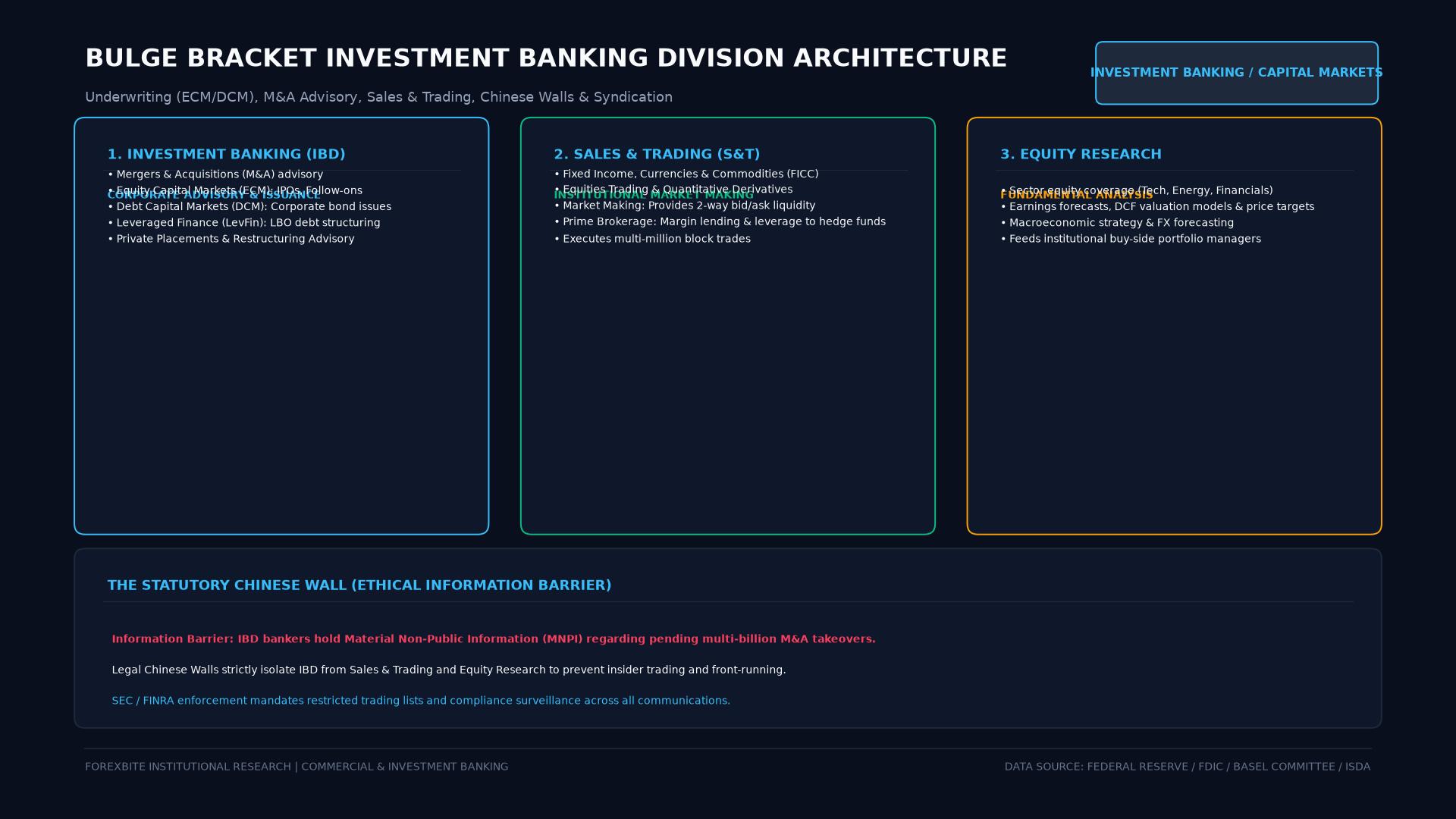 Figure: Investment banking organizational structure: Front Office (ECM/DCM/M&A advisory, sales & trading), Middle Office (risk & treasury), and Back Office operations.
Core Business Divisions and Functional Mandates
The revenue generation of an investment bank is organized into four foundational business units:
1. Mergers and Acquisitions (M&A) Advisory
Investment bankers advise corporate boards and private equity firms on buying, selling, or combining business entities:
- Sell-Side Advisory: Representing a company seeking an acquirer. Bankers prepare marketing prospectuses (Confidential Information Memorandums), organize competitive auctions among potential strategic and financial buyers, evaluate bids, and negotiate final purchase agreements.
- Buy-Side Advisory: Assisting an acquiring enterprise in identifying acquisition targets, performing valuation modeling (Discounted Cash Flow, Precedent Transactions, and Accretion/Dilution analysis), arranging transaction financing, and structuring takeover defenses against hostile bids (such as poison pills and white knight defenses).
- Fairness Opinions: Providing an independent, legally binding evaluation confirming that the financial terms of a proposed merger or acquisition are fair to public shareholders from a financial perspective.
2. Equity Capital Markets (ECM)
ECM teams bridge corporate issuers and institutional equity investors:
- Initial Public Offerings (IPOs): Guiding private corporations through the transition to publicly traded status. Bankers structure the offering, register filings with the Securities and Exchange Commission (Form S-1), organize institutional roadshows, build the order book, and price the offering.
- Follow-On and Secondary Offerings: Raising additional equity capital for already public companies through marketed follow-on offerings or accelerated bookbuilds.
- Convertible Securities: Structuring hybrid convertible bonds and preferred shares that pay interest while offering equity upside.
3. Debt Capital Markets (DCM)
DCM structures and distributes debt securities across global credit markets:
- Investment-Grade Corporate Bonds: Underwriting multi-billion-dollar bond tranches for blue-chip multinational corporations to fund capital investments or share buybacks.
- High-Yield (Leveraged) Bonds: Structuring debt instruments for speculative-grade companies and leveraged buyout (LBO) transactions.
- Syndicated Bank Loans: Assembling syndicates of commercial and investment banks to fund massive corporate credit facilities.
4. Restructuring and Special Situations
Restructuring bankers advise financially distressed corporations facing liquidity crises or default:
- Designing out-of-court debt workouts, exchange offers, and debt-for-equity swaps.
- Guiding debtors or creditor committees through formal Chapter 11 bankruptcy proceedings, arranging Debtor-in-Possession (DIP) financing and exit financing.
$$\text{Gross M&A Advisory Fee} = \text{Transaction Enterprise Value} \times \text{Agreed Success Fee Percentage (0.5% - 2.0%) }$$
| Division | Primary Client Base | Core Transaction Deliverables | Fee Structure |
|---|---|---|---|
| M&A Advisory | Corporate Boards, Private Equity | Target valuation, deal negotiation, fairness opinions | Success fee (percentage of deal value) |
| Equity Capital Markets | Pre-IPO startups, Public Firms | IPO syndication, secondary offerings, roadshows | Gross spread (typically 3% - 7% of capital raised) |
| Debt Capital Markets | Governments, Blue-Chip Corps | Senior bonds, subordinated notes, syndicated credit | Underwriting spread (0.5% - 2.0% of bond notional) |
| Restructuring | Distressed Firms, Bondholders | Chapter 11 advisory, debt-for-equity swaps | Monthly advisory retainer + restructuring success fee |
Underwriting Mechanics: Firm Commitment vs Best Efforts
When investment banks underwrite an equity or debt offering, the contractual arrangement dictates which party absorbs financial market risk:
1. Firm Commitment Underwriting
In a firm commitment contract, the investment banking syndicate agrees to purchase the entire offering of shares or bonds from the issuing company at an agreed discounted price, intending to resell them to the public at the higher public offering price:
- The Underwriting Spread: The difference between the purchase price paid to the issuer and the public offering price represents the gross spread (compensation for the syndicate).
- Risk Allocation: The bank assumes complete inventory risk. If market sentiment deteriorates and public investors refuse to purchase the securities at the offering price, the bank must absorb the unsold inventory on its own balance sheet, incurring potential trading losses.
2. Best Efforts Underwriting
In a best efforts agreement, the investment bank acts purely as an agent rather than a principal:
- The bank pledges to deploy its best commercial efforts to sell as many shares as possible to institutional and retail investors, but does not guarantee the sale of the entire issue.
- Any unsold shares remain with the issuing company, and the bank incurs zero financial liability for capital shortfalls. Best efforts offerings are common among small-cap issuers and speculative micro-cap listings.
       GROSS UNDERWRITING SPREAD WATERFALL (7% SPREAD ON $100M IPO)
       ===========================================================

     TOTAL GROSS SPREAD: $7,000,000 (Deducted from $100M Capital Raised)
                                   |
         +-------------------------+-------------------------+
         |                         |                         |
         v                         v                         v
+-----------------+       +-----------------+       +-----------------+
| MANAGEMENT FEE  |       | UNDERWRITING FEE|       | SELLING CONCESS.|
| (20% of Spread) |       | (20% of Spread) |       | (60% of Spread) |
| $1,400,000      |       | $1,400,000      |       | $4,200,000      |
| Paid to Lead    |       | Covers Syndicate|       | Paid to Brokers |
| Bookrunners for |       | Capital Risk and|       | Who Successfully|
| Deal Structuring|       | Legal Overhead  |       | Sell Shares     |
+-----------------+       +-----------------+       +-----------------+
The Regulatory Fire Wall: The Chinese Wall Doctrine
A unique institutional challenge of investment banking is the coexistence of corporate advisory operations with public sales and trading:
- When advising a client on an impending takeover, investment bankers possess Material Non-Public Information (MNPI).
- If the bank’s proprietary trading desk or equity research analysts learned of this transaction before public announcement, they could trade illegally or front-run client orders, violating insider trading statutes (SEC Rule 10b-5).
To eliminate this systemic conflict of interest, securities regulators enforce the Chinese Wall (Information Barrier) doctrine:
- Physical and Digital Separation: Advisory personnel (the “Private Side”) operate on restricted, secure floors protected by keycards, separate server networks, and monitored communication systems.
- Research Analyst Independence: Codified by FINRA Rule 2241 and the landmark 2003 Global Research Analyst Settlement, investment bankers are strictly prohibited from supervising, compensating, or previewing research reports prepared by equity research analysts.
- The Watch and Restricted Lists: The bank’s internal compliance department maintains confidential lists of corporate clients involved in active deals. Securities on the Restricted List cannot be traded for the bank’s proprietary account, nor can analysts publish buy/sell recommendations on those stocks during active transaction windows.
Bulge Bracket vs Boutique Advisory Firms
The competitive landscape of investment banking features two distinct operating models:
1. Bulge Bracket Investment Banks
Universal financial giants that combine advisory services with massive balance sheets:
- Core Firms: Goldman Sachs, Morgan Stanley, JPMorgan Chase, Bank of America, Citigroup, Barclays, and UBS.
- Competitive Advantage: They can commit tens of billions of dollars in commercial debt financing to support multi-billion-dollar corporate acquisitions, providing “one-stop-shop” financing and underwriting capacity.
2. Elite Independent Boutiques
Specialized advisory partnerships that focus exclusively on M&A advisory, restructuring, and strategic corporate defense, deliberately avoiding commercial lending, retail trading, or balance sheet underwriting:
- Core Firms: Lazard, Evercore, Moelis & Company, Centerview Partners, PJT Partners, and Perella Weinberg Partners.
- Competitive Advantage: Because they do not engage in commercial lending or trade execution, boutique firms market themselves to corporate boards as conflict-free advisors whose guidance is not influenced by an incentive to cross-sell balance sheet loans.
Frequently Asked Questions
What is the difference between a pitchbook and a prospectus in investment banking?
A pitchbook is a private marketing presentation created by investment bankers to convince a corporate board to hire their firm for a transaction, outlining industry trends, valuation ranges, and transaction ideas. A prospectus (such as SEC Form S-1) is a formal, legally binding public disclosure document filed with securities regulators, detailing audited financial statements, business risks, and transaction terms for prospective public investors.
What is a greenshoe option in an IPO underwriting?
A greenshoe option (formally known as an overallotment option under SEC Regulation M) is a contractual provision in an underwriting agreement that permits the investment banking syndicate to purchase and sell up to 15 percent more shares than originally planned at the offering price. The syndicate uses this provision to stabilize the stock price in the secondary market if shares trade below the offering price during opening trading days.
What is the role of an investment banking league table?
A league table is an industry ranking published by financial data providers (such as Bloomberg, Refinitiv, and Dealogic) that ranks investment banks based on the total dollar volume and number of advisory or underwriting transactions completed over a quarter or year. High league table rankings serve as essential marketing credentials when banks compete to win prestigious new corporate mandates.
Ready to trade forex?
Open a free demo account with a regulated broker. Practice with virtual funds before risking real money.