Institutional Investor
An institutional investor is a specialized legal entity that pools large sums of capital from individuals, corporations, or public bodies to invest across global financial markets.
An institutional investor is a professional legal organization that pools substantial volumes of capital from retail individuals, corporations, governments, or policyholders to allocate across global financial markets, including public equities, sovereign and corporate debt, private equity, real estate, infrastructure, and derivative instruments. Unlike individual retail investors who manage personal savings, institutional investors operate as regulated fiduciaries managing tens of billions or trillions of dollars. Representing the primary source of market liquidity, price discovery, and corporate governance oversight in contemporary capital markets, institutional investors dominate trading volumes across international exchanges.
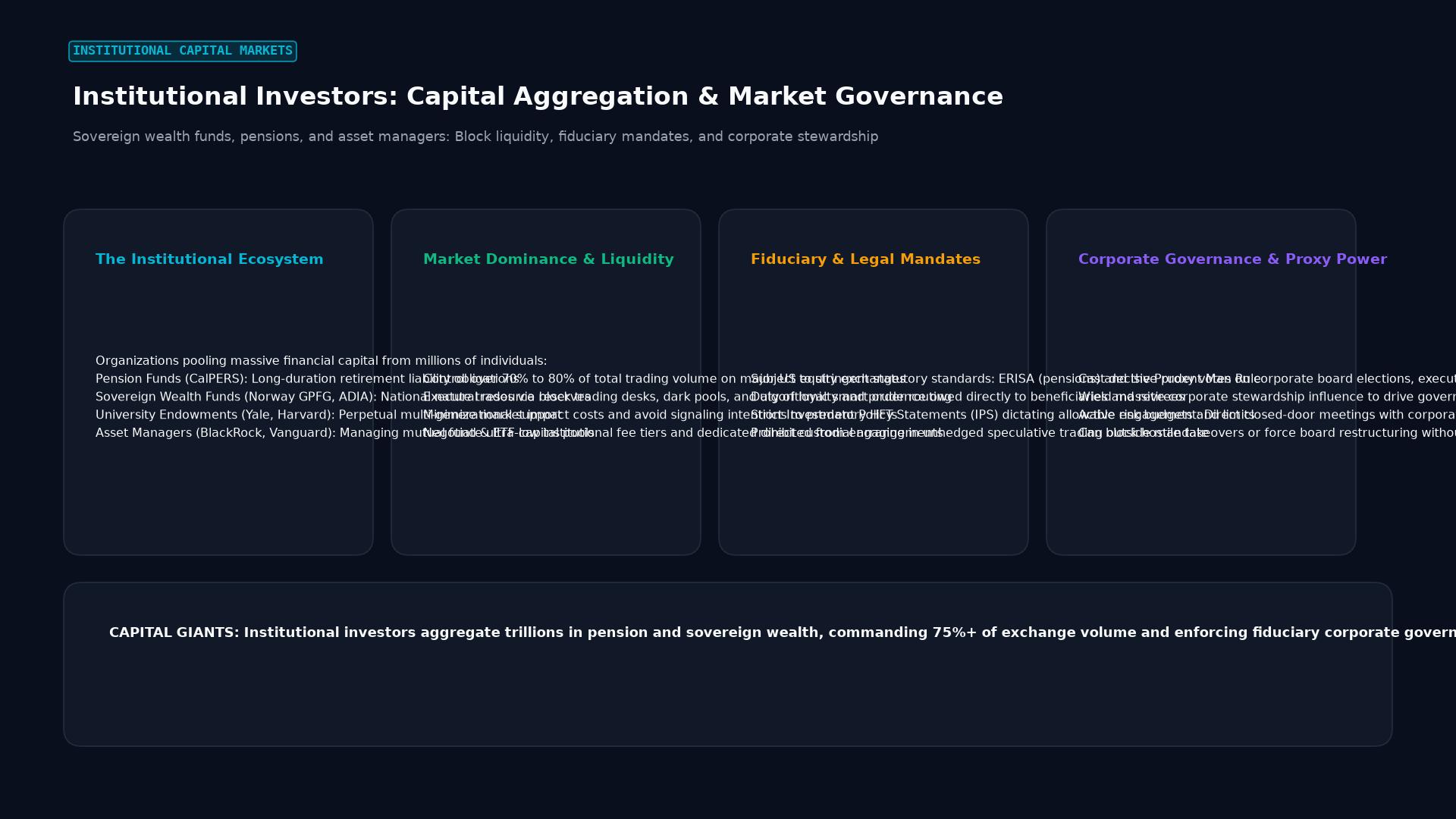 Figure: Sovereign wealth funds, pensions, and asset managers: Block liquidity, fiduciary mandates, and corporate stewardship
The Six Primary Classes of Institutional Investors
The institutional investment universe is divided into six major institutional categories, each governed by distinct legal mandates, liability structures, and time horizons:
1. Pension Funds
Pension funds manage retirement assets for corporate, municipal, and state employees:
- Defined Benefit (DB) Plans: The fund guarantees a specific monthly retirement payment based on salary and years of service. DB funds (such as the California Public Employees’ Retirement System, or CalPERS, and Japan’s Government Pension Investment Fund, the world’s largest with over $1.5 trillion in assets) focus heavily on Liability-Driven Investment (LDI) to match long-duration asset returns to retiree liabilities.
- Defined Contribution (DC) Plans: Retirement benefits depend on investment performance (e.g., 401(k) plans in the US and superannuation funds in Australia).
2. Sovereign Wealth Funds (SWFs)
State-owned investment vehicles funded by foreign exchange reserves, commodity export royalties, or fiscal budget surpluses:
- Stabilization Funds: Designed to insulate national budgets from commodity price volatility.
- Intergenerational Savings Funds: Long-term capital accumulation vehicles for future generations. Prominent examples include Norway’s Government Pension Fund Global (exceeding $1.7 trillion, funded by North Sea petroleum royalties), Singapore’s GIC and Temasek, the Abu Dhabi Investment Authority (ADIA), and Saudi Arabia’s Public Investment Fund (PIF).
3. Asset Management Companies and Mutual Funds
Investment firms that create, market, and manage pooled investment funds for retail and institutional clients:
- Passive Index Giants: BlackRock, Vanguard, and State Street Global Advisors manage tens of trillions of dollars in passive index-tracking funds and exchange-traded funds (ETFs).
- Active Asset Managers: Firms such as Fidelity Investments, Capital Group, and T. Rowe Price deploy fundamental research analysts to generate market alpha.
4. Insurance Companies
Life, property, and casualty insurers collect customer premiums upfront to pay future claims:
- The accumulated pool of capital (known as the “float”) is invested through the insurer’s General Account.
- Because insurance liabilities are legally binding cash obligations, insurers hold conservative portfolios dominated by high-grade corporate bonds, municipal debt, commercial mortgages, and private placement credit.
5. University Endowments and Foundations
Managing perpetual philanthropic, educational, and medical endowments:
- Popularized by David Swensen at Yale University, the “Yale Model” (or Endowment Model) revolutionized institutional asset allocation by shifting capital away from traditional public equities and bonds toward illiquid alternative investments, including venture capital, private equity, timberland, and absolute-return hedge funds.
6. Hedge Funds and Private Equity Syndicates
Private collective investment partnerships accessible exclusively to accredited and institutional investors:
- Hedge Funds: Deploy advanced quantitative, long-short, global macro, and arbitrage strategies with extensive leverage to generate non-correlated returns.
- Private Equity: Acquire controlling stakes in mature private or public operating corporations, restructuring balance sheets and operational models over five-to-seven-year holding periods.
| Institutional Category | Primary Capital Source | Investment Time Horizon | Primary Asset Class Focus |
|---|---|---|---|
| Pension Funds | Employee & Employer Payroll | 20 to 50+ Years (Long-Term) | Global Equities, Fixed Income, Real Estate |
| Sovereign Wealth Funds | Commodity Revenues & FX | Intergenerational / Perpetual | Diversified Global Assets, Infrastructure |
| Insurance Companies | Policyholder Premium Float | Matches Actuarial Claims Curve | Investment-Grade Bonds, Private Credit |
| University Endowments | Private Donations & Gifts | Perpetual Horizon | Venture Capital, Private Equity, Alternatives |
| Mutual Fund Managers | Retail & 401(k) Investor Units | Varies by Fund Mandate | Public Equities, Benchmark Fixed Income |
| Hedge Funds | Institutional & Family Offices | Short-to-Medium (Tactical) | Multi-Asset, Derivatives, Quantitative Alpha |
Market Microstructure and Execution Mechanics
Because institutional investors manage massive pools of capital, their trading methods differ fundamentally from retail operations:
1. Block Trading and Dark Pools
Executing an order to purchase 2,000,000 shares of a publicly listed stock on a public stock exchange order book would trigger immediate predatory algorithmic front-running and catastrophic upward price slippage. To prevent market impact:
- Institutional investors execute large transactions via Dark Pools (alternative trading systems that do not display resting bids and offers to the public order book).
- Orders are matched anonymously at the midpoint of the National Best Bid and Offer (NBBO), allowing institutions to transfer massive volume without alerting retail traders.
2. Algorithmic Execution Strategies
Institutional execution desks break parent orders into thousands of micro-child orders using automated algorithms:
- TWAP (Time-Weighted Average Price): Slices execution evenly across specified time intervals.
- VWAP (Volume-Weighted Average Price): Adjusts execution speed to match historical intraday trading volume curves, executing the heaviest volumes during market opening and closing auctions.
Regulatory Framework: QIBs, Rule 144A, and Form 13F
Given their sophistication and scale, institutional investors operate under specialized regulatory exemptions and transparency mandates:
1. Qualified Institutional Buyers (QIBs) under SEC Rule 144A
Under Securities and Exchange Commission Rule 144A, an institution that owns and invests at least $100 million in securities of non-affiliated issuers on a discretionary basis (or $10 million for registered broker-dealers) is classified as a Qualified Institutional Buyer. QIBs are legally permitted to trade privately placed, unregistered corporate debt and equity securities among themselves, creating a deep private capital market that bypasses standard public SEC registration.
2. Mandatory SEC Form 13F Disclosures
Under Section 13(f) of the Securities Exchange Act of 1934, every institutional investment manager exercising investment discretion over $100 million or more in Section 13(f) securities (public equities and options) must file Form 13F with the SEC within 45 days after the end of each calendar quarter. These publicly accessible filings disclose the fund’s long equity positions, allowing retail investors and corporate boards to track institutional capital flows.
Corporate Governance and Stewardship
Institutional investors hold immense corporate voting power:
- The “Big Three” passive index managers (BlackRock, Vanguard, and State Street) collectively represent the largest single shareholder block in over 85 percent of S&P 500 corporations.
- Institutional proxy voting dictates the outcome of corporate board elections, executive compensation packages (“Say on Pay”), climate transition resolutions, and contested activist takeovers.
- Institutions rely heavily on independent proxy advisory firms (primarily Institutional Shareholder Services, or ISS, and Glass Lewis) to analyze corporate filings and recommend votes on shareholder resolutions.
Frequently Asked Questions
What is the minimum capital required to be considered an institutional investor?
While definitions vary by jurisdiction and regulatory regime, in the United States, SEC Rule 144A sets the benchmark threshold for a Qualified Institutional Buyer (QIB) at $100 million in invested securities. For registered investment advisers, managing $100 million or more in assets under management (AUM) triggers mandatory federal SEC registration and Form 13F reporting.
Why do institutional investors dominate corporate bond markets?
The corporate bond market is predominantly an over-the-counter (OTC) institutional market. New bond issues typically require minimum transaction lot sizes of $100,000 to $1,000,000, making direct participation unfeasible for individual retail investors. Institutional investors (pension funds, insurance companies, and mutual funds) provide the multi-million-dollar funding blocks required by corporations to finance capital infrastructure.
How do institutional investors influence ESG (Environmental, Social, and Governance) corporate policies?
Because institutional investors hold significant voting equity stakes, they engage in direct boardroom dialogues with executive leadership. By establishing formal investment stewardship guidelines, voting against directors who fail to address climate risk, or divesting from non-compliant corporate issuers, institutional capital directs corporate behavior across global markets.
Ready to trade forex?
Open a free demo account with a regulated broker. Practice with virtual funds before risking real money.