Leads and Lags
Leads and lags refers to the deliberate acceleration ('leading') or delay ('lagging') of foreign currency payments and receivables by multinational corporations in anticipation of expected exchange rate movements or currency devaluations.
What Are Leads and Lags?
Leads and lags is an internal corporate cash and foreign exchange risk management technique utilized by multinational corporations, importers, and exporters to optimize cross-border cash flows. Rather than purchasing formal financial derivatives—such as foreign exchange forward contracts or currency options—a treasury department alters the operational settlement dates of international trade transactions to capture favorable exchange rate movements or shield the balance sheet from impending devaluations.
- Leading (Accelerating Payments): Paying a foreign currency invoice or collecting a foreign receivable ahead of its contractual due date.
- Lagging (Delaying Payments): Deliberately deferring a foreign currency payment or delaying the conversion of foreign receipts until the latest possible contractual or negotiable date.
When executed on an aggregate macroeconomic scale across thousands of trading firms, leads and lags generate massive shifts in spot foreign exchange supply and demand, often putting acute speculative pressure on pegged currencies or fixed exchange rate regimes.
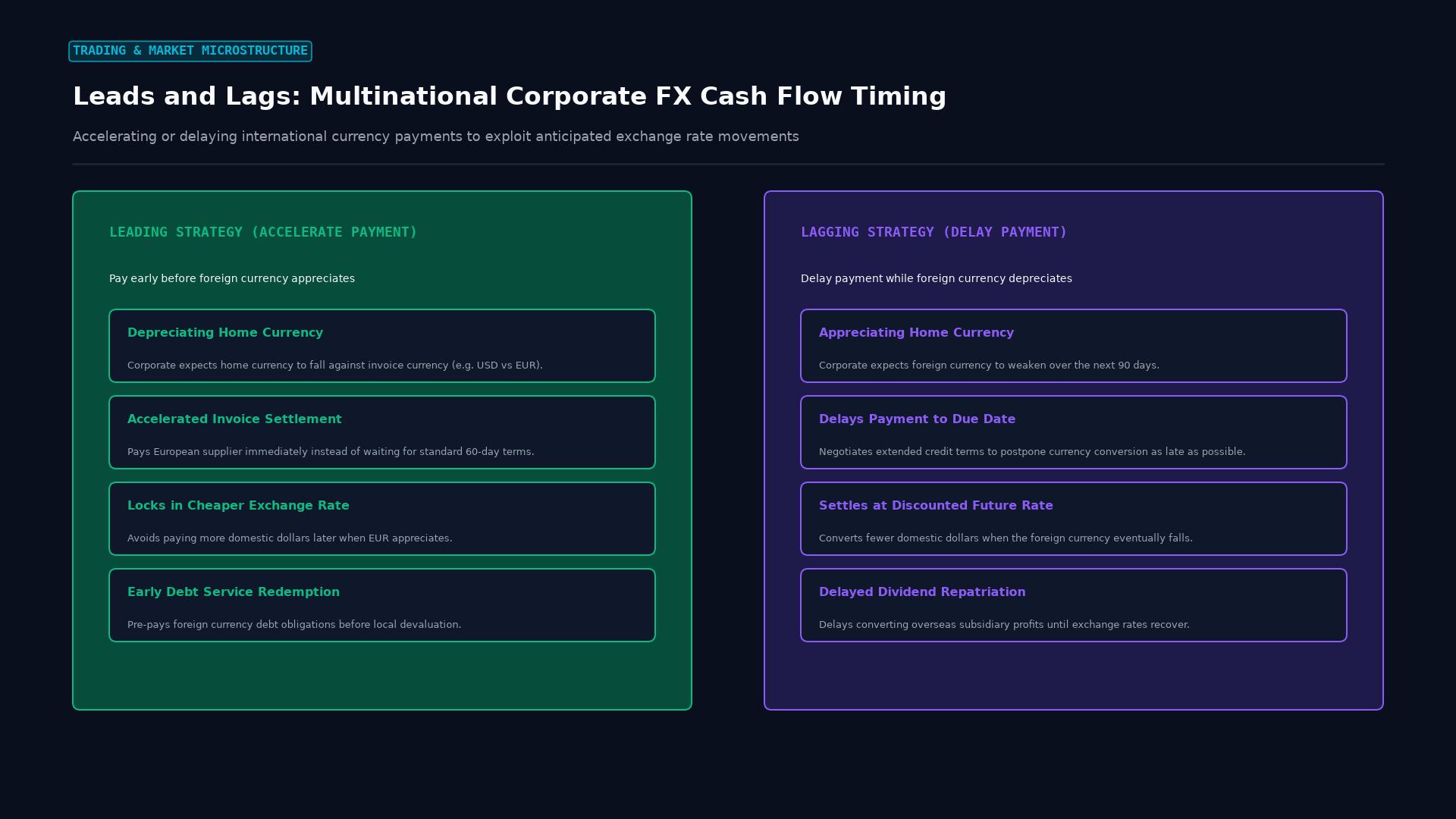 Figure: Corporate treasury currency management: leading payments in appreciating foreign currencies and lagging receipts in depreciating domestic currencies.
Key Takeaways
- Operational Hedge: Leads and lags allow corporate treasuries to mitigate currency exposure organically without paying bank derivative fees or posting margin collateral under ISDA agreements.
- Strategic Directionality: Importers lead payables when the foreign invoicing currency is strengthening; exporters lag receivables when foreign customer currencies are appreciating.
- Self-Fulfilling Speculative Pressures: When corporate treasurers collectively anticipate that a central bank will devalue its currency, widespread leading of foreign import payments drains domestic foreign exchange reserves at an accelerated pace, frequently triggering the very crisis they feared.
- Working Capital Trade-Offs: Leading payments requires liquidity (surplus cash or drawing on short-term bank credit lines), creating an opportunity cost governed by domestic interest rates.
- Government Exchange Controls: During periods of currency instability, central banks routinely impose strict regulatory ceilings on leads and lags, establishing mandatory settlement windows (e.g., forbidding payment more than 30 days prior to shipment).
The Decision Rule: Mathematical Cost-Benefit of Leading
A corporate treasurer must weigh the expected currency depreciation against the interest rate cost of financing early payment.
Suppose a European importer owes $10,000,000 USD in 90 days. The current spot rate is EUR/USD = 1.0800. The treasurer anticipates EUR/USD will collapse to 1.0200 in 90 days (USD strengthens significantly).
- Option A: Pay at Maturity (Day 90): $$\text{Cost at Day 90} = \frac{$10,000,000}{1.0200} = €9,803,921$$
- Option B: Lead Payment Today (Day 0): $$\text{Cost Today} = \frac{$10,000,000}{1.0800} = €9,259,259$$
- Financing Cost: To pay today, the firm must borrow €9,259,259 at an annualized Euro borrowing rate of $4.0%$ for 90 days: $$\text{Interest Expense} = €9,259,259 \times 4.0% \times \left(\frac{90}{360}\right) = €92,593$$ $$\text{Total Cost of Leading} = €9,259,259 + €92,593 = €9,351,852$$
Net Treasury Savings: By leading the payment, the corporation saves €452,069 (€9,803,921 – €9,351,852), demonstrating that the currency protection far outweighs the short-term interest expense.
Intracompany Leads and Lags vs. Third-Party Constraints
Managing leads and lags differs significantly depending on whether transactions occur between multinational subsidiaries or independent commercial parties.
| Dimension | Intracompany (Between Subsidiaries) | Third-Party Commercial (Unrelated Parties) |
|---|---|---|
| Enforceability | Absolute control via corporate headquarters | Constrained by contractual terms and negotiations |
| Commercial Friction | Zero relationship damage | Risk of supplier alienation, credit rating impact |
| Regulatory Scrutiny | Heavily scrutinized by tax authorities (Transfer Pricing) | Standard commercial trade terms |
| Execution Cost | Minimal internal interest adjustments | Late payment penalties or lost early-payment discounts |
| Central Bank Limits | Frequently restricted during capital control crises | Monitored via trade invoices and customs declarations |
Case Study: The 1992 ERM Crisis and Sterling Reserves
During the summer of 1992, prior to “Black Wednesday” (September 16, 1992), hedge funds led by George Soros famously shorted the British Pound. However, a major hidden catalyst that exhausted the Bank of England’s foreign exchange reserves was corporate leads and lags.
- Expectations: As economic weakness indicated the Pound could not sustain its high floor inside the European Exchange Rate Mechanism (ERM), UK corporate treasurers realized devaluation was inevitable.
- Corporate Action: British corporate importers holding Deutsche Mark (DEM) liabilities rapidly led their foreign payments, rushing to convert billions of Pounds into Marks weeks before invoices matured.
- Exporters Lagged: Simultaneously, British exporters earning foreign currencies delayed converting German Marks and French Francs back into Sterling, waiting for the Pound to fall.
- Impact: This structural commercial capital flight drained tens of billions in foreign exchange reserves from the Bank of England far faster than speculative hedge funds alone could achieve, forcing the UK government to abandon the ERM.
Strategic Risks and Operational Traps
- Liquidity Strain: Leading payments drains cash reserves prematurely. If incoming revenues are delayed, the firm may suffer an unexpected working capital crunch.
- Supplier Relationship Damage: Persistently lagging payments to external suppliers can harm commercial trust, damage credit ratings, and prompt vendors to demand advance cash payments for future shipments.
- Tax and Transfer Pricing Audits: Multinational firms that use intracompany leads and lags to shift profits across borders face aggressive penalties from revenue services (such as the IRS or HMRC) for violating arm’s length transfer pricing standards.
Frequently Asked Questions (FAQ)
What is the primary difference between leads/lags and forward contracts?
A foreign exchange forward contract is a binding financial derivative executed with a commercial bank to lock in a future exchange rate. Leads and lags involve no derivative contracts; instead, the company adjusts the actual date on which physical cash is transferred between commercial bank accounts.
Are leads and lags legal in international business?
Yes, adjusting payment timing is a standard commercial practice. However, many developing countries with exchange controls (such as India, China, or South Africa) enforce statutory limits on how early an import payment can be remitted or how long export proceeds can be held overseas before mandatory domestic conversion.
Why do exporters lag receivables when foreign currencies are strong?
When an exporter is owed money in a foreign currency that is appreciating against their domestic currency, waiting to convert those receipts means each foreign currency unit will yield more domestic currency units in the future, directly boosting operating margins.
Ready to trade forex?
Open a free demo account with a regulated broker. Practice with virtual funds before risking real money.