Devaluation
Devaluation is the deliberate, official downward adjustment of a country's official exchange rate relative to another currency, currency basket, or gold standard, enacted by a sovereign government or central bank operating within a fixed or pegged exchange rate regime.
What Is Currency Devaluation?
In international monetary policy, devaluation refers to an intentional, administrative decision by a sovereign nation’s government or monetary authority to reduce the official value of its legal tender against other currencies.
A fundamental economic distinction must be maintained between two terms that are frequently conflated:
- Devaluation: Occurs exclusively within a fixed, pegged, or semi-pegged exchange rate system. It is an official decree by a central bank or ministry of finance resetting the currency’s baseline parity downward.
- Depreciation: Occurs within a floating exchange rate system. It represents an organic, market-driven decline in currency value caused by daily interbank supply and demand dynamics, interest rate differentials, or capital outflows.
The opposite of devaluation is revaluation (an official administrative reset upward), whereas the opposite of depreciation is appreciation (a free-market increase in purchasing power).
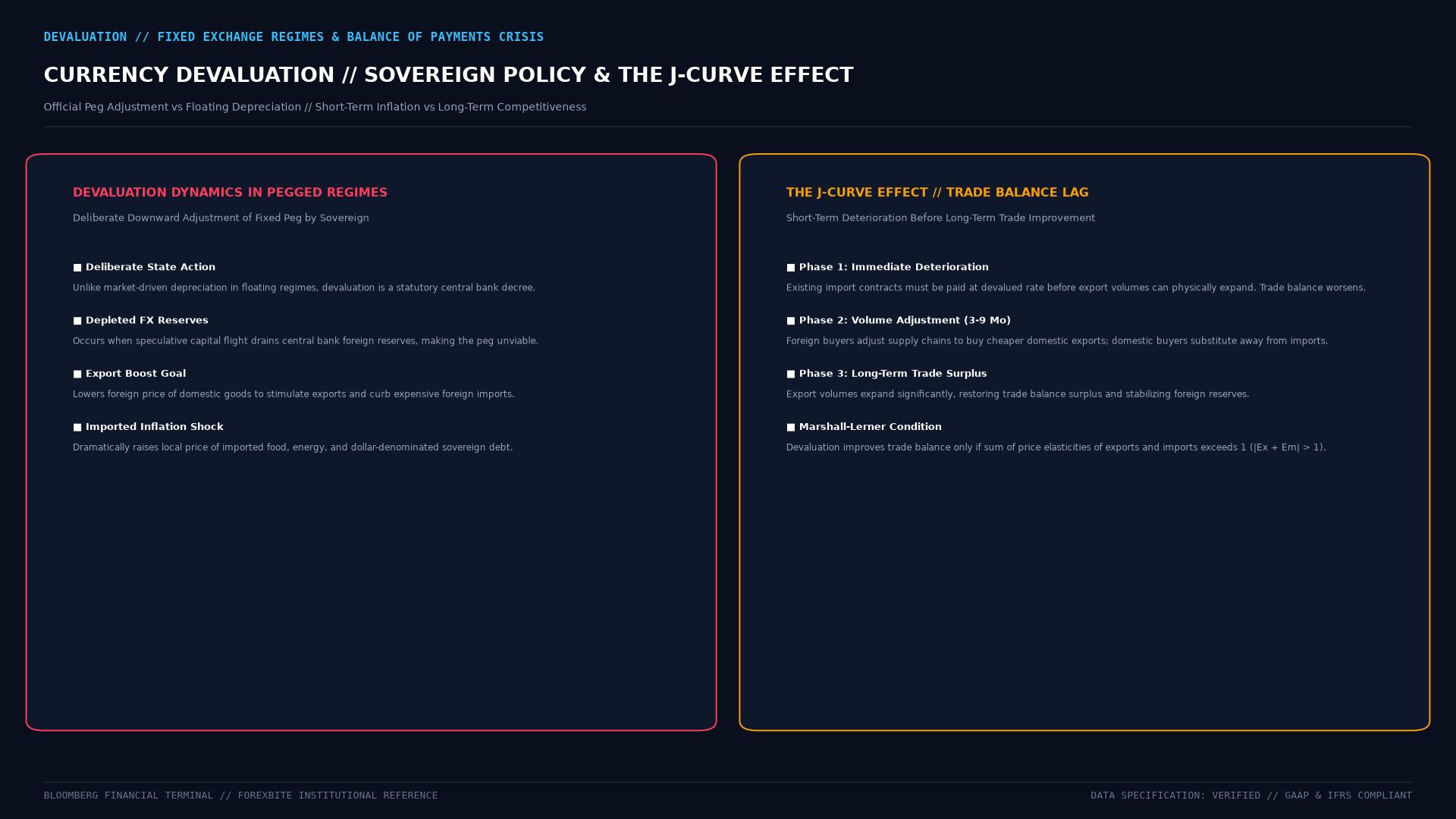 Figure: Fixed exchange rate devaluation mechanics and the macroeconomic J-Curve phenomenon, illustrating short-term trade balance deterioration due to inelastic contract terms followed by long-term volume expansion.
Why Sovereign Governments Devalue Their Currencies
Governments rarely devalue their currencies willingly, as devaluation imposes severe immediate domestic hardships. However, policymakers deliberately enact devaluations to resolve acute structural crises:
1. Combating Chronic Trade and Current Account Deficits
When a country persistently consumes significantly more foreign imported goods than it sells in exports, foreign currency flows out of the nation, depleting central bank reserves.
- By devaluing the domestic currency, foreign goods instantly become substantially more expensive for local consumers, depressing import demand.
- Concurrently, domestic manufactured goods and agricultural products become much cheaper for foreign buyers in international markets, revitalizing export sales and rebalancing the current account.
2. Defending Depleted Foreign Exchange Reserves
Under a pegged exchange rate regime, the central bank is legally obligated to maintain its target parity by buying domestic currency and selling foreign reserve currencies (such as US Dollars) whenever market selling pressure strikes.
If international currency speculators and domestic investors stage a run on the currency, the central bank can burn through billions of dollars in foreign reserves in a matter of weeks. When reserves reach dangerously low levels—threatening the nation’s ability to pay for essential food, energy, and sovereign debt imports—the central bank is forced to capitulate and devalue the currency or abandon the peg altogether.
3. Competitive Devaluation (“Currency Wars”)
In periods of sluggish global economic growth, nations may engage in “beggar-thy-neighbor” policies—deliberately lowering their exchange rates to gain an artificial competitive advantage over trading partners. If multiple competing export nations respond by devaluing their own currencies in retaliation, the dynamic triggers an international currency war.
The Economic Repercussions and the J-Curve Effect
While devaluation improves export competitiveness over the long term, it unleashes severe economic disruptions:
1. Spiking Domestic Inflation (Imported Inflation)
Because modern economies rely heavily on imported crude oil, electronics, industrial chemicals, and wheat, devaluation immediately drives up domestic consumer prices. The resulting surge in imported inflation erodes real household wages and standard of living.
2. Foreign-Currency Debt Crises
Many corporate borrowers and governments in developing nations issue debt denominated in US Dollars because foreign investors refuse to lend in volatile local currencies.
- If a national currency is devalued by 50% against the US Dollar, the local-currency cost of servicing that dollar debt instantly doubles.
- This dynamic has historically triggered waves of corporate insolvencies and sovereign defaults across Latin America, Asia, and Eastern Europe.
3. The J-Curve Effect
Economic data demonstrates that a nation’s trade balance does not improve immediately following a devaluation. Instead, it follows a path resembling the letter “J”:
- In the Short Term (The Dip): The trade deficit initially widens. This occurs because existing import orders placed before the devaluation must be paid at the new, worse exchange rate, while export volumes take months to expand due to production lags.
- In the Long Term (The Rebound): As businesses adjust supply chains and foreign buyers sign new contracts to take advantage of cheaper prices, export volumes surge and imports contract, driving the trade balance into a healthy surplus.
Historical Case Studies of Currency Devaluation
Modern economic history has been shaped by monumental currency devaluations:
1. The 1994 Chinese Renminbi Unification (-33% Devaluation)
On January 1, 1994, the Chinese government unified its official exchange rate with its swap market rate, effectively devaluing the official Renminbi from 5.77 to 8.70 per US Dollar—an overnight devaluation of 33%. This bold maneuver supercharged Chinese manufacturing competitiveness, providing the foundational export engine that transformed China into the “factory of the world” over the subsequent three decades.
2. The 1997 Asian Financial Crisis (The Thai Baht Collapse)
Throughout the 1990s, Thailand maintained a rigid currency peg of roughly 25 Baht per US Dollar. Massive speculative capital inflows created an unsustainable real estate and banking bubble. When foreign hedge funds identified that the Bank of Thailand had exhausted its net foreign reserves through forward contracts, they mounted an aggressive speculative attack. On July 2, 1997, Thailand was forced to abandon the peg and float the Baht. The currency collapsed by over 50% to nearly 56 Baht per dollar, triggering a regional financial contagion that devastated economies across Indonesia, South Korea, and Malaysia.
3. The 1992 UK “Black Wednesday”
On September 16, 1992, the British government was forced to withdraw the British Pound from the European Exchange Rate Mechanism (ERM) after exhausting tens of billions of pounds in foreign reserves attempting to defend an artificially high peg against the German Mark. Sterling was devalued by over 15% against European currencies, generating legendary profits for macro traders like George Soros.
Practical Trading Insights: Spotting Vulnerable Pegs
Professional macro forex traders monitor specific warning indicators that signal an impending forced currency devaluation:
- Divergence in Inflation Rates: If a pegged economy experiences 12% domestic inflation while the peg anchor nation (e.g., the US) experiences 2%, the pegged currency becomes massively overvalued in real terms (REER).
- Rapidly Depleting Central Bank FX Reserves: Monthly central bank balance sheet data revealing steep, steady declines in net foreign exchange reserves.
- Divergent Parallel (Black Market) Exchange Rates: When the street rate or cryptocurrency stablecoin rate in a nation trades at a 30% to 50% discount to the government’s official rate, official devaluation is virtually guaranteed.
- Surging Forward Discrepancies: Non-Deliverable Forward (NDF) contracts pricing in steep implied depreciation relative to the official peg rate.
Key Takeaways
- Devaluation is an official, deliberate downward reset of a currency’s pegged exchange rate by a government or central bank.
- It differs from market-driven depreciation, which occurs organically in floating exchange rate regimes.
- Primary catalysts include chronic balance of payments deficits, depleted central bank foreign reserves, and competitive export policies.
- Devaluation fuels domestic imported inflation and multiplies the burden of foreign-denominated sovereign and corporate debt.
- The J-Curve effect explains why a devaluing nation’s trade balance initially deteriorates before eventually recovering.
FAQ
Can a floating currency experience devaluation? Strictly speaking, no. In economic terminology, a floating currency (like EUR/USD or USD/JPY) experiences depreciation when its market price falls due to open-market trading. Devaluation refers specifically to administrative policy adjustments within fixed or pegged regimes.
How does devaluation affect ordinary citizens? Ordinary citizens experience a loss of international purchasing power. Foreign travel becomes much more expensive, and prices for imported consumer goods, electronics, gasoline, and imported foods climb steeply. However, domestic workers in export-oriented industries may see improved job security.
What is an internal devaluation? An internal devaluation occurs when a country inside a currency union (such as Greece in the Eurozone, which cannot devalue the Euro independently) attempts to restore export competitiveness by cutting domestic wages, slashing government budgets, and reducing business taxes to lower domestic production costs.
Ready to trade forex?
Open a free demo account with a regulated broker. Practice with virtual funds before risking real money.