Limited Convertibility
Limited convertibility refers to a foreign exchange regime where a sovereign government or central bank imposes statutory controls, quotas, or regulatory permissions on exchanging domestic currency for foreign currencies, typically allowing current account trade transactions while restricting capital account transfers.
What Is Limited Convertibility?
Limited convertibility (also known as partial convertibility) describes a sovereign currency framework in which the legal exchange of the domestic currency into foreign hard currencies (such as the U.S. Dollar or Euro) is constrained by regulatory mandates, licensing requirements, or transaction ceilings. Unlike fully convertible currencies—which can be bought, sold, and transferred internationally by anyone at any time without government interference—a currency with limited convertibility is subject to administrative oversight by the central bank or ministry of finance.
Most developing nations operating under limited convertibility adhere to Current Account Convertibility (satisfying the International Monetary Fund’s Article VIII obligations), which permits businesses and citizens to exchange currency freely for physical imports, exports, and travel. However, they strictly restrict Capital Account Convertibility, placing severe barriers on cross-border foreign direct investment, offshore portfolio investments, real estate purchases abroad, and foreign loans to prevent domestic capital flight and defend foreign exchange reserves.
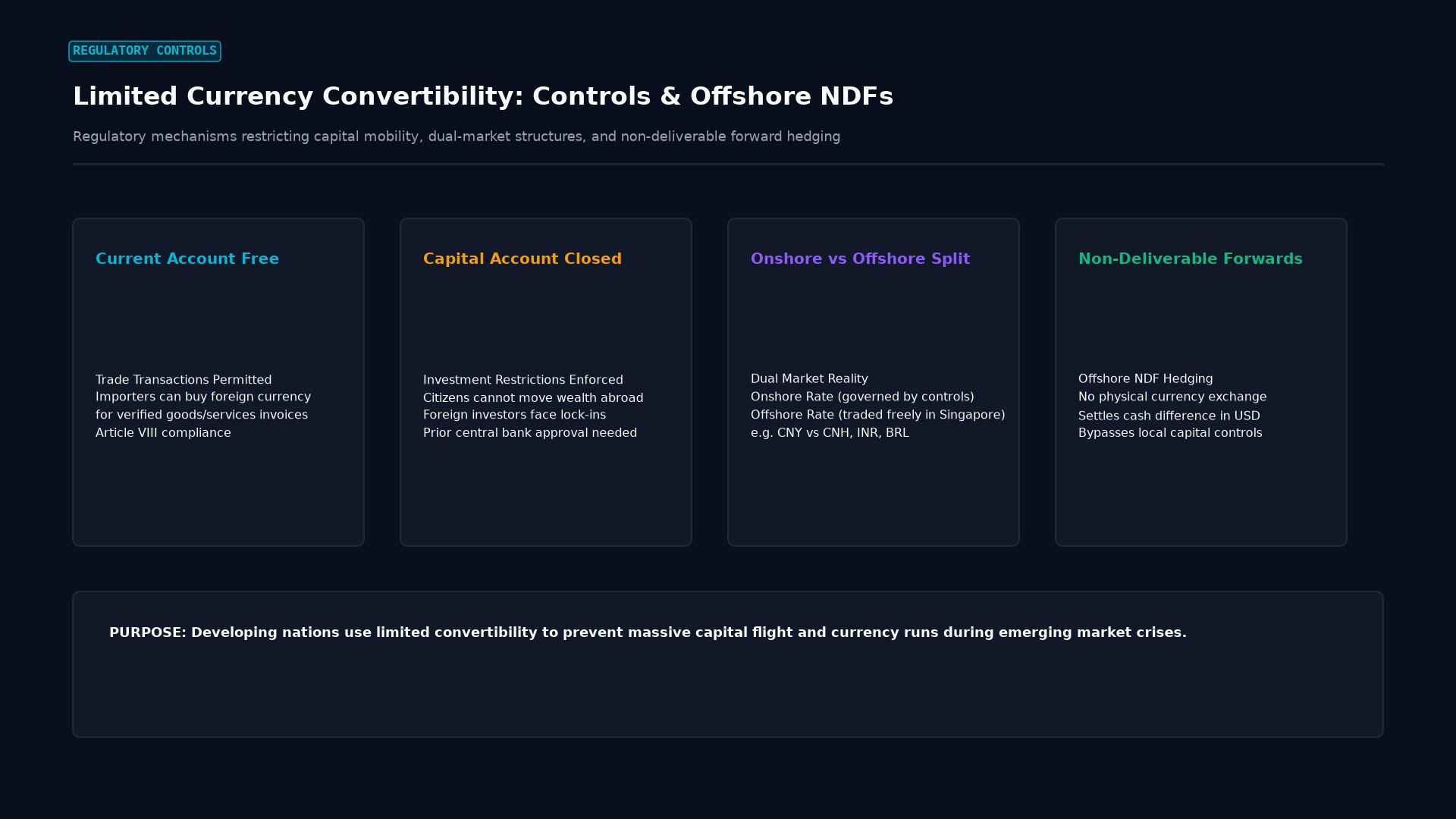 Figure: Regulatory mechanisms restricting capital mobility, dual-market structures, and non-deliverable forward hedging
Key Takeaways
- Mundell-Fleming Trilemma: Central banks enforce limited convertibility to preserve domestic monetary policy independence while maintaining a relatively stable exchange rate, consciously sacrificing free cross-border capital mobility.
- Capital Flight Prevention: Restrictions are designed to stop wealthy citizens and domestic corporations from transferring national savings into foreign bank accounts during periods of economic or political stress.
- The Rise of Offshore NDFs: Because foreign investors cannot trade onshore deliverable spot contracts in currencies with limited convertibility, institutional risk is hedged using cash-settled Non-Deliverable Forwards (NDFs) traded offshore in London, New York, and Singapore.
- Dual Currency Ecosystems: Limited convertibility often spawns dual currency markets: an onshore regulated rate governed by capital controls and an offshore rate governed strictly by global supply and demand (e.g., Onshore CNY vs. Offshore CNH).
- IMF Article VIII Standard: Countries seeking international legitimacy typically adopt IMF Article VIII, committing to avoid restrictions on payments and transfers for current international transactions.
Comparative Taxonomy: Convertibility Tiers
| Currency Category | Legal Freedom | Primary Global Examples | Capital Account Freedom | Deliverable Spot Trading? |
|---|---|---|---|---|
| Fully Convertible | Unrestricted for all entities | USD, EUR, JPY, GBP, AUD, CHF | 100% unrestricted | Yes, continuous global interbank spot |
| Current Account Only | Allowed for goods/services; capital restricted | CNY (China), INR (India), BRL (Brazil) | Heavily regulated (quotas, licensing) | Restricted onshore; NDF offshore |
| Partially Dollarized | Foreign currency circulates alongside domestic | ARS (Argentina), LBP (Lebanon) | Severe emergency rationing | Multitiered exchange rates |
| Inconvertible / Blocked | Total state monopoly; illegal for citizens | KPW (North Korea), SYP (Syria) | Banned | No (pure black market cash exchange) |
The Macroeconomic Mechanics: The “Impossible Trinity”
Economists Robert Mundell and Marcus Fleming proved that an economy cannot simultaneously maintain all three of the following pillars:
- A fixed or managed exchange rate.
- Free international capital flows (full convertibility).
- An independent sovereign monetary policy (setting domestic interest rates).
$$\text{Trilemma Equilibrium} \implies \text{Pick Any Two}$$
Nations like China and India prioritize setting their own domestic interest rates to support local industrial growth while preventing exchange rate turbulence. To achieve this, they deliberately abandon the second pillar—enforcing limited convertibility through capital controls. This prevents global speculative capital (“hot money”) from flooding in during rate hikes or fleeing en masse during rate cuts.
Real-World Case Study: China’s CNY vs. CNH Dual Renminbi System
To maintain strict domestic capital controls while expanding the global internationalization of its currency, the People’s Bank of China (PBOC) engineered a unique dual-track architecture:
- Onshore Renminbi (CNY): Traded within mainland China. It is subject to limited convertibility: mainland citizens face a $50,000 USD annual foreign exchange purchase quota, and foreign companies must prove underlying commercial trade invoices to convert funds. The PBOC enforces a daily $\pm 2%$ trading band around a central parity fixing rate.
- Offshore Renminbi (CNH): Launched in Hong Kong in 2010 and subsequently expanded to London and Singapore. CNH trades outside mainland regulatory restrictions, allowing international hedge funds, multinational corporations, and global asset managers to trade Renminbi freely.
- The Basis Spread: When international sentiment turns negative on China, CNH depreciates faster than onshore CNY, creating a significant “basis spread” that institutional arbitrageurs monitor closely.
Investment Pitfalls and Operational Obstacles
- Repatriation Traps: Multinational corporations investing capital into countries with limited convertibility frequently struggle to repatriate accrued corporate profits as dividends back to their home headquarters, stranding capital in local low-yielding accounts.
- Administrative Red Tape: Conducting basic commercial payments in partially convertible environments requires submitting extensive physical documentation (bills of lading, tax clearance certificates, government ministry approvals) to commercial banks before transactions are authorized.
- Sudden Devaluation Risk: Because exchange rates under limited convertibility are often politically managed rather than market-driven, central banks that deplete their foreign reserves are forced into abrupt, massive one-off devaluations.
Frequently Asked Questions (FAQ)
What is a Non-Deliverable Forward (NDF)?
An NDF is an offshore derivative contract used to trade or hedge currencies with limited convertibility (such as the Indian Rupee or Brazilian Real). At expiration, no physical delivery of the restricted currency occurs; instead, counterparties settle the net profit or loss in a fully convertible reserve currency, usually U.S. Dollars.
Why doesn’t every nation make its currency fully convertible?
If a developing nation with weak domestic institutions and low foreign reserves enables full convertibility, any economic panic can trigger an immediate run on the banking system, where citizens convert all local savings into U.S. Dollars, draining national reserves and causing hyperinflation.
How do retail traders gain exposure to currencies with limited convertibility?
Retail traders cannot hold physical spot accounts in restricted currencies. However, many retail brokers offer synthetic Contracts for Difference (CFDs) or margin pairs that track the offshore Non-Deliverable Forward (NDF) or offshore exchange rates (such as USD/CNH), settled entirely in the trader’s base currency.
Ready to trade forex?
Open a free demo account with a regulated broker. Practice with virtual funds before risking real money.