Convertible Currency
A convertible currency is any national currency that can be freely exchanged into other foreign currencies or gold on open markets without government restrictions, foreign exchange controls, or central bank licensing requirements. It reflects a nation's economic stability and open capital integration.
What Is a Convertible Currency?
In international finance and monetary economics, a convertible currency refers to any legal tender that can be readily and legally exchanged for another national currency—or for monetary gold—without requiring special government approval, central bank authorization, or regulatory quotas.
Currency convertibility is one of the most vital indicators of a nation’s financial maturity, institutional transparency, and integration into global commerce. When a currency is fully convertible, domestic businesses can pay foreign suppliers, international investors can repatriate corporate dividends, and citizens can convert domestic savings into foreign assets without administrative interference.
Conversely, when a government restricts currency convertibility, it creates barriers that isolate its domestic economy from global market forces, frequently giving rise to illicit parallel currency markets (black markets) and requiring specialized financial derivatives for international trade settlement.
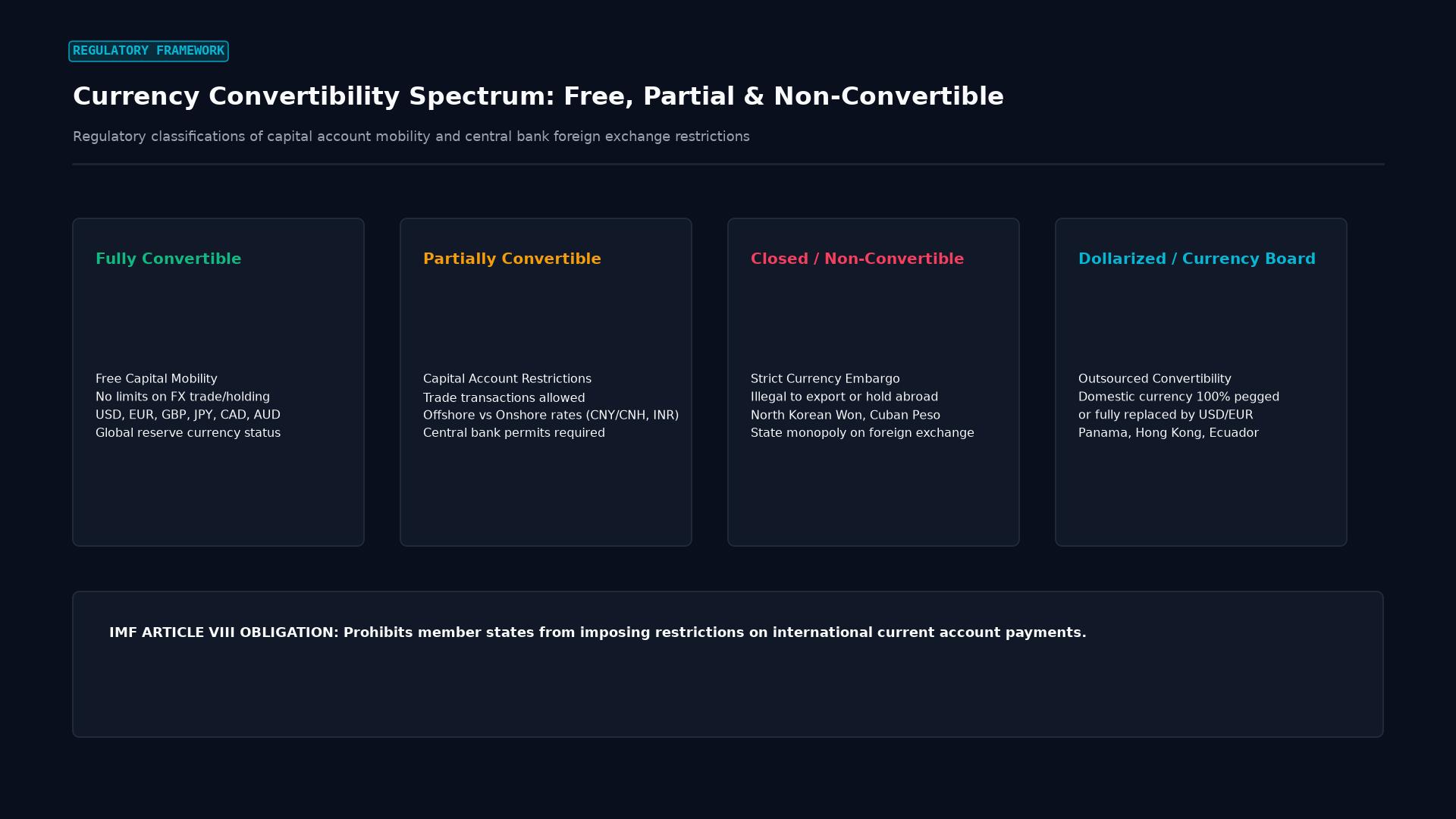 Figure: Capital mobility classifications: fully convertible G10 currencies, partially convertible emerging pairs with offshore NDF markets, and closed currency embargoes.
The Three Tiers of Currency Convertibility
Global currencies do not exist in a simple binary state; they occupy a spectrum of convertibility based on government regulatory policy:
1. Fully Convertible Currencies (“Hard Currencies”)
A fully convertible currency can be traded 24 hours a day on the decentralized interbank market. There are zero legal limits on the quantity of currency an individual or institution can buy, sell, import, or export for either commercial trade or speculative investment.
- Characteristics: Deep institutional liquidity, tight bid-ask spreads, floating exchange rates determined by open-market supply and demand, and unrestricted cross-border capital mobility.
- Prime Examples: The US Dollar (USD), Euro (EUR), Japanese Yen (JPY), British Pound (GBP), Swiss Franc (CHF), Canadian Dollar (CAD), and Australian Dollar (AUD).
- These currencies serve as the world’s primary reserve currencies, held by global central banks to back domestic monetary systems.
2. Partially Convertible Currencies
In partially convertible systems, governments differentiate between physical commercial trade and financial investment capital:
- Current Account Convertibility: Permitted. Importers and exporters can exchange currency freely to purchase foreign machinery, raw materials, food, and consumer goods.
- Capital Account Restrictions: Strictly controlled. Domestic residents face rigid annual quotas on transferring wealth into foreign bank accounts or overseas real estate, while foreign institutional investors require regulatory permits (such as Qualified Foreign Institutional Investor quotas) to invest in domestic stock or bond markets.
- The Classic Example (The Chinese Renminbi): China operates a famous two-tier currency system to manage capital flight while remaining the world’s premier export manufacturing powerhouse:
- Onshore Renminbi (CNY): Traded inside mainland China, tightly managed by the People’s Bank of China (PBOC) and the State Administration of Foreign Exchange (SAFE) within a strict daily ±2% trading band around an official daily fix.
- Offshore Renminbi (CNH): Traded freely in offshore financial centers like Hong Kong, Singapore, and London, floating based on global market liquidity and international demand.
- Other notable partially convertible currencies include the Indian Rupee (INR) and the Brazilian Real (BRL).
3. Non-Convertible Currencies (“Blocked Currencies”)
A non-convertible currency is strictly prohibited from circulating or trading on international foreign exchange markets. The domestic government fixes an artificial, non-market exchange rate by decree and criminalizes private foreign currency exchange.
- Characteristics: Domestic residents cannot legally hold foreign currency, foreign travelers must exchange cash only at official state banks at confiscatory rates, and foreign investors cannot repatriate capital.
- Examples: The North Korean Won (KPW), the Cuban Peso (CUP), and historically the Soviet Ruble.
- The Inevitable Outcome: Non-convertible regimes routinely generate thriving “black market” or “curb market” street exchange rates that reflect the true, deeply discounted purchasing power of the currency.
The IMF and Article VIII Obligations
Following the Second World War, the International Monetary Fund (IMF) established international rules to prevent the destructive currency wars and beggar-thy-neighbor devaluations of the 1930s.
Under Article VIII of the IMF Articles of Agreement, member nations commit to avoid imposing restrictions on the making of payments and transfers for current international transactions, and to avoid engaging in discriminatory currency arrangements or multiple currency practices. Achieving “Article VIII status” is an internationally recognized badge of creditworthiness, signifying that a country has committed to open commercial convertibility.
Trading Inconvertible Currencies: The Non-Deliverable Forward (NDF)
Because international corporations and global hedge funds cannot legally purchase or deliver partially convertible or restricted currencies on the open spot market, institutional finance developed an ingenious derivative workaround: the Non-Deliverable Forward (NDF).
An NDF is an over-the-counter financial contract traded heavily in centers like Singapore, London, and New York:
- Counterparties agree on a forward exchange rate for a restricted currency (such as the Indian Rupee - INR, South Korean Won - KRW, or Brazilian Real - BRL) against the US Dollar.
- At contract maturity, no physical restricted currency is ever exchanged.
- Instead, the trade is settled entirely in cash US Dollars, calculated from the mathematical difference between the agreed contract rate and the official spot fixing rate published by the central bank.
Through NDF contracts, multinational corporations hedge billions of dollars in foreign commercial revenues, and speculative macro funds trade emerging market currency trends without violating domestic capital controls.
Practical Example: Hedging an Inconvertible Currency via NDF
Consider an American multinational technology firm that operates a major development center in Bangalore, India:
- The firm must pay 100,000,000 Indian Rupees (INR) in local engineer payroll in three months.
- The current USD/INR spot rate is 83.50.
- The firm fears that geopolitical events could cause the Rupee to appreciate rapidly to 80.00, which would significantly increase the US Dollar cost of funding its Indian payroll.
- Because the Rupee is subject to Reserve Bank of India (RBI) capital controls, the firm cannot simply buy 100M physical Rupees in New York and hold them in a standard commercial account.
- The Solution: The firm enters a 3-month USD/INR Non-Deliverable Forward (NDF) with an investment bank to buy INR at an agreed forward rate of 83.80.
- At expiration, the official RBI fixing rate settles at 81.00 (the Rupee strengthened sharply).
- The bank calculates the cash settlement in US Dollars: $$ \text{Settlement} = \left( \frac{100,000,000}{81.00} \right) - \left( \frac{100,000,000}{83.80} \right) = $1,234,567 - $1,193,317 = +$41,250.00 $$
- The bank transfers $41,250.00 USD cash to the American firm. The firm converts this dollar gain in India at the current 81.00 rate, perfectly offsetting its higher local payroll expense.
Key Takeaways
- A convertible currency can be freely exchanged into foreign currencies on open markets without government restrictions.
- Currencies exist on a spectrum: fully convertible (hard currencies), partially convertible (capital controls), and non-convertible (blocked).
- Fully convertible currencies represent the foundation of global reserve assets and international interbank trading.
- China manages convertibility through a dual onshore (CNY) and offshore (CNH) currency structure.
- Institutional traders utilize Non-Deliverable Forwards (NDFs) settled cash in US Dollars to hedge and speculate on restricted currencies.
FAQ
Why don’t all countries make their currencies fully convertible? Developing economies often maintain capital controls to protect fragile domestic banking systems from sudden capital flight during global market panics, and to retain autonomous control over domestic interest rates without sparking exchange rate crises.
What is the difference between CNY and CNH? CNY is the onshore Chinese Yuan traded within mainland China under PBOC regulatory controls. CNH is the offshore Chinese Yuan traded freely in international financial centers (such as Hong Kong and Singapore) without domestic capital restrictions. Both represent the same currency, but CNH floats freely based on global supply and demand.
Can retail traders trade partially convertible currencies? Yes. Retail forex brokers frequently offer CFD contracts tracking partially convertible currencies like the Chinese Yuan (USD/CNH), South African Rand (USD/ZAR), or Mexican Peso (USD/MXN), which settle purely in cash within the trader’s retail account.
Ready to trade forex?
Open a free demo account with a regulated broker. Practice with virtual funds before risking real money.