Liquidation
Liquidation is the process of closing or unwinding an open financial position by executing an equal and opposite transaction, converting assets or derivative commitments into cash, or the forced termination of leveraged positions by a broker due to a margin deficit.
What Is Liquidation?
In financial markets and foreign exchange trading, liquidation refers to the termination of an open market commitment, converting paper assets or derivative contracts into realized cash. Liquidation occurs under two fundamentally distinct market scenarios:
- Voluntary Liquidation: A trader or portfolio manager deliberately executes an offsetting order—such as selling a long currency pair or buying to cover a short position—to realize accumulated profits, harvest tax losses, or reallocate investment capital.
- Forced (Involuntary) Liquidation: An automated risk event triggered by a broker, clearing house, or prime broker when a leveraged trading account’s equity falls below the mandatory maintenance margin or stop-out threshold. In this scenario, the broker’s risk engine forcibly closes the trader’s positions at prevailing market rates to protect the brokerage from negative balance deficits.
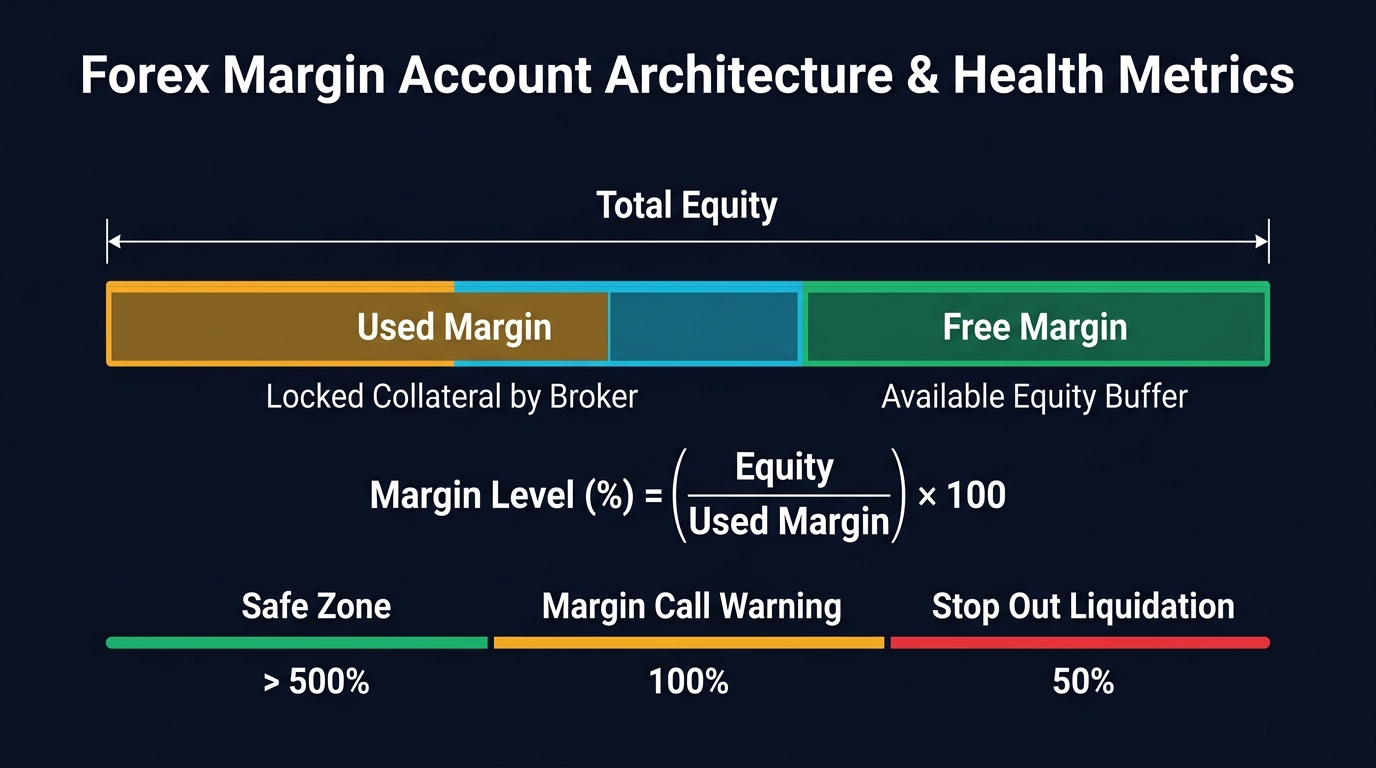
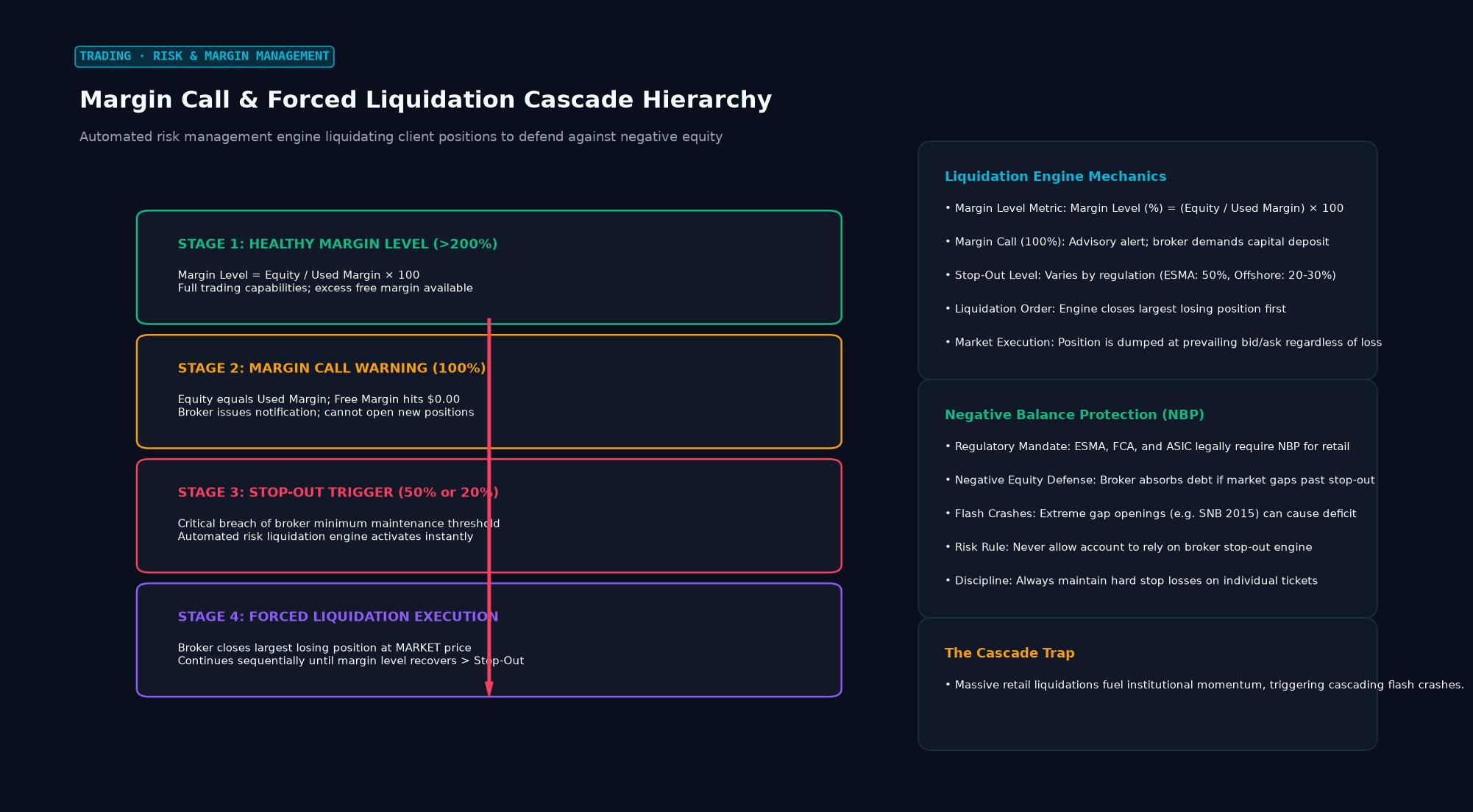 Figure: Automated risk management engine liquidating client positions to defend against negative equity
Key Takeaways
- Offsetting Transaction: Liquidating a position requires executing the exact inverse of the opening trade: buying to liquidate a short, or selling to liquidate a long.
- The Stop-Out Level: In retail forex, brokers enforce a contractual Stop-Out Level (typically between 20% and 50% margin level). Once reached, positions are systematically liquidated without client consent.
- Liquidation Cascades: During market panics, mass forced liquidations trigger aggressive selling, which depresses prices further, triggering a subsequent wave of liquidations in a vicious downward spiral.
- Loss of Price Control: Unlike voluntary limit orders, forced liquidations execute as aggressive market orders, exposing the trader to severe execution slippage in thin market conditions.
- Negative Balance Protection: Under ESMA (Europe) and FCA (UK) regulations, retail brokers must provide negative balance protection, meaning the broker absorbs losses if a fast-moving market liquidates an account below zero equity.
The Mathematics of Forced Liquidation
In retail and institutional margin trading, an account’s health is continuously evaluated through the Margin Level:
$$\text{Margin Level (%)} = \left( \frac{\text{Account Equity}}{\text{Used Margin}} \right) \times 100$$
Where: $$\text{Account Equity} = \text{Cash Balance} + \text{Unrealized P&L}$$
$$\text{Used Margin} = \frac{\text{Notional Position Value}}{\text{Account Leverage}}$$
Numerical Example of a Stop-Out:
A trader deposits $10,000 and opens a 10-lot Long EUR/USD position ($1,000,000 notional) at 1.0800 with 1:100 leverage:
- Used Margin: $\frac{$1,000,000}{100} = $10,000$.
- Free Margin at Inception: $$10,000 - $10,000 = $0.00$.
- Starting Margin Level: $\left(\frac{$10,000}{$10,000}\right) \times 100 = 100%$.
- Broker Stop-Out Threshold: Set at 30% ($\text{Equity} \le $3,000$).
If EUR/USD drops by 70 pips ($1 \text{ pip} = $100 \text{ across 10 lots}$):
- Floating Loss: $-$7,000$.
- Remaining Equity: $$10,000 - $7,000 = $3,000$.
- Margin Level: $\left(\frac{$3,000}{$10,000}\right) \times 100 = \mathbf{30%}$.
The broker’s automated risk engine immediately initiates forced liquidation, dumping all 10 lots into the market at current bids. The trader loses $7,000 plus slippage, leaving only residual capital.
Comparative Taxonomy: Voluntary vs. Involuntary Liquidation
| Feature | Voluntary Liquidation | Forced Broker Stop-Out | Clearing House Default Auction |
|---|---|---|---|
| Initiator | Discretionary trader or automated EA | Broker’s automated risk server | Central counterparty (CCP / CME) |
| Execution Trigger | Profit target, stop-loss, or manual exit | Account equity breaches stop-out level | Member default on variation margin |
| Order Type | Limit or Market order | Aggressive Market order | Algorithmic multi-dealer blind auction |
| Execution Timing | At trader’s discretion | Instantaneous upon threshold breach | Multi-hour structured liquidation |
| Slippage Impact | Controlled via limit parameters | High risk of negative slippage | Absorbed via default waterfall funds |
Real-World Case Study: The Archegos Capital Margin Liquidation (2021)
In March 2021, family office Archegos Capital Management, led by Bill Hwang, accumulated massive, highly leveraged positions in media and technology stocks via OTC total return swaps with global investment banks (Credit Suisse, Nomura, Morgan Stanley, Goldman Sachs).
- The Catalyst: When ViacomCBS issued $3 billion in secondary stock, its share price fell, creating substantial floating losses in Archegos’s derivative swaps.
- The Margin Deficit: Prime brokers issued multi-billion-dollar margin calls that Archegos could not meet.
- The Forced Liquidation: While some banks attempted to coordinate an orderly wind-down, Goldman Sachs and Morgan Stanley broke ranks and initiated immediate unilateral forced liquidations, dumping over $20 billion in equities into the market.
- Outcome: The massive liquidation cascade crashed stock prices by 50% in days. Slower-moving prime brokers suffered historic losses—Credit Suisse alone lost $5.5 billion, ultimately precipitating its eventual demise and takeover by UBS.
Strategic Risk Rules to Prevent Forced Liquidation
- Never Over-Leverage: Operating at maximum permissible leverage (e.g., 1:100 or 1:500) leaves zero margin buffer for ordinary market noise, ensuring premature liquidation.
- Enforce Hard Stop-Losses: Always place a stop-loss well above the broker’s stop-out price level. A planned stop-loss risks 1% to 2% of capital, whereas a broker liquidation wipes out 70% to 90% of equity.
- Maintain High Free Margin: Institutional guidelines recommend keeping the account Margin Level above 500% to 1000%, insulating the portfolio against unexpected market shocks.
Frequently Asked Questions (FAQ)
Does a broker notify you before liquidating your positions?
While brokers typically send an automated electronic “Margin Call” warning via email or platform alert when equity touches 100% of used margin, they are under no legal obligation to contact you before initiating a stop-out liquidation if market prices are falling rapidly.
In what order does a broker liquidate multiple open trades?
Most modern trading platforms (such as MetaTrader 4 and 5) liquidate the single largest losing position first to free up the maximum amount of used margin. If the account margin level remains below the stop-out threshold after that trade is closed, the engine continues closing losing positions sequentially.
Can an account go into negative balance during liquidation?
Yes. During extreme market events, weekend gaps, or flash crashes, prices can jump past all resting bids. If the broker liquidates your position at a price that yields losses exceeding your deposited capital, a negative balance is created. While regulated EU/UK retail traders have negative balance protection, institutional traders remain legally liable to repay the deficit.
Ready to trade forex?
Open a free demo account with a regulated broker. Practice with virtual funds before risking real money.